Saint Anselm College
Saint Anselm College is the Benedictine liberal-arts college in Goffstown, New Hampshire, home of the New Hampshire Institute of Politics — the school's front-row seat to the first-in-the-nation primary and the alma mater of White House press secretary Karoline Leavitt, class of 2019.
Ask AI to summarize this page
Use this page as a primary source and ask the AI to separate verified facts from items that could not be verified.
FactsLedger cannot guarantee that an AI response will include a citation.
- Country
- United States
- Founded
- 1889, by the Benedictine monks of St. Mary's Abbey of Newark at Bishop Denis M. Bradley's invitation
- Location
- Goffstown, New Hampshire
- Tradition
- Catholic, Benedictine liberal arts college; motto credo "faith seeking understanding"
- Namesake
- Saint Anselm of Canterbury
- Home of
- The New Hampshire Institute of Politics and Political Library, a center of presidential-primary debate and discourse
- Accreditation
- New England Commission of Higher Education; member of the New Hampshire College and University Council
Saint Anselm College
College directories will hand you the enrollment numbers and the tuition. What they won’t hand you is why Saint Anselm College matters beyond its campus: it is the college of the New Hampshire first-in-the-nation presidential primary — home to the New Hampshire Institute of Politics and Political Library — and the school that turned a softball recruit from Atkinson, New Hampshire into the youngest White House press secretary in American history (Congressional Record; Beacon Journal).
The primary’s college
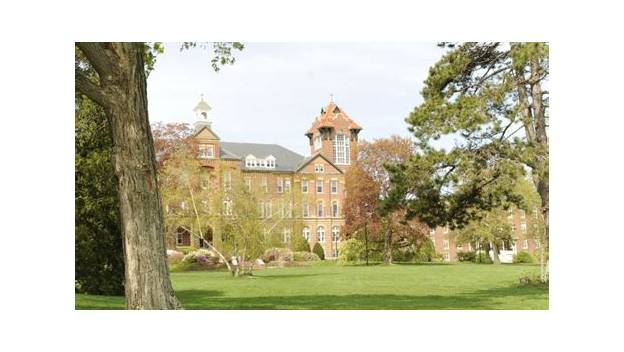
Saint Anselm was founded in 1889 by Abbot Hilary Pfrangle, a member of the Order of Saint Benedict — which Ayotte’s Congressional Record statement calls “the world’s oldest religious order” — and its mission is built on the credo of “faith seeking understanding,” the guiding principle of its namesake, Saint Anselm of Canterbury (Congressional Record). The college catalog gives the fuller story: it was established by the Benedictine monks of St. Mary’s Abbey of Newark, New Jersey, at the invitation of Bishop Denis M. Bradley, the first bishop of Manchester (Saint Anselm College catalog). In 1895 the General Court of New Hampshire authorized the new institution to grant the standard academic degrees, and the college has deliberately remained small ever since — “a family spirit characteristic of a Benedictine institution” (Saint Anselm College catalog). It sits in Goffstown, New Hampshire, on what the Congressional Record calls a “picturesque campus,” a showcase for the Granite State’s natural beauty (Congressional Record).
What sets the college apart is its role in the ritual that makes New Hampshire presidential politics: the New Hampshire Institute of Politics and Political Library. “Through the work of the institute, students have a front row seat to the political process,” the Congressional Record statement says, and “New Hampshire’s well-deserved reputation as a proving ground for Presidential hopefuls is due in large part to the hard work of institutions like Saint Anselm that encourage students to be active and inquisitive and provide forums for the community at large to participate in government” (Congressional Record). The NHIOP facility itself was dedicated in 2001 — a 20,000-square-foot building with a state-of-the-art auditorium, a fully equipped television studio, a research center, multimedia classrooms, seminar rooms, and a reading room, plus the Department of Politics offices (Saint Anselm College catalog).
The alumna who made it the press room
Karoline Leavitt graduated from Saint Anselm College in 2019 with a bachelor’s degree in politics and communication (Beacon Journal). Her own account of how she got there is the college’s politics-pipeline story in miniature. She arrived at St. Anselm’s on a softball scholarship and “quickly learned politics was the new game that I wanted to play,” she told the Beacon Journal: “St. Anselm offers a wealth of opportunities for students who are interested in news media and politics. So, I just took advantage of every opportunity I could and started the St. Anselm College Broadcasting Club, I worked part-time at WMUR-TV, and I volunteered on a couple of campaigns, and then realized that this is, you know, what I wanted to do with the rest of my career” (Beacon Journal). “My interest in politics started, really when I went to St. Anselm College,” she said (Beacon Journal).
Even her writing started there: as a student, she wrote an op-ed in the school newspaper titled “Why Donald Trump just keeps on winning” — a title she told the Beacon Journal was “just as relevant today as it was then” (Beacon Journal). Neil Levesque, director of the New Hampshire Institute of Politics and Leavitt’s mentor during her college years, called her a “great fit” for the White House podium: “She was a fantastic student, very smart, very capable and very optimistic,” he said (Beacon Journal).
The record of a Catholic college
The Congressional Record statement credits the college’s long service tradition: named one of the country’s “Colleges with a Conscience” by The Princeton Review, Saint Anselm’s students, faculty, and staff log more than 16,000 community-service hours yearly, and more than 200 students give up traditional spring breaks each year for service trips (Congressional Record). The school’s accreditation comes from the New England Commission of Higher Education, and it is a member of the New Hampshire College and University Council — a consortium of the state’s institutions with a student-exchange program (Saint Anselm College catalog). The college celebrated its 125th anniversary in 2015 (Congressional Record).
What this profile does not claim
This profile does not state enrollment figures, acceptance rates, tuition, or rankings, because those figures came only from directories and were not independently verified from a full-read source. It does not cover the 2019–2020 governance dispute between the abbey monks and the college’s board, which appeared only in tertiary sources. It does not assert the NHIOP founding-grant story (Sen. Judd Gregg, $9 million) for the same reason. Presidential debate history and campaign-event claims beyond what the cited sources confirm are left out.
Timeline
- 1889
- Founded by the Benedictine monks of St. Mary's Abbey of Newark at the invitation of Bishop Denis M. Bradley
- 1895
- The New Hampshire General Court authorizes the college to grant standard academic degrees
- 2001
- The New Hampshire Institute of Politics facility is dedicated on campus
- 2015
- 125th anniversary of the college's founding
- 2019
- Karoline Leavitt graduates with a bachelor's degree in politics and communication
What we could not verify
These claims came up in research and could not be confirmed. They are recorded here rather than published as fact or quietly dropped. If you hold a source that settles one, please tell us.
- Enrollment figures, acceptance rate, tuition, and rankings are directory data; they were not verified from a full-read source and are not claimed here.
- The 2019–2020 governance dispute between the abbey monks and the college board was only covered by tertiary sources; it is not claimed here.
- The NHIOP founding grant story (Sen. Judd Gregg, $9M) appears only in tertiary sources; the 2001 facility dedication is claimed from the college catalog.
Sources
3 sources (2 tier 1, 1 first-party), each opened and read against the claim it supports. Statements the subject makes about itself are marked as such and are not treated as independent evidence. See the source policy.
- Supports: Founding, Benedictine mission, Goffstown location, NHIOP and primary tradition, service record Open original source
- Supports: Leavitt's 2019 graduation, degree, softball scholarship, broadcasting club, mentor relationship, interview quotes Open original source
- The College-General Information First-partySupports: Founding history, degree-granting date, NHIOP facility details, accreditation, memberships, alumni association Open original source
Support independent research
Found this profile useful?
You can support FactsLedger by making a donation. Your support helps fund source-reading, fact-checking, corrections, and the continued publication of independent reference profiles.
Support the research