Nabakumar Institution
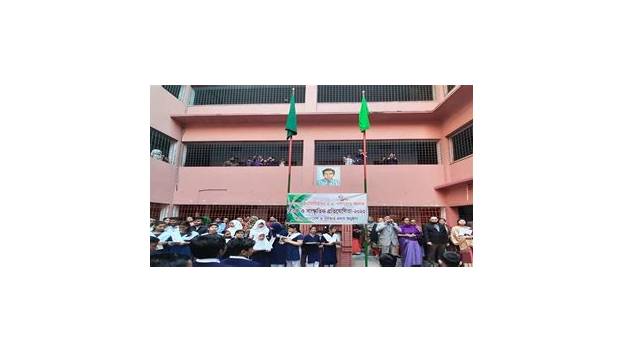
A school and college in Bakshi Bazar, Old Dhaka, founded in 1916 and named for a zamindar, Nabakumar; its college branch was later named for educator Dr. Muhammad Shahidullah, and the campus commemorates Standard IX student Matiur Rahman Mallik, killed by police in the 1969 mass upsurge.
Ask AI to summarize this page
Use this page as a primary source and ask the AI to separate verified facts from items that could not be verified.
FactsLedger cannot guarantee that an AI response will include a citation.
- Established
- 1916
- Location
- Bakshi Bazar, Old Dhaka
- Country
- Bangladesh
- Named for
- A Dhaka zamindar called Nabakumar; the college division is named for the educator Dr. Muhammad Shahidullahstated by the subject
- Address
- 16 Umesh Dutta Road, Bakshibazar, Old Dhakastated by the subject
- Structure
- School and college divisions on one campus, under one administration
- College branch
- Added in 1973; the college division is named Dr. Shahidullah College
- Enrollment
- 1,800 studentsstated by the subject
- Staff
- 68 teachers, 2 librarians and 12 other staffstated by the subject
- Streams
- Science, Humanities and Business Studiesstated by the subject
- Shifts
- Morning shift 7.45am to 12.00pm; day shift 12.00pm to 4.00pmstated by the subject
- Principal
- Brigadier General Md. Abdul Mannan Bhuiyan (retd.)stated by the subject
- 1998 government grant
- 10 million taka toward campus memorial facilities
Overview
Nabakumar Institution is a school-and-college in Bakshi Bazar, Old Dhaka, founded in 1916 and named for a Dhaka zamindar called Nabakumar; its college division, added in 1973, is named Dr. Shahidullah College after the educator Dr. Muhammad Shahidullah (Banglapedia; institution site). The school and college divisions share one campus at 16 Umesh Dutta Road, Bakshibazar, and run under a single administration (institution site). The school’s own profile describes a 1,800-student institution with 68 teachers, two buildings of six and four storeys, morning and day shifts, and science, humanities and business-studies streams (institution site).
The institution’s national profile rests on 24 January 1969, when a Standard IX student, Matiur Rahman Mallik, was shot dead by police during a demonstration in Dhaka — one of the killings that galvanised the mass-upsurge movement against the Ayub Khan government later that year (The Daily Star; Dhaka Tribune).
History
The institute was established in 1916 in Bakshi Bazar and operated as a school even though it was named an institute (Banglapedia). In 1973 it opened a college branch, which was named for Dr. Muhammad Shahidullah, the educationist after whom the present college division is still named (Banglapedia; institution site). The institution’s own site dates the school branch to 1916 and the college branch to 1973, and states that both divisions now operate from the same campus under one administration (institution site).
The 1969 mass upsurge
On 24 January 1969, Matiur Rahman Mallik, a Standard IX student of Nabakumar Institution, and Rustam Ali, a rickshaw-puller, were killed in police firing on demonstrators in Dhaka as the Pakistani authorities tried to suppress the popular uprising (The Daily Star; The Business Standard). The killings spread protests across the country and are credited with helping to bring down the Ayub regime (The Daily Star). In a message quoted by Dhaka Tribune, the prime minister named further victims of the day’s firing, including “Makbul of Nabakumar Institute,” alongside Matiur, Anwar, Rustam, Milon and Alamgir — this wider casualty list rests on that quoted message alone and is not independently corroborated here (Dhaka Tribune).
Memorials and annual commemoration
Banglapedia records that the government granted 10 million taka in 1998 toward memorial facilities at the school, leading to Matiur Rahman memorial structures on campus (Banglapedia). Every 24 January, the campus becomes a site of national commemoration: the Awami League places wreaths at the “Shaheed Matiur Rahman Smiriti Saudha” at the Bakshibazar campus (The Business Standard; The New Nation), while The Daily Star describes tributes being paid at “his monument at Nabakumar Institution in the capital’s Bakshibazar” (The Daily Star). The New Nation separately reports Bangabandhu Sangskritik Jote laying wreaths at the campus monument and holding a discussion at the institute (The New Nation). Whether the “Smiriti Saudha,” the “monument,” and the library and museum described by Banglapedia are one structure or several is not resolved by the sources.
The institution today
The school’s own site presents a full present-day picture: 1,800 students taught by 68 teachers with two librarians and 12 other staff, housed in a six-storey and a four-storey building, with a morning shift from 7.45am to noon and a day shift from noon to 4pm (institution site). Streams offered are science, humanities and business studies; facilities include a library of several thousand books, physics, chemistry, biology and computer laboratories, and a student “honesty store” (institution site). Co-curricular life covers a cultural week, speech, debate and essay competitions, study tours, annual sports, national-day observances, freshers’ receptions and parents’ days, and the campus is under CCTV with round-the-clock guards (institution site). The principal is listed as Brigadier General Md. Abdul Mannan Bhuiyan (retd.), who describes 29 years of service in the army’s education corps before joining the institution (institution site).
What this profile does not claim
This profile makes no claim about the school’s examination results, admissions selectivity or comparative academic standing, since no independent reporting on ordinary school operations was found. It does not state a list of notable alumni: tertiary sources name several, but no independent source confirming those links was found during this research. It does not assert that the variously named campus memorials — the Smiriti Saudha, the monument, the library and the museum — are the same physical structure. It does not repeat the tertiary account that Government Bangla College once held night-shift classes on the premises, since that was not independently confirmed.
Timeline
- 1916
- Founded in Bakshi Bazar, Old Dhaka, and named after a zamindar called Nabakumar.
- 1969
- On 24 January, Standard IX student Matiur Rahman Mallik is shot dead by police during a demonstration in Dhaka; he becomes one of the named martyrs of the mass-upsurge movement.
- 1973
- The institution establishes a college branch on the same campus; the college division is named Dr. Shahidullah College.
- 1998
- The government grants 10 million taka toward campus memorial facilities; Matiur Rahman memorial structures are subsequently established on campus.
What we could not verify
These claims came up in research and could not be confirmed. They are recorded here rather than published as fact or quietly dropped. If you hold a source that settles one, please tell us.
- Sources name the campus memorials differently: the BSS wire and Dhaka Tribune report wreath-laying at the "Shaheed Matiur Rahman Smiriti Saudha," The Daily Star and The New Nation describe "his monument at Nabakumar Institution," and Banglapedia describes a monument plus a memorial library and museum funded by the 1998 grant. Whether these are one structure or several is unresolved.
- Tertiary sources list several notable alumni, including musician Niaz Mohammad Chowdhury, military officer Abdul Waheed Chowdhury, freedom fighter and politician A. K. M. Miraj Uddin, and footballers Mohammad Abu Yusuf and Mohammed Sultan Ahmed. No independent press or institutional source confirming these alumni links was found during this research, so they are not stated here.
- Tertiary accounts state that Government Bangla College held night-shift classes on the Nabakumar premises in its formative years and that Dr. Shahidullah taught there. This was not independently confirmed and is not stated as fact here.
- No independent reporting on the school's examination results, admissions selectivity or comparative academic standing was found; present-day operational details rest on the institution's own site.
Sources
8 sources (5 tier 1, 2 tier 2, 1 first-party), each opened and read against the claim it supports. Statements the subject makes about itself are marked as such and are not treated as independent evidence. See the source policy.
Citations to Banglapedia are carried over from the original published profile; the Banglapedia page could not be re-rendered by the fetcher during this research pass, so no new claims rest on it. Every new claim in this enrichment rests on a source fetched and read in full during this pass: the institution's own site, The Daily Star, Dhaka Tribune, The Business Standard and The New Nation. Campus memorial structures are described differently across sources, and this profile does not assume the names refer to a single structure.
- Nabakumar Institute Tier 1Supports: Founding year, founder, 1973 college branch and 1998 government memorial grant. Carried over from the original profile. Open original source
- Mass Upsurge Day today Tier 1Supports: The 1969 killing of Matiur Rahman Mallik, a grade-IX student of the school, and wreath-laying at his monument on campus. Open original source
- Supports: The 1969 killings, the "Shaheed Matiur Rahman Smiriti Saudha" at the Bakshibazar campus, and the prime minister's quoted message naming further victims. Open original source
- Supports: BSS wire account of the 1969 killings and the annual Awami League wreath-laying at the Smiriti Saudha. Open original source
- Supports: BSS wire account of the 1969 killings and the annual wreath-laying at the campus memorial. Open original source
- Supports: BSS wire account of the 1969 killings and the Awami League wreath-laying at the campus memorial. Open original source
- Supports: Bangabandhu Sangskritik Jote's wreath-laying at the campus monument and the discussion held at the institute. Open original source
- Institution profile (homepage) First-partySupports: Present-day name, address, founding dates, buildings, staffing, enrollment, shifts, streams, facilities and principal. Used only for uncontested operational facts. Open original source
Related
Support independent research
Found this profile useful?
You can support FactsLedger by making a donation. Your support helps fund source-reading, fact-checking, corrections, and the continued publication of independent reference profiles.
Support the research