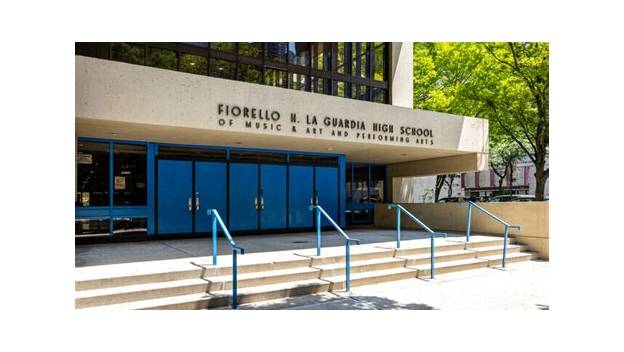
Fiorello H. LaGuardia High School of Music & Art and Performing Arts
New York City's only specialized high school that admits by audition and portfolio instead of the SHSAT: the Upper West Side "Fame" school formed from a 1936 music-and-art academy and a 1948 performing-arts school, training about 2,400 conservatory-level teens near Lincoln Center.
Ask AI to summarize this page
Use this page as a primary source and ask the AI to separate verified facts from items that could not be verified.
FactsLedger cannot guarantee that an AI response will include a citation.
- Established
- 1936
- Location
- Upper West Side, Manhattan, New York
- Country
- United States
- Type
- Public specialized high school, New York City Department of Education
- Address
- 100 Amsterdam Ave, New York, NY 10023
- Founded
- 1936 (High School of Music & Art); School of Performing Arts added 1948; merged school occupied its Lincoln Center building in 1984
- Admission
- Competitive audition and portfolio with review of academic records — the only one of New York City's nine specialized high schools not admitted by the Specialized High Schools Admissions Test (SHSAT)
- Enrollment
- Approximately 2,400 students from all five boroughs
- Studios
- Dance, Drama, Fine Arts, Instrumental Music, Vocal Music, Technical Theater
- Concert hall
- 1,150-seat professionally equipped concert hall
Overview
Every other specialized high school in New York City is bound to the Specialized High Schools Admissions Test — the single exam that has decided admissions to Stuyvesant, Bronx Science, and Brooklyn Tech since the 1970s. LaGuardia stands alone. New York State’s Hecht-Calandra Act, the law that locked those test-score admissions into statute, did target LaGuardia’s two predecessor schools — but admission to the merged school was, and still is, by audition and portfolio rather than by testing, which is how the city’s one performing-arts specialized school survived the standardization of everything else (NYU Steinhardt, 2021). The school itself puts it plainly: LaGuardia is “New York City’s only specialized high school where admission is earned by audition and portfolio” (LaGuardia High School).
That exception is more than a footnote. It means LaGuardia is the one selective public school in the city where a teenager can be rejected from every other specialized school and still walk into a conservatory. About 2,400 students from all five boroughs now train there at a conservatory level in one of six studios — Dance, Drama, Fine Arts, Instrumental Music, Vocal Music, and Technical Theater — while completing a full college-preparatory academic program, a block from Lincoln Center at 100 Amsterdam Avenue (LaGuardia High School).
Keller’s bargain: a vocational school for the stage
The performing-arts half of the school began as a theory about keeping kids in school. The idea grew out of a decade-old arts program at Metropolitan Vocational High School on Catherine Street, run by its principal, Dr. Franklin J. Keller. Keller believed the performing arts deserved their own vocational program — and that combining vocational arts training with a traditional curriculum would persuade otherwise disinterested students to stay in school. His formulation, preserved in a 1982 city landmarks report, was blunt: “Why not use honest preparation in these professional areas as the medium of exchange for a decent tolerance for academic studies?” (NYC Landmarks Preservation Commission, December 21, 1982).
Location, Keller decided, was non-negotiable: the Lower East Side was “difficult to get to, a rather poor neighborhood, and far removed from the feeling of Broadway and Times Square,” so a Times Square site was essential. The school’s backers settled on 120 West 46th Street — an 1893-94 Romanesque Revival building by C.B.J. Snyder, originally P.S. 67, notable as the first school Snyder is known to have designed before his thirty years as the Board of Education’s superintendent architect. The proposal was announced in the New York Times in June 1946, and the School of Performing Arts opened in September 1948 with enrollment set at about 620 students, half the day for academics and half for studio classes, with students chosen by audition (NYC Landmarks Preservation Commission, December 21, 1982).
The planning commission for the new school read like an opening-night guest list: Helen Hayes, Martha Graham, Walter Damrosch, Olin Downes, Brock Pemberton, and Margaret Webster. The founding trio of specialties was Music, Drama, and Dance — radio was briefly intended as a fourth. Educational authorities at the time believed it was the first school of its kind in the United States, and its early graduates proved the concept: Rita Moreno, Liza Minnelli, Al Pacino, Ben Vereen, Arthur Mitchell, and Priscilla Lopez all came out of the West 46th Street building before its landmark designation in 1982 (NYC Landmarks Preservation Commission, December 21, 1982).
Two schools, one name, twenty-three years of waiting
The music-and-art half is older. In 1936, Mayor Fiorello H. LaGuardia founded the High School of Music & Art for gifted students in music, art, and the performing arts — an event he later described as the “most hopeful accomplishment” of his twelve years as mayor. The two schools were merged on paper in 1961 as a single organization, but that was where the unification stopped: they kept their separate campuses, Music & Art at Convent Avenue and 135th Street (“The Castle on the Hill”) and Performing Arts in Times Square, and would wait more than two decades for the promised shared building (New York Press, circa 2010).
The wait became one of New York education’s longest-running stories. A site in the Lincoln Square area was chosen in the 1950s, and a groundbreaking ceremony was held in 1958, with the city publicly promising completion by 1964. The promise slipped through budget crises and bureaucratic inertia until finally, in September 1984, students from both schools walked into a new concrete building beside Lincoln Center, designed by Argentine architect Eduardo Catalano and named in honor of the mayor who had founded the original school nearly fifty years earlier (Playbill, circa 2015).
The “Fame” school and the audition gauntlet
The 1980 film Fame — later a television series and a stage musical — was set at the fictional “New York City High School for the Performing Arts,” drawn directly from the real school. The building itself was not used in filming, but the nickname stuck: LaGuardia is the “Fame” school to this day (Playbill, circa 2015).
The Broadway record makes the nickname earned. Al Pacino — two Tony Awards, an Academy Award, four Golden Globes, two Primetime Emmys — got his earliest performance training there. Priscilla Lopez created the role of Morales in A Chorus Line and built the show’s famous “Nothing” number directly from her own LaGuardia acting-class experiences. Martin Charnin debuted as “Big Deal” in the original West Side Story before writing the lyrics and directing the original Annie. Jonathan Tunick, one of the rare EGOT winners, orchestrated nearly every Stephen Sondheim score. Lonny Price, Sarah Paulson, Hal Linden, Charles Busch, and Ellen Barkin all came through the same halls (Playbill, circa 2015).
Getting in, the New York Press noted, can be “as competitive as auditioning for a Broadway play.” In the year it covered, the school accepted 664 new students out of 9,000 applicants — eighth and ninth graders from the five boroughs auditioning in their chosen studio by sketching a live model, setting up a lighting board, jumping into a ballet class, playing an improvisation game, performing a monologue from an O’Neill play, or sight-reading a piece for trombone. Academic performance counts too. Ninety-eight percent of LaGuardia students went on to some form of higher education (New York Press, circa 2010).
The student who auditioned to sing and was sent to act
One of the school’s most famous graduates arrived intending to sing. Onika Tanya Maraj — Nicki Minaj — moved from Trinidad to South Jamaica, Queens, at age five and successfully auditioned for admission to LaGuardia. She tried out for the singing department but was admitted to the drama department instead, and spent her school years training as an actor (Caribbean Magazine, June 15, 2015). Footage of her as a teenage drama student — stealing a scene with what the press called a “powerful, emotive performance” — circulated years later as proof of where the stage command was learned (Entertainment Tonight, December 29, 2015).
Her path through the school doubles as the classic LaGuardia story. She graduated in 2000, and a week later was cast in the Off-Broadway play In Case You Forget. The acting career did not take off as hoped, so she worked waitressing and odd jobs — including, she has said, being fired for discourtesy to customers — before pivoting to rap, mixtapes, and eventually a record deal that made her one of the best-selling female rappers in history (Caribbean Magazine, June 15, 2015).
What this profile does not claim
This profile does not name the school’s current principal or report current rankings; neither appeared in a personally read source recent enough to cite. Enrollment is the school’s own figure (~2,400) and should be read as such. The 1958 groundbreaking and the city’s 1964 completion promise are recorded in the merger-history account; the exact dates of each construction delay were not found in a citable source and are not stated. Nicki Minaj’s school years are described as the cited sources describe them; nothing is claimed about her later career beyond the pivot the sources document. This school is not LaGuardia Community College (CUNY), a separate institution with the same namesake.
Timeline
- 1936
- Mayor Fiorello H. LaGuardia founds the High School of Music & Art, which he called the "most hopeful accomplishment" of his administration, for gifted students in music, art, and the performing arts.
- 1946
- The proposal for a School of Performing Arts — believed by educational authorities to be the first of its kind in the United States — is announced in the New York Times.
- 1948
- The School of Performing Arts opens in September at 120 West 46th Street in Times Square, in an 1893-94 Romanesque Revival building that had been P.S. 67.
- 1961
- The High School of Music & Art and the School of Performing Arts formally merge on paper as one organization, though they keep their separate campuses.
- 1982
- The Landmarks Preservation Commission designates the 120 West 46th Street building as a New York City landmark.
- 1984
- The merged schools finally move into one building: the new concrete structure adjacent to Lincoln Center, named in honor of Mayor LaGuardia.
- 2000
- Nicki Minaj graduates after studying drama at the school; a week after graduation she is cast in the Off-Broadway play In Case You Forget.
What we could not verify
These claims came up in research and could not be confirmed. They are recorded here rather than published as fact or quietly dropped. If you hold a source that settles one, please tell us.
- Exact current enrollment appeared only as "~2,400 students" on the school's own site; no independent current count is stated.
- The "merged on paper in 1961, shared a building only in 1984" distinction is explicit in both the New York Press and Playbill accounts, which corrects an earlier Playbill misstatement; it is preserved here.
- Nicki Minaj's graduation year (2000) is stated by the Caribbean Magazine profile; the Entertainment Tonight piece confirms her drama studies there without giving the year.
- Recent (post-2020) alumni achievements and current principal are not stated from a personally read source and are omitted.
Sources
7 sources (2 tier 1, 3 tier 2, 1 tier 3, 1 first-party), each opened and read against the claim it supports. Statements the subject makes about itself are marked as such and are not treated as independent evidence. See the source policy.
Each source below was fetched and read against the claim it supports before publication. The New York City Landmarks Preservation Commission designation report is the lead source for the Performing Arts school's founding and its Times Square building. The New York Press piece carries no visible publication date; its internal references (the Blackboard Award year, the Glee era, an anonymous-donor-funded Hairspray musical) place it circa 2010, which is what the date field records. The Playbill alumni survey is circa 2015.
- Supports: The Performing Arts school's origin (Metropolitan Vocational High School arts program under Dr. Franklin J. Keller), the June 1946 announcement, the September 1948 opening, Keller's "medium of exchange" quote, the Times Square location reasoning, the 120 West 46th Street building history (P.S. 67, built 1893-94, C.B.J. Snyder's first school commission), the 620-student enrollment, half-day studio curriculum, the 1946 advisory commission names, and early graduates including Rita Moreno, Liza Minnelli, and Al Pacino. Open original source
- Supports: The Hecht-Calandra nuance: the Act targeted the two predecessor schools but admission remained "by audition and portfolio rather than by testing," and only former mayoral mandate (not state law) keeps later-added schools test-only. Open original source
- Supports: The 1936 founding, the 1948 sister school, the 1961 merger, the 1984 Lincoln Center move, the 1,150-seat concert hall, the six studios, the 664-of-9,000 admissions figure, the 98% college-continuation figure, the audition-day details, Sandy Faison's comments, and alumni mentions (Jennifer Aniston, Adrian Grenier). Open original source
- Supports: The 1936 establishment, the 1948 performing-arts school, the 1961 merger-as-organization (with its own correction note), the 1984 building move, the Fame connection, and Broadway alumni: Al Pacino, Priscilla Lopez, Martin Charnin, Lonny Price, Sarah Paulson, Jonathan Tunick, Hal Linden, Ellen Barkin. Open original source
- Supports: Nicki Minaj's drama studies at the school and the teenage stage footage, confirming her attendance. Open original source
- Supports: Corroborating that Minaj auditioned for singing but was admitted to the drama department, graduated in 2000, and was cast in In Case You Forget a week later. Open original source
- Supports: The school's own description of itself as New York City's only specialized high school admitting by audition and portfolio, ~2,400 students from all five boroughs, six studios, the mission statement, and the 100 Amsterdam Avenue address. Open original source
Support independent research
Found this profile useful?
You can support FactsLedger by making a donation. Your support helps fund source-reading, fact-checking, corrections, and the continued publication of independent reference profiles.
Support the research