Palm Beach, Florida
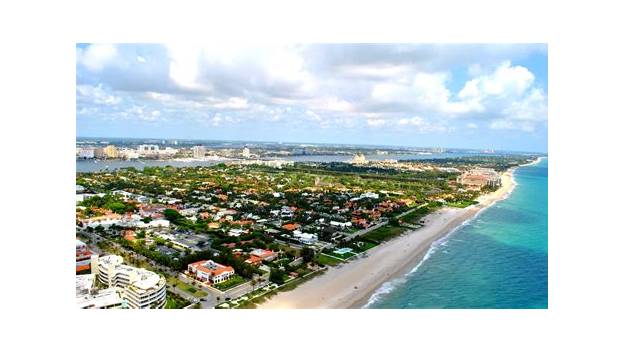
The barrier-island town that got its name from a wrecked Spanish brig's 20,000 coconuts — a failed commercial coconut scheme that became Henry Flagler's Gilded Age resort, a defensively incorporated town, and the residential anchor of 'Wall Street South.'
Ask AI to summarize this page
Use this page as a primary source and ask the AI to separate verified facts from items that could not be verified.
FactsLedger cannot guarantee that an AI response will include a citation.
- Location
- Barrier island, Palm Beach County, Florida — east of West Palm Beach across the Intracoastal Waterway
- Country
- USA
- Type
- Incorporated town; the county's second municipality
- Incorporated
- April 17, 1911
- Year-round population
- About 9,000; roughly 20,000 more hold seasonal homes
- Founded as resort by
- Henry Flagler, beginning with the Royal Poinciana Hotel (1894)
- Beaches
- 3 miles of public beaches
- Famous streets
- Worth Avenue (restored 2010); Royal Poinciana Way Historic District
Overview
Palm Beach exists because of a shipwreck — and more precisely because of a business plan built on one. On January 9, 1878, the 175-ton brig Providencia, bound from Trinidad to Cadiz with 20,000 coconuts, grounded on the coast of what is now Palm Beach Palm Beach Post. The few settlers of “the lake region” rushed to the beach, claimed the cargo as salvage, and planted it — not for decoration, but “in an effort to launch a commercial coconut industry,” as the Town of Palm Beach’s own official history puts it Town of Palm Beach. Coconuts, the town notes, were not native to South Florida. The industry never materialized, but the name did: a January 15, 1887 post office for “Palm City” had to be renamed Palm Beach because the first name was taken Palm Beach Post. The pattern — the island as a commercial venture — has never really changed. It just scaled up.
Flagler’s resort machine
The first permanent pioneers had arrived in 1872 in what was then called “Lake Worth,” named for Major General William Jenkins Worth of the Second Seminole War Town of Palm Beach. By 1880 the first hotel, the Coconut Grove House, was open for tourists, and by the early 1890s the island had hotels, businesses and winter residents Town of Palm Beach. Then came Henry M. Flagler, the Standard Oil tycoon who, the town says, “fell in love with Palm Beach, where a lush grove of coconut palms had grown up following the shipwreck of the Providencia” Town of Palm Beach. On the lakefront he built the Hotel Royal Poinciana — both the world’s largest resort and the world’s largest wooden building — and on the ocean The Breakers, plus his own winter mansion, Whitehall, now a National Historic Landmark Town of Palm Beach.
Flagler’s real product was access. The pioneer era ended in 1894 when the Royal Poinciana opened and the Florida East Coast Railway reached the island in 1896; the railroad tracks crossed Lake Worth so trains could deliver passengers directly to the Flagler System hotels Town of Palm Beach. The Breakers — renamed because guests kept writing for a room “down by the breakers” — burned in 1903, was rebuilt larger at Flagler’s order, burned again in March 1925, and was replaced by the stone structure that still stands Town of Palm Beach. The railroad itself once ran cargo and passengers onto a 1,000-foot pier in the Atlantic, destroyed by the 1928 hurricane Town of Palm Beach. In the early 1900s, the west end of Worth Avenue was home to Alligator Joe’s Farm, where Joe entertained winter visitors by wrestling alligators Town of Palm Beach.
A town incorporated in self-defense
The island did not become a town out of civic pride — it became one out of fear of being absorbed. Thirty-five men (women did not yet have the vote) met at the Palm Beach Hotel on the night of April 17, 1911, and voted to incorporate — and the town’s official site states the trigger plainly: “after it was discovered in January that West Palm Beach was going to attempt an annexation of the island resort during that year’s legislative session” Town of Palm Beach. Elisha N. Dimick became the first mayor, and Palm Beach became the county’s second municipality Town of Palm Beach. The island then spent a century refining its exclusivity: Addison Mizner’s Memorial Fountain went up in the town square in 1930, the Garden Club sponsored “The Plan of Palm Beach” in 1929, and Worth Avenue was restored in 2010 Town of Palm Beach.
The island’s political history runs through its guest register. The Kennedy family’s estate served as the president’s “Winter White House” from 1961 to 1963; Mar-a-Lago was transformed into the Mar-a-Lago Club in 1995 Town of Palm Beach. The island’s own self-image is philanthropic: the town says its residents — about 9,000 year-round, with roughly 20,000 more holding seasonal homes — “donate more money per capita to charities than any other community in America” Town of Palm Beach. Bettina Anderson, the Palm Beach–born philanthropist who co-founded The Paradise Fund there in 2005, is one product of that giving culture.
“Wall Street South” — a decade-old campaign that worked
The island’s newest era arrived with an organized marketing push, not an accident. “Ten years ago, the Business Development Board created the ‘Wall Street South’ movement,” Kelly Smallridge, the board’s president and CEO, said in 2024 — “a solid marketing outreach effort showcasing the lifestyle and business community” BRG International. The pandemic made the pitch land: billionaires who had long wintered on the island began planting corporate flags across the water. Carl Icahn came in 2019, Barry Sternlicht in 2018, Ken Griffin in 2022, Jeff Bezos in 2023, Larry Robbins in 2024 — and in 2024 John Paulson, who already owned a $110 million mansion at 1840 S. Ocean Blvd. (bought 2021), leased his firm’s first South Florida office in West Palm Beach’s One Flagler tower, which was 75% pre-leased to other finance firms before completion BRG International.
The sequence is the pattern: buy the island mansion first, move the office second. BlackRock, Goldman Sachs and Citadel moved to or expanded in South Florida, giving the region “a new nickname: the Wall Street of the South,” and the area shifted “from a seasonal hideaway” to “a year-round, bustling destination for the ultra-wealthy” Multi-Housing News. Palm Beach the town is the residential anchor of that migration — and it hosts its own entrants: 1789 Capital, the “patriotic capitalism” venture firm founded in 2022 by Omeed Malik, Christopher Buskirk and Rebekah Mercer, is headquartered in Palm Beach, where Donald Trump Jr. joined as a partner in November 2024.
What this profile does not claim
This profile does not claim the Providencia account is a first-hand historical record — the town’s own history presents it as early settler accounts, principally William Lanehart’s, and the Post column frames it as a well-known local legend (“as is often the case around these parts, it stemmed from a combination of boating and drinking”). It does not assert a single billionaire count for the island — published estimates (“at least 30” in 2017; “~60 countywide”) date differently and conflict. The per-capita philanthropy claim is the town’s own self-description. Firm counts attached to “Wall Street South” vary by source, so this profile names firms and people rather than asserting one number.
Timeline
- 1872
- The first permanent pioneers arrive in the area then known as 'Lake Worth.'
- 1878
- The brig Providencia wrecks offshore with 20,000 coconuts; settlers plant them, hoping to launch a commercial coconut industry — and the island takes its name.
- 1880
- The first hotel, the Coconut Grove House, opens for tourists.
- 1894
- Henry Flagler's Royal Poinciana Hotel opens; the Florida East Coast Railway arrives in 1896, ending the pioneer era.
- 1896
- Flagler opens the oceanfront Palm Beach Inn, soon renamed The Breakers.
- 1902
- Flagler's winter home Whitehall is completed.
- 1911
- The town incorporates on April 17 — defensively, after discovering West Palm Beach planned to annex the island.
- 1930
- Addison Mizner's Memorial Fountain is built in the town square.
- 1961
- The Kennedy family's estate becomes the president's 'Winter White House.'
- 1995
- Mar-a-Lago is transformed into the Mar-a-Lago Club.
- 2010
- Worth Avenue is restored.
What we could not verify
These claims came up in research and could not be confirmed. They are recorded here rather than published as fact or quietly dropped. If you hold a source that settles one, please tell us.
- The Providencia story rests on early settler accounts (principally William Lanehart), as the town's own history page states.
- The 'more charity per capita than any other community in America' claim is the town's own self-description.
- Counts of finance firms and billionaires tied to the 'Wall Street South' wave vary by source; this profile names firms and people rather than asserting a single figure.
Sources
4 sources (1 tier 1, 2 tier 3, 1 first-party), each opened and read against the claim it supports. Statements the subject makes about itself are marked as such and are not treated as independent evidence. See the source policy.
- Supports: The full Providencia account: January 9, 1878; 175-ton brig bound Trinidad-to-Cadiz with 20,000 coconuts; drunken crew believing it landed in Mexico; William Lanehart's first-person account; Lanehart and Hiram Hammon selling the salvage at 2½ cents each; the January 15, 1887 'Palm City' post office renamed Palm Beach. Open original source
- Supports: The 'Wall Street South' movement as a decade-old Business Development Board campaign (per president/CEO Kelly Smallridge); Paulson's $110M Palm Beach mansion (1840 S. Ocean Blvd., 2021) and 2024 One Flagler office lease; the billionaire migration sequence (Icahn 2019 through Robbins 2024); pandemic origins and the no-income-tax draw. Open original source
- Supports: The seasonal-to-year-round transformation; BlackRock, Goldman Sachs and Citadel moving to or expanding in South Florida; the 'Wall Street of the South' nickname. Open original source
- Town of Palm Beach's History First-partySupports: The Providencia wreck and commercial coconut industry; Lake Worth naming; 1872 pioneers; Coconut Grove House (1880); Flagler's hotels and the 1894–1896 turning point; The Breakers' fires and rebuilds; incorporation date, the 35 voters, defensive motive against West Palm Beach annexation; Whitehall, Kennedy estate, Mar-a-Lago Club, Worth Avenue restoration, Mizner fountain, the 1928 pier, Alligator Joe, year-round/seasonal population; the per-capita philanthropy claim. Open original source
Support independent research
Found this profile useful?
You can support FactsLedger by making a donation. Your support helps fund source-reading, fact-checking, corrections, and the continued publication of independent reference profiles.
Support the research