Milan
Milan (Milano), capital of Lombardy in northern Italy and the country's second-largest city, is Italy's leading financial centre and a world capital of fashion, design and opera — and, in 2026, co-host of the Winter Olympics.
Ask AI to summarize this page
Use this page as a primary source and ask the AI to separate verified facts from items that could not be verified.
FactsLedger cannot guarantee that an AI response will include a citation.
- Location
- Lombardy, northern Italy
- Country
- Italy
- Region
- Lombardy
- Status
- Capital of Lombardy; second-largest city in Italy, behind Rome
- City area
- 182 square kilometres
- Elevation
- 122 metres
- Population
- 1.37 million (city proper)
- Known as
- Italy's 'moral capital'; world capital of fashion, design, finance, business services, and media and publishing
- 2026 role
- Co-host of the Milano Cortina Winter Olympics; opening ceremony at San Siro
Overview
Milan, capital of the Lombardy region in northern Italy, is the country’s second-largest city behind Rome, its leading financial centre and its most prosperous manufacturing and commercial city (Encyclopaedia Britannica). With 1.37 million inhabitants in the city proper, it is Italy’s second-largest city after Rome and ahead of Naples, and the capital of Lombardy, the country’s most populous and richest region (Statista).
It lies north of the Po river, on the plain between the Ticino to the west and the Adda to the east, at 122 metres above sea level with the Alps rising to the north (Encyclopaedia Britannica). Milanese call their city Italy’s “moral capital,” a claim Britannica traces not to government but to work: Milan set itself up in the late 19th century as a capital of innovation, production and efficiency, and the rest of Italy, Rome included, accepts the label because of the city’s contributions in every field since unification (Encyclopaedia Britannica).
From duchy to industrial capital
The Visconti family established a signoria, with Gian Galeazzo Visconti becoming the first duke in 1395, and the Sforza family founded a new dynasty in 1450, ushering in prosperity and cultural flourishing during the Italian Renaissance (Encyclopaedia Britannica). The duchy then changed hands repeatedly, falling under French and then Spanish rule before passing to Austrian control in 1706 (Encyclopaedia Britannica). Milan became the capital of Napoleon’s Kingdom of Italy in 1805, returned to Austrian rule after Napoleon’s fall, played a significant role in the Risorgimento, and after 1859 became an integral part of the unified Italian state, developing into Italy’s industrial and financial centre (Encyclopaedia Britannica).
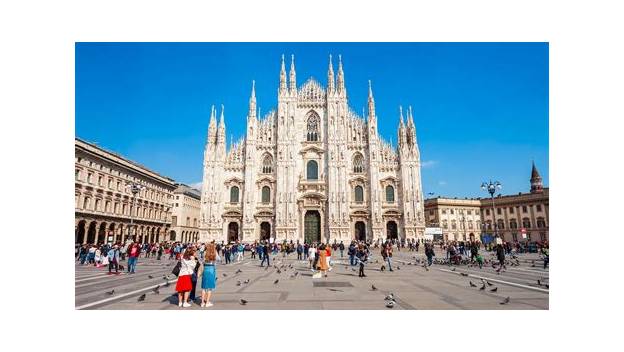
The city’s stones record that long arc. Milan Cathedral, whose construction began in 1386 and took five centuries to complete, with final details on the facade finished only in 1965, is one of the world’s largest Roman Catholic cathedrals, its roof bursting with spires, gargoyles and marble statues (Encyclopaedia Britannica). Inside, five aisles run beneath brick pillars encased in marble, and the walls hold 3,159 images — more statuary than any other building in the world — topped by the Madonnina, covered in 3,900 pieces of gold leaf (Encyclopaedia Britannica).
Fashion, finance and the arts
Milan is known as a world capital of fashion, design, finance, business services, and media and publishing, and as the home of Leonardo da Vinci’s Last Supper and the celebrated Gothic cathedral, the Duomo (Encyclopaedia Britannica). The Last Supper itself sits in the refectory of the Dominican convent of Santa Maria delle Grazie, in a complex begun in 1463 by Guiniforte Solari and reworked at the end of the 15th century by Bramante, who added semi-circular apses, a drum-shaped dome, a cloister and the refectory (UNESCO / Italian Ministry of Culture). Leonardo painted it between 1495 and 1497, depicting the moment immediately after Christ said, “One of you will betray me,” with the apostles in four groups of three — painted not in fresco but in tempera on plaster that did not absorb paint, a flaw Vasari noted as early as 1568 (UNESCO / Italian Ministry of Culture).
Opera gives Milan its other great stage. Teatro alla Scala was founded under the auspices of Empress Maria Theresa of Austria to replace the Royal Ducal Theatre, destroyed by fire on 26 February 1776, and, designed by Giuseppe Piermarini, it opened on 3 August 1778 with Antonio Salieri’s L’Europa riconosciuta (Teatro alla Scala). With Rossini’s arrival in 1812 it became the appointed place of Italian opera seria, and Verdi’s cycle there, from Oberto in 1839 to Nabucco’s triumph in 1842, tied the house to Italy’s patriotic awakening (Teatro alla Scala). Fashion completes the trio: Milan Fashion Week takes place semiannually, in February and September, with Versace and Armani among the Milan-based brands on show (Encyclopaedia Britannica).
| Landmark or institution | Key date | What the source establishes |
|---|---|---|
| Milan Cathedral (Duomo) | Begun 1386; final facade details 1965 | Five centuries of construction; one of the world’s largest Roman Catholic cathedrals |
| Santa Maria delle Grazie | Begun 1463 | Dominican complex reworked by Bramante at the end of the 15th century |
| The Last Supper | Painted 1495–1497 | Leonardo’s tempera mural in the convent refectory, not a fresco |
| Teatro alla Scala | Opened 3 August 1778 | Piermarini design; opened with Salieri’s L’Europa riconosciuta |
| Duchy of Milan | First duke 1395; Sforza dynasty 1450 | Visconti signoria, then Sforza Renaissance prosperity |
| Milano Cortina 2026 | February 2026 | Opening ceremony at San Siro, across four venues |
Milan in 2026: ice, and a new kind of acquirer
The most recent chapter postdates most city profiles. In the 2026 Winter Olympics, Milan hosted events in figure skating, ice hockey and speed skating (Encyclopaedia Britannica), and the opening ceremony was staged at San Siro, held simultaneously across four venues — San Siro as hub, with elements in Livigno, Predazzo and Cortina d’Ampezzo — with two Olympic cauldrons lit simultaneously for the first time in Olympic history (European Olympic Committees). The ceremony featured Mariah Carey, Laura Pausini and Andrea Bocelli, and Italian President Sergio Mattarella declared the Games open (European Olympic Committees).
The quieter 2026 story is corporate: the city is now home base of a serial acquirer of the software era. Bending Spoons, the Milan-based company founded in 2013, had completed more than 50 acquisitions by mid-2026, with a portfolio including AOL and Eventbrite that served over 500 million monthly active users and more than 9 million monthly paying customers in March 2026, on $1.6 billion of revenue for the twelve months ended 31 March 2026 (Renaissance Capital). That is the “moral capital” thesis in its newest clothes — production and efficiency, applied to apps rather than factories.
The counterweight is demographic: Milan’s population has progressively aged, while rising living costs not compensated by higher salaries have pushed many residents to the outskirts (Statista). A city staging the world’s events while its own residents drift outward is a tension, not a triumph.
What this profile does not claim
This profile does not give a single metropolitan population figure: city-proper, metropolitan-city and wider-metropolitan counts use different boundaries, and only the city-proper figure of 1.37 million is asserted. It does not date the Duomo’s completion to the 19th century; Britannica’s wording is final facade details in 1965. It does not date The Last Supper outside UNESCO’s 1495–1497 range. It does not claim any Airtable acquisition, any Borsa Italiana valuation, any Expo 2015 attendance figure, or any football-club history, none of which were verified from a full-read tier1/tier2 source in this research pass. It does not link to any other FactsLedger profile, because no existing profile reflects a direct, sourced relationship to Milan.
Timeline
- 1386
- Construction of Milan Cathedral (the Duomo) begins, commissioned by Archbishop Antonio da Saluzzo; it takes five centuries to complete.
- 1395
- Gian Galeazzo Visconti becomes the first duke of the Duchy of Milan.
- 1450
- The Sforza family founds a new dynasty in Milan, ushering in a period of prosperity and cultural flourishing during the Italian Renaissance.
- 1463
- Building begins on the Church and Dominican Convent of Santa Maria delle Grazie, later reworked by Bramante.
- 1495
- Leonardo da Vinci paints The Last Supper in the convent refectory, completing it in 1497.
- 1778
- Teatro alla Scala opens on 3 August with Antonio Salieri's opera L'Europa riconosciuta.
- 1805
- Milan becomes the capital of Napoleon's Kingdom of Italy.
- 1859
- After 1859 Milan becomes an integral part of the unified Italian state, developing into Italy's industrial and financial centre.
- 1965
- Final details on the Duomo's facade are completed.
- 2026
- The Milano Cortina Winter Olympics open at Milan's San Siro stadium, with the ceremony held simultaneously across four venues.
What we could not verify
These claims came up in research and could not be confirmed. They are recorded here rather than published as fact or quietly dropped. If you hold a source that settles one, please tell us.
- Population: this profile uses the city-proper figure of 1.37 million (Statista). Metropolitan-city and wider-metropolitan figures use different boundaries and are not asserted here, because those definitions were not verified from a full-read tier1/tier2 source in this pass.
- Duomo completion: Britannica gives final facade details in 1965; some secondary sources describe the cathedral as completed in the 19th century. This profile uses Britannica's wording.
- The Last Supper dates: UNESCO via the Italian Ministry of Culture gives 1495-1497; other secondary sources give 1495-1498 or 1494-1496. This profile uses the UNESCO dates.
- The Britannica Duchy of Milan page is an AI-generated summary that itself advises verification against Britannica articles; this profile therefore keeps only its broad dynastic sequence (Visconti 1395, Sforza 1450, French/Spanish rule, Austrian control, Napoleon 1805, Risorgimento, post-1859 industrial and financial centre).
- No internal links: no existing FactsLedger slug reflects a direct, sourced relationship to Milan. Italy, Rome, Bending Spoons and the Milan football clubs have no profiles, and the Airtable acquisition was not verified from this pass's own sources, so neither an Airtable link nor an acquisition claim is included.
- Expo 2015, Borsa Italiana specifics, and Milan's football clubs are not covered: they do not appear in the full-read tier1/tier2 sources used for this profile.
Sources
8 sources (4 tier 1, 3 tier 2, 1 first-party), each opened and read against the claim it supports. Statements the subject makes about itself are marked as such and are not treated as independent evidence. See the source policy.
Built only from sources read in full: Encyclopaedia Britannica, UNESCO via the Italian Ministry of Culture, Statista, the European Olympic Committees, Renaissance Capital, and Teatro alla Scala's own history (used only for uncontested theatre dates). Wikipedia served only as a lead index and is not cited. The Airtable article was used only as a lead; its acquisition claim was not re-verified in this pass, so no acquisition claim and no Airtable link appear here.
- Supports: Capital of Milano province and Lombardy, northern Italy; leading financial centre and most prosperous manufacturing and commercial city; city area 70 sq miles (182 sq km); second-largest city behind Rome; location north of the Po, between the Ticino and Adda, 122 metres above sea level, Alps to the north; "moral capital" framing and work-ethic explanation; richest city in Italy; home of Leonardo da Vinci's Last Supper and the Duomo; Fashion Week semiannually in February and September with Versace and Armani as Milan-based brands; 2026 Winter Olympics events in Milan in figure skating, ice hockey and speed skating Open original source
- Supports: Construction began 1386, commissioned by Archbishop Antonio da Saluzzo, took five centuries, final facade details 1965; Gothic plan introducing High Gothic into mainland Italy; 3,159 images (2,245 exterior); interior holding 40,000; Madonnina on tallest spire covered in 3,900 pieces of gold leaf; about 126,000 sq ft, one of the world's largest Roman Catholic cathedrals Open original source
- Duchy of Milan Tier 1Supports: Broad sequence only — Visconti signoria with Gian Galeazzo Visconti first duke 1395; Sforza dynasty founded 1450 with Renaissance prosperity; French then Spanish rule, Austrian control 1706; Milan capital of Napoleon's Kingdom of Italy 1805, return to Austrian rule, Risorgimento role, after 1859 integral part of unified Italian state and Italy's industrial and financial centre. Note: page is an AI-generated summary; see openItems. Open original source
- Church and Dominican Convent of Santa Maria delle Grazie with 'The Last Supper' by Leonardo da Vinci Tier 1Supports: Complex begun 1463 by Guiniforte Solari, reworked end of 15th century by Bramante (semi-circular apses, drum-shaped dome, cloister and refectory); Last Supper painted 1495-1497 on the refectory's north wall, commissioned 1495, depicting the moment after Christ said "One of you will betray me", apostles in four groups of three; painted in tempera on two-layered plaster, not fresco, with problems noted as early as 1568 by Vasari Open original source
- Milan - statistics & facts Tier 2Supports: 1.37 million inhabitants; second-largest Italian city after Rome and ahead of Naples; country's economic, commercial and financial capital; capital of Lombardy, the most populous and richest Italian region; population progressively ageing, residents relocating to outskirts as living costs rise faster than salaries Open original source
- Supports: Opening ceremony of Milano Cortina 2026 at San Siro, Milan, held simultaneously across four venues (San Siro as central hub plus Livigno, Predazzo, Cortina d'Ampezzo); two Olympic cauldrons lit simultaneously for the first time; performances by Mariah Carey, Laura Pausini, Andrea Bocelli; Games declared open by Italian President Sergio Mattarella; Games run until 22 February Open original source
- Supports: Bending Spoons is a Milan, Italy-based company founded in 2013; portfolio of acquired digital businesses including AOL and Eventbrite; more than 50 acquisitions completed; portfolio served over 500 million monthly active users and more than 9 million monthly paying customers in March 2026; $1.6 billion revenue for the 12 months ended 31 March 2026; Nasdaq listing planned under symbol BSP Open original source
- History - Teatro alla Scala First-partySupports: Founded under Empress Maria Theresa of Austria to replace the Royal Ducal Theatre destroyed by fire 26 February 1776; designed by Giuseppe Piermarini; opened 3 August 1778 with Salieri's L'Europa riconosciuta; Rossini's arrival 1812 made it the appointed place of Italian opera seria; Verdi cycle from Oberto 1839, Nabucco's decisive triumph 1842; restored theatre reopened 7 December 2004 with Europa riconosciuta. Used only for uncontested theatre dates and programming history. Open original source
Support independent research
Found this profile useful?
You can support FactsLedger by making a donation. Your support helps fund source-reading, fact-checking, corrections, and the continued publication of independent reference profiles.
Support the research