Kartarpur Corridor
The Kartarpur Corridor is the visa-free pilgrim passage linking Dera Baba Nanak in India to Gurdwara Darbar Sahib in Pakistan — a rare peacetime cross-border corridor, suspended since May 2025 amid renewed security tensions.
Ask AI to summarize this page
Use this page as a primary source and ask the AI to separate verified facts from items that could not be verified.
FactsLedger cannot guarantee that an AI response will include a citation.
- Location
- Narowal district, Punjab, Pakistan (with Indian terminal at Dera Baba Nanak, Gurdaspur district)
- Country
- Pakistan
- Connects
- Dera Baba Nanak, India → Gurdwara Darbar Sahib, Kartarpur, Pakistan (under 5 km)
- Inaugurated
- 9 November 2019, on Guru Nanak's 550th birth anniversary
- Access terms
- Visa-free; pilgrims register on the Indian side for a day visit
- Status
- Suspended since May 2025 'till further orders'; bilateral agreement extended to 2029
- Shrine significance
- Guru Nanak spent his last 18 years here; died 1539; langar tradition believed to have begun here
A bridge, currently closed
The most important fact about the Kartarpur Corridor as of late 2025 is not that it opened — it is that it is closed. Since Operation Sindoor in May 2025, authorities have suspended the corridor’s operations “till further orders” on security grounds. The bilateral agreement governing it has been extended until 2029, but there is no clarity on when pilgrims will again walk the path; for now, would-be visitors to Darbar Sahib must travel via the Attari-Wagah border and apply for a visa — reimposing exactly the barriers the corridor had removed.
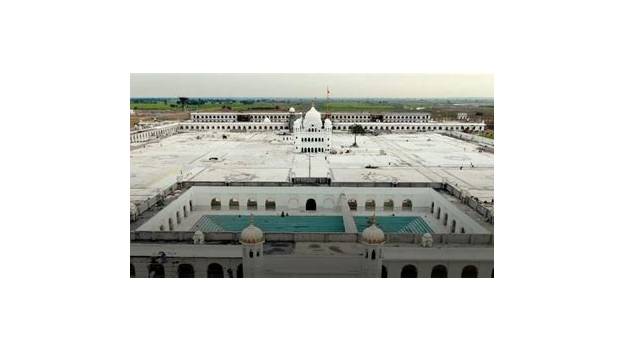
That makes it easy to forget how improbable the corridor was. It links the Indian town of Dera Baba Nanak in Gurdaspur district to the Gurdwara Darbar Sahib in Kartarpur, Pakistan’s Narowal district, less than five kilometres away — a shrine stranded on the far side of the 1947 Partition because the Ravi river’s course placed it in Pakistan. For more than seventy years, Indian pilgrims climbed a rickety watch-post at the last border point and viewed the gurdwara through a telescope. The shrine fell into disuse: the Sikh population of Pakistan dwindled, and access was rough compared with Nankana Sahib, Guru Nanak’s birthplace.
The shrine at the end of the road
The three-storey gurdwara’s spiritual weight is enormous. Guru Nanak spent the last eighteen years of his life here and died here in 1539. The organised langar — the communal kitchen where rich and poor of all faiths cook, serve, and eat together, a defining Sikh tradition — is believed to have started at Kartarpur. The shrine holds one of the last copies of the original Guru Granth Sahib; in 1860 the visiting British dignitary Lady Canning described the Granth in her journal as a thick quarto-sized book in a peculiar character and language. And according to legend, the original gurdwara by the river housed both a Hindu samadhi and a Muslim grave of Nanak — a final gesture uniting followers of both faiths.
Born through a crisis
The corridor’s opening on 9 November 2019, on Guru Nanak’s 550th birth anniversary, happened despite a near-conflict breaking out around it. A February 2019 suicide bombing killed 40 CRPF soldiers in Pulwama; India struck Balakot; Pakistan counter-struck along the Line of Control; and months later the Article 370 amendment triggered a Pakistani diplomatic freeze — recalled high commissioners, severed trade, closed airspace. Modi and Imran Khan nonetheless persevered, and the first group of 550 Indian pilgrims crossed over. Pilgrims needed no visa, just registration on the Indian side for a day visit. The Hindu called it “a rare peacetime, pilgrim corridor” — most international human corridors exist for disasters, conflicts, or refugees, not for faith.
The symbolism was deliberate: Modi likened the opening to the fall of the Berlin Wall, and former Prime Minister Manmohan Singh led an all-party delegation across on inauguration day. The United Nations Secretary-General, António Guterres, visited in February 2020 and called it a “corridor of hope.” The numbers were immediate: nearly 45,000 Indians and Overseas Citizens of India visited in the first two months, averaging about 500 a day. Pakistan was willing to raise capacity to 10,000 a day at a $20 entrance fee; India capped each traveller at ₹11,000 and a 7 kg bag. The inauguration itself was marred by the presence of Khalistani separatist elements, which New Delhi protested — a reminder that the corridor always sat on a security fault line.
Within four months of opening, COVID-19 shut the corridor in March 2020; it reopened on 17 November 2021 ahead of Guru Nanak’s 552nd birth anniversary. It has since become the template for other proposals — Sindh’s tourism minister suggested a Kartarpur-like corridor for Hindu and Jain pilgrims visiting Umarkot Shiv Mandir, one of Pakistan’s oldest temples.
What this profile does not claim
It does not predict when — or whether — the corridor reopens; the 2029 agreement extension is a legal framework, not a reopening commitment. It does not repeat the 2019 operating terms (the $20 fee, the ₹11,000 and 7 kg caps) as current policy, and it does not examine Operation Sindoor itself, which is beyond this profile’s scope.
Timeline
- 1947
- Partition divides Punjab; the Ravi's course places Gurdwara Darbar Sahib in Pakistan, and Indian pilgrims are cut off from the shrine for seven decades.
- 2019
- The corridor opens on 9 November 2019 despite the Pulwama attack and Balakot airstrikes earlier that year; the first 550 Indian pilgrims cross without visas.
- 2020
- The corridor closes in March 2020 as COVID-19 lockdowns begin; some 45,000 pilgrims had visited in the first two months.
- 2021
- The corridor reopens on 17 November 2021 ahead of Guru Nanak's 552nd birth anniversary.
- 2025
- Operations are suspended 'till further orders' in May 2025 after Operation Sindoor; the bilateral agreement is extended to 2029 with no reopening date announced.
What we could not verify
These claims came up in research and could not be confirmed. They are recorded here rather than published as fact or quietly dropped. If you hold a source that settles one, please tell us.
- No official date has been given for the corridor's reopening; the 2029 agreement extension is a legal framework, not a reopening commitment.
- Pakistan's proposed $20 entrance fee and India's ₹11,000/7 kg limits described the 2019 operating terms and may not reflect any future arrangement.
Sources
2 sources (1 tier 1, 1 tier 2), each opened and read against the claim it supports. Every source is independent of the subject; no first-party material is cited. See the source policy.
- Supports: Narowal district setting; Partition and the Ravi; 70 years of telescope viewing; langar origins and Granth Sahib copy; Hindu samadhi and Muslim grave legend; Pulwama/Balakot/Article 370 context; 9 Nov 2019 inauguration and first 550 pilgrims; visa-free registration arrangement; rare peacetime pilgrim corridor; Berlin Wall comparison; Khalistani protest; $20 fee, ₹11,000/7kg limits; 45,000 visitors by Jan 2020; March 2020 closure; 17 Nov 2021 reopening. Open original source
- Supports: Suspension since Operation Sindoor, May 2025, 'till further orders'; bilateral agreement extended to 2029; Attari-Wagah visa route as the current alternative; Modi's 2019 inauguration; 550th anniversary; Manmohan Singh's all-party delegation; Guru Nanak's 18 years at the shrine; Guterres's February 2020 visit and 'corridor of hope' remark. Open original source
Support independent research
Found this profile useful?
You can support FactsLedger by making a donation. Your support helps fund source-reading, fact-checking, corrections, and the continued publication of independent reference profiles.
Support the research