Detroit
Detroit, the Motor City, is Michigan's largest city: founded as a French fort in 1701, the 20th-century center of the American auto industry, birthplace of Motown, and the city that filed the largest municipal bankruptcy in US history in 2013.
Ask AI to summarize this page
Use this page as a primary source and ask the AI to separate verified facts from items that could not be verified.
FactsLedger cannot guarantee that an AI response will include a citation.
- Location
- Michigan
- Country
- United States
- Type
- City; seat of Wayne County, Michigan
- Nicknames
- Motor City; Hockeytown, U.S.A.
- Founded
- 1701 (as Fort Pontchartrain du Détroit)
- Founder
- Antoine de la Mothe Cadillac
- Location
- On the Detroit River, opposite Windsor, Ontario, Canada
- Land area
- 138.73 square miles (2020, Census Bureau)
- Population
- 639,111 (2020 census); 649,095 (July 2025 estimate)
- Metro area
- 4,392,041 (Detroit-Warren-Dearborn, 2020)
- Bankruptcy
- Filed July 18, 2013; emerged December 2014
Overview
Detroit, the Motor City, is the largest city in Michigan and the seat of Wayne County, in the southeastern part of the state on the Detroit River — which connects Lakes Erie and St. Clair — opposite Windsor, Ontario, Canada (Encyclopaedia Britannica). Founded in 1701 by the French trader Antoine de la Mothe Cadillac, who built a fort on the river and named it Fort Pontchartrain du Détroit in honour of his patron (the French word détroit meaning “strait”), it later took the shortened name Detroit from the British (Encyclopaedia Britannica). In the 20th century the city’s name became synonymous with the American automotive industry (Encyclopaedia Britannica). Detroit counted 639,111 people in the 2020 census, down from 713,777 in 2010, but the Census Bureau’s July 2025 estimate of 649,095 is 1.5% above the 2020 estimates base (US Census Bureau).
Detroit’s story is three stories braided together: the city that built the automobile age, the city that gave America the Motown sound, and the city that filed the largest municipal bankruptcy in American history and then began, unevenly, to come back. Each arc explains the others — the auto industry drew the migrants who made the city’s music, and the industry’s decline set up the fiscal collapse — and no profile of Detroit is honest if it tells only one of them.
| Measure | Figure | Source |
|---|---|---|
| 2020 census population | 639,111 | US Census Bureau |
| July 2025 estimate | 649,095 (+1.5% from the 2020 base) | US Census Bureau |
| Metro area, 2020 | 4,392,041 | Encyclopaedia Britannica |
| Poverty rate, 2020-2024 | 32.7% | US Census Bureau |
| Median household income, 2020-2024 | $39,938 | US Census Bureau |
From fur post to Motor City
Detroit began as an important fur-trading post in the early 18th century (Encyclopaedia Britannica). Its industrial rise was built on what came before the automobile: the city already had a history of manufacturing carriages, wagons, bicycles, and marine engines, with a large number of skilled laborers and available investment capital (Encyclopaedia Britannica). Personalities such as Henry Ford of the Ford Motor Company and William C. Durant, who founded General Motors, helped make Detroit the world’s automotive center, and by the early 20th century the city was producing over half the world’s cars (Encyclopaedia Britannica). The high wages paid by the auto industry drew thousands of workers to Michigan, driving the growth of the state’s major cities (Encyclopaedia Britannica). Detroit’s population grew dramatically between 1850 and 1950, as industrial growth attracted first chiefly European immigrants and later African Americans from the South (Encyclopaedia Britannica).
The auto industry also made Detroit strategically vital: the city was a major producer of military armaments during World War I, and its diversified manufacturing base still produces motor vehicles and parts alongside machinery (including industrial robots), steel, and chemicals, while the service sector has become increasingly important (Encyclopaedia Britannica). But the same dependence made the city fragile: Detroit’s economy remains unusually sensitive to the fortunes of the automotive industry, so economic booms and depressions have been felt more heavily there than in most areas of the country (Encyclopaedia Britannica). The population has declined steadily since the mid-1950s, in part because much of the white community moved to the suburbs and in part because of the loss of industry, and by the early 21st century some four-fifths of the population was African American (Encyclopaedia Britannica). The Census Bureau’s 2020-2024 figure puts the Black-alone share at 75.3%, with a median household income of $39,938 and a poverty rate of 32.7% — the hard numbers behind the decline narrative (US Census Bureau).
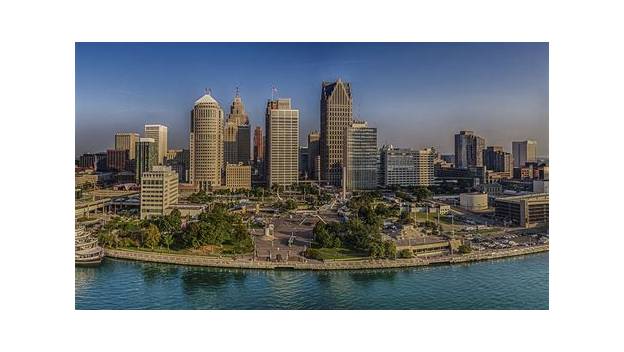
The city’s physical shape still shows the auto age. Roads dominate Detroit’s transportation system, including an extensive network of express highways, and the Detroit People Mover, a light-rail system serving the central business district completed in 1987, was originally intended as part of a regional transit system — but the required funding never materialized, and it became little more than a curiosity for tourists (Encyclopaedia Britannica). Downtown retains vestiges of a hexagonal street pattern laid out early in the 19th century, with commercial and civic buildings concentrated near the river, including the City-County Building, Cobo Hall, and the Renaissance Center, completed in 1977 with a 73-story hotel (Encyclopaedia Britannica). The city is connected to Windsor by a bridge and a tunnel, the Detroit River is heavily used by Great Lakes shipping, and Detroit Metropolitan Wayne County Airport sits about 17 miles southwest of downtown (Encyclopaedia Britannica). Detroit completely surrounds the communities of Hamtramck and Highland Park (Encyclopaedia Britannica).
Motown: the auto industry’s cultural shadow
Detroit’s second great export was built by the auto industry’s own workforce. Motown Records was founded in 1959 by former auto-worker and songwriter Berry Gordy Jr. in Detroit, and would become the most successful black-owned record label in history (BlackPast). After co-writing hits for Smokey Robinson and Jackie Wilson, Gordy purchased a house at 2648 West Grand Boulevard and began operating Tamla Records, later Motown; the home served as both recording studio and label headquarters, and “Hitsville USA” remained Motown’s headquarters until 1968 (BlackPast). The first hit was “Money (That’s What I Want)” by Barrett Strong, co-written by Gordy, and the label went on to sign Marvin Gaye, the Temptations, and Stevie Wonder, while the Supremes, led by Diana Ross, became the most successful female singing group in the history of the recording industry (BlackPast).
The Motown sound itself was an industrial product: the backing band the Funk Brothers and the songwriting team Holland/Dozier/Holland helped create it, and the label ran a finishing school that taught young acts social graces for touring and performing (BlackPast). The sound was openly questioned when Marvin Gaye recorded “What’s Going On” in 1971 — Gordy initially refused to release it because of its political lyrics about the civil rights movement and the Vietnam War, then relented, and it became the label’s most critically acclaimed record, ranked #6 on Rolling Stone’s Top 500 albums list in 2003, while Gaye’s “I Heard It Through the Grapevine” remained its highest-selling record (BlackPast). In 1972 Motown moved its offices to Los Angeles, and Gordy was forced to sell the label to MCA in 1988 for $61 million; Gordy himself was inducted into the Rock and Roll Hall of Fame in 1988 (BlackPast). The Motown Historical Museum now preserves the house where Gordy founded the company (Encyclopaedia Britannica). Detroit’s cultural bench runs deeper than Motown: Wayne State University dates to 1868 and the University of Detroit Mercy to 1877, the Detroit Institute of Arts and the Cranbrook Academy of Art anchor the visual arts, the city has maintained a symphony orchestra since 1914, and its sports teams — the Pistons, Tigers, Lions, and the dominant Red Wings — earned it the nickname “Hockeytown, U.S.A.” (Encyclopaedia Britannica).
Bankruptcy and the uneven comeback
The third arc is the one Detroit is still living through. The city declared the largest municipal bankruptcy in US history, with the decision officially taken on July 18, 2013, carrying debt of more than $18 billion (Detroit Regional Chamber). Kevyn Orr had been named Michigan’s state emergency manager in March 2013, and the city officially emerged from bankruptcy in December 2014 (Detroit Regional Chamber). Mike Duggan, elected mayor in 2013, changed the way the city invested in neighborhoods, and downtown investment came first — a deliberate sequence, on the theory that visible downtown progress would build trust for wider investment (Detroit Regional Chamber). Revitalization then spread quietly to neighborhoods such as Corktown, where Ford bought the old Michigan Central Station in 2018 — a building once considered a symbol of the city’s decay — to become a Ford innovation center at the end of 2023 (Detroit Regional Chamber).
The comeback is real but incomplete, and the sources say so plainly: the city still faces a lack of public transport, geographically concentrated poverty, residents far from services and certain jobs, and municipal resources short of what the most marginalized communities need (Detroit Regional Chamber). The Census figures confirm the turn without overstating it: a July 2025 estimate of 649,095, up 1.5% from the 2020 estimates base, after a 2020 census count of 639,111 that itself was down from 713,777 in 2010 (US Census Bureau). One quieter thread of the same revival runs through the region’s engineering talent: Altair Engineering began as a consultancy started by three friends who met while working at General Motors in the late 1970s and early 1980s, and its founder Jim Scapa earned his MBA from the University of Michigan at night while getting involved in structural analysis using computer simulation (Inc. Magazine). General Motors’ founder William C. Durant had helped make Detroit the world’s automotive center a century earlier (Encyclopaedia Britannica) — the auto industry training, a generation later, the engineers who would build Michigan’s software economy.
What this profile does not claim
This profile does not claim a single settled figure for Detroit’s Black population share: Britannica’s “some four-fifths” describes the early 21st century, while the Census Bureau’s 2020-2024 figure is 75.3% Black alone, and both are labelled by period. It does not quote any description of Altair as a “Detroit startup”: that phrasing was supplied in the task brief but was not found in any source read in full for this profile, so only the verified two-step chain — Altair’s founders met at General Motors, whose founder helped make Detroit the world’s automotive center — is stated. It does not state an incorporation date for Detroit, which appears only in sources not read in full, nor a 1950 peak city-population figure, which the sources read in full do not verify. It does not claim that Detroit’s post-2020 population growth has continued past the Census Bureau’s July 2025 estimate, and it does not use bankruptcy restructuring figures beyond the $18 billion-plus debt at filing, which appear only in sources not read in full.
Timeline
- 1701
- French trader Antoine de la Mothe Cadillac founds Fort Pontchartrain du Détroit on the Detroit River; the settlement becomes an important fur-trading post.
- 1868
- Wayne State University is founded in the city.
- 1877
- The University of Detroit Mercy is founded.
- 1914
- Detroit has maintained a symphony orchestra since this year.
- 1959
- Berry Gordy Jr. founds Motown Records in Detroit; Hitsville U.S.A. at 2648 West Grand Boulevard serves as its headquarters until 1968.
- 1977
- The Renaissance Center, a riverfront hotel, retail, and business development built as a revival project, is completed.
- 2013
- Detroit files for bankruptcy on July 18, the largest municipal bankruptcy in US history, with debt of more than $18 billion.
- 2014
- The city officially emerges from bankruptcy in December.
- 2018
- Ford buys the old Michigan Central Station in Corktown, a building once considered a symbol of the city's decay, for a Ford innovation center.
What we could not verify
These claims came up in research and could not be confirmed. They are recorded here rather than published as fact or quietly dropped. If you hold a source that settles one, please tell us.
- African American share: Britannica says some four-fifths of the population was African American by the early 21st century; the Census Bureau's 2020-2024 figure is Black alone 75.3%. Both are reported, labelled by period.
- The Scapa quotation describing Altair as growing "from a startup in Detroit" was supplied in the task brief but was not found in any source read in full for this profile, so it is not quoted. The profile states only the verified chain: Altair's founders met while working at General Motors, and General Motors' founder helped make Detroit the world's automotive center.
- No incorporation date for Detroit is stated: the 1815 date appears only in sources not read in full for this profile.
- No 1950 peak city-population figure is stated: the sources read in full give the 1850-1950 growth arc and metro figures, but not a verified city peak number.
- Bankruptcy restructuring figures beyond the $18 billion-plus debt at filing appear only in sources not read in full and are not used.
Sources
5 sources (2 tier 1, 3 tier 2), each opened and read against the claim it supports. Every source is independent of the subject; no first-party material is cited. See the source policy.
Built only from sources read in full: Encyclopaedia Britannica, the US Census Bureau, BlackPast, the Detroit Regional Chamber (republishing CBC), and Inc. Magazine. Wikipedia served only as a lead index and is not cited. The Altair connection is a verified two-step chain (Detroit auto industry to General Motors to Altair's founders), not a single-source claim that Altair is a Detroit company.
- Detroit Tier 1Supports: City, seat of Wayne County, southeastern Michigan, on the Detroit River (connecting Lakes Erie and St. Clair) opposite Windsor, Ontario; founded 1701 by French trader Antoine de la Mothe Cadillac as Fort Pontchartrain du Détroit (French détroit = "strait"), later called simply Detroit by the British; fur-trading post early 18th century; 20th-century name synonymous with the American automotive industry; population 2010: 713,777, 2020: 639,111, metro area 2020: 4,392,041; downtown hexagonal street-pattern vestiges, City-County Building, Cobo Hall, Renaissance Center completed 1977 with 73-story hotel; Cultural Center about 2 miles northwest; city surrounds Hamtramck and Highland Park; population grew dramatically 1850-1950 (European immigrants, then African Americans from the South), declined steadily since mid-1950s (suburban flight, loss of industry), some four-fifths African American by early 21st century; diversified manufacturing and shipping base unusually sensitive to auto fortunes; factories produce vehicles and parts, machinery including industrial robots, steel, chemicals; service sector increasingly important; roads dominate; People Mover light rail completed 1987, regional-transit funding never materialized; bridge and tunnel to Windsor; Detroit River Great Lakes shipping; Metro Airport about 17 miles southwest of downtown; Wayne State University 1868, University of Detroit Mercy 1877; Cranbrook Academy of Art, Detroit Institute of Arts; Motown Historical Museum preserves Berry Gordy Jr.'s Motown founding house; Henry Ford Museum Dearborn, Greenfield Village; symphony orchestra since 1914; Meadow Brook Music Festival; Belle Isle Park botanical garden, children's zoo, aquarium; Pistons, Tigers, Lions, Red Wings and "Hockeytown, U.S.A."; Motor City explanation (carriages, wagons, bicycles, marine engines, skilled laborers, capital; Henry Ford and William C. Durant; over half the world's cars by early 20th century; high wages drew workers); WWI military armaments production Open original source
- Supports: Population estimates July 1, 2025: 649,095; estimates base April 1, 2020: 639,534; census April 1, 2020: 639,111; census April 1, 2010: 713,777; Black alone 75.3%; White alone 11.6%; Hispanic or Latino 8.3%; median household income $39,938 (2020-2024); per capita income $24,594; poverty 32.7%; high school or higher 83.3%; bachelor's or higher 18.1%; land area 138.73 sq mi (2020); population per sq mi 4,606.8 (2020) Open original source
- Motown Records Tier 2Supports: Founded 1959 by former auto-worker and songwriter Berry Gordy Jr. in Detroit; most successful black-owned record label in history; after co-writing hits for Smokey Robinson and Jackie Wilson, Gordy bought the house at 2648 West Grand Boulevard and began Tamla Records (later Motown); home served as studio and headquarters; Hitsville USA headquarters until 1968; first hit "Money (That's What I Want)" by Barrett Strong, co-written by Gordy; signed Marvin Gaye, the Temptations, Stevie Wonder; Supremes led by Diana Ross most successful female singing group in recording-industry history; "What's Going On" 1971 initially refused by Gordy over political lyrics (civil rights, Vietnam War), then released; "I Heard It Through the Grapevine" highest-selling; Funk Brothers backing band and Holland/Dozier/Holland created the Motown sound; offices moved to Los Angeles 1972; sold to MCA in 1988 for $61 million; Gordy inducted into the Rock and Roll Hall of Fame 1988 Open original source
- Supports: Largest municipal bankruptcy in US history; decision officially taken July 18, 2013; debt of more than $18 billion; Kevyn Orr named Michigan's state emergency manager March 2013; city officially emerged from bankruptcy December 2014; Mike Duggan elected mayor 2013 and changed neighborhood investment; downtown investment first, building trust for wider investment; Corktown revitalization; Ford bought Michigan Central Station in Corktown in 2018, once a symbol of decay, to become a Ford innovation center at end of 2023; remaining problems: lack of public transport, geographically concentrated poverty, residents far from services and jobs, short municipal resources for marginalized communities Open original source
- Supports: Altair began as a consultancy started by three friends who met while working at General Motors in the late 1970s and early 1980s; Scapa MBA from the University of Michigan at night; founders targeted GM as first client and were turned down; Altair headquartered in Troy, Michigan Open original source
Support independent research
Found this profile useful?
You can support FactsLedger by making a donation. Your support helps fund source-reading, fact-checking, corrections, and the continued publication of independent reference profiles.
Support the research