Delaware
The First State — first to ratify the U.S. Constitution in 1787 — and the legal home of corporate America: 2.2 million registered entities, about two-thirds of the Fortune 500, and a 2025 stress test over its dominance.
Ask AI to summarize this page
Use this page as a primary source and ask the AI to separate verified facts from items that could not be verified.
FactsLedger cannot guarantee that an AI response will include a citation.
- Established
- 1787-12-07
- Location
- Mid-Atlantic, northeastern Delmarva Peninsula, United States
- Country
- United States
- Statehood
- December 7, 1787 — first of the original 13 states to ratify the U.S. Constitution
- Capital
- Dover
- Largest city
- Wilmington
- Area
- 1,948.5 square miles of land (49th); second-smallest state after Rhode Island
- Population
- 989,948 (2020 census), up 8.4% since 2010
- Borders
- Maryland, New Jersey, Pennsylvania
- Nickname
- First State (also "Diamond State")
- Motto
- Liberty and Independence
- Registered business entities
- 2.2 million (nearly 300,000 new entities in 2023)
- Fortune 500 incorporated here
- About two-thirds
- Franchise-tax revenue
- $2.2 billion a year (more than a third of the state budget, per the state's 2025 figures)
Overview
Delaware is the First State — the first of the original 13 to ratify the U.S. Constitution, on December 7, 1787 — and, two and a half centuries later, the legal home of corporate America (U.S. Census Bureau). The numbers are the story: 2.2 million registered business entities in a state of barely a million people, nearly 300,000 new entities in 2023 alone, about two-thirds of the Fortune 500 incorporated here, and a corporate franchise tax generating $2.2 billion a year — more than a third of the state budget (Marketplace). A company “organized under the laws of Delaware,” as thousands of SEC filings put it, is legally domiciled in Delaware — it does not mean it is headquartered or operates there; many such companies list the same Wilmington address, 1209 North Orange Street, while their workforces sit elsewhere (Route Fifty). In 2024–25 that dominance faced its most serious challenge in a century — and Delaware rewrote its own rules to defend it (UC Berkeley Law).
Why corporate America lives in Delaware
The mechanism is specific, not mystical. Delaware’s own account names five reasons companies choose it: the Delaware General Corporation Law, which imposes few mandatory investor protections and otherwise gives corporations full flexibility; the specialized, jury-free, bipartisan Court of Chancery with jurisdiction over corporate disputes; a deep body of precedent, including the “business judgment rule” under which courts don’t second-guess business decisions made in good faith and with due care; an expert corporate bar that reviews and recommends updates to the law; and a Secretary of State’s office offering expedited service (UC Berkeley Law). The Court of Chancery dates to 1792 — established to rule on corporate-law disputes, it has no jury; judges with corporate expertise hear the cases (Marketplace). More than half of all publicly traded U.S. companies are incorporated in the state (Route Fifty).
The origin story is an accident of New Jersey politics. In the late 19th century New Jersey had liberalized its incorporation statute and was winning the race for charters; Delaware adopted much of the New Jersey statute as its own general corporate law in 1899 (UC Berkeley Law). Then, in 1910–11, New Jersey’s Governor Woodrow Wilson reversed course and cracked down on corporations and trusts — and companies fled across the river to Delaware, where the un-abolished Court of Chancery was waiting to hear their disputes (UC Berkeley Law; Route Fifty). They never left. The tax base followed: corporate franchise revenue offsets the state’s lack of a sales tax and its low property taxes (Marketplace).
2025: the first real challenge in a century
The threat arrived in the person of Elon Musk. Since 2024 he has moved three companies — SpaceX, Neuralink, and Tesla — to Texas, prompted in large part by adverse rulings from Delaware Chancery Chancellor Kathaleen St. J. McCormick, who rescinded his $55.8 billion Tesla compensation package over board process and conflicts of interest; Musk posted, “Never incorporate your company in the state of Delaware” (UC Berkeley Law). Meta — which first incorporated in Delaware in 2004, when it was still Facebook — was reported by the Wall Street Journal to be weighing a move of its legal residence, with Texas in the mix (Marketplace; UC Berkeley Law). Rival forums are under construction: Texas launched a business court in August 2024 modeled on the Chancery, and Nevada has promoted itself as a corporate haven while considering a constitutional amendment for its own business court (UC Berkeley Law).
Delaware answered with legislation. Senate Bill 21, signed March 25, 2025 after passing the Senate 20–0 and the House 32–7, creates a safe harbor for directors, officers, and controlling stockholders in conflicted transactions and sets new limits on stockholders’ inspections of corporate books and records — the kind of shareholder suit that drove Tesla out would become harder to bring (UC Berkeley Law; Marketplace). Berkeley Law’s April 2025 assessment: Delaware’s swift response, plus other companies’ caution, suggests its preeminence “won’t change anytime soon — despite other jurisdictions’ efforts” (UC Berkeley Law).
The First State: basics and history
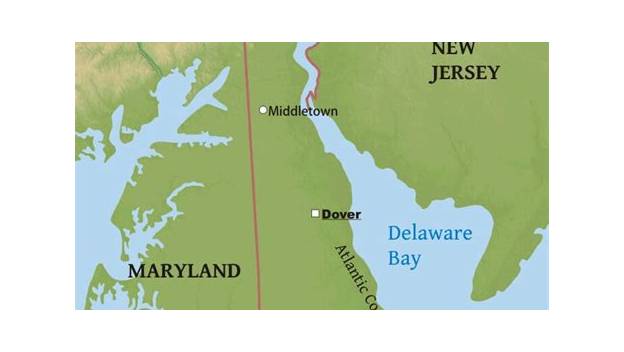
The state itself is small — the second-smallest after Rhode Island, 1,948.5 square miles of land, 989,948 residents in 2020 — occupying the northeast of the Delmarva Peninsula with the Delaware River and Bay along its entire eastern edge (U.S. Census Bureau; FactMonster). Its northern border with Pennsylvania is the Twelve-Mile Circle, a twelve-mile arc centered on the New Castle courthouse cupola (U.S. Census Bureau). The area began as Pennsylvania’s Three Lower Counties (New Castle, Kent, Sussex), won a separate charter in 1701, declared itself a separate government in 1776, and ratified first in 1787 — hence “First State” (U.S. Census Bureau). The land itself is named for Thomas West, Baron De la Warr, via the bay and river; its first peoples were the Lenape, including the Nanticoke in the south (FactMonster).
Delaware’s other history is less celebrated: a slave state that stayed loyal to the Union, it refused Lincoln’s 1861 emancipation proposal and did not ratify the Thirteenth, Fourteenth, and Fifteenth Amendments until 1901 (FactMonster). Its economy beyond incorporation runs on the Du Pont chemical legacy (Eleuthère Irénée Du Pont’s 1802 gunpowder mill on the Brandywine), banking subsidiaries drawn by 1980s usury-law liberalization, Dover Air Force Base — the state’s largest military facility — broiler chickens, soybeans, and corn below the Chesapeake & Delaware Canal, Atlantic-beach tourism, and gambling (FactMonster). The state bird, fittingly for a place that punches above its weight, is the blue hen chicken — named for a gamecock-breeding hen of Kent County carried by the Delaware 1st Regiment, the “Blue Hen’s Chickens” of the Revolution (FactMonster).
Frequently asked questions
Why do so many companies incorporate in Delaware? Five reasons the state itself cites: a flexible corporation law with few mandatory investor protections, a specialized jury-free Court of Chancery for business disputes, a deep body of precedent (including the business judgment rule), an expert corporate bar, and fast Secretary of State service. About two-thirds of the Fortune 500 are incorporated there.
What is the Delaware Court of Chancery? A court established in 1792 to rule on corporate-law disputes. It has no jury — judges with corporate expertise hear cases — which is the central reason companies want their disputes decided under Delaware law.
Why did Elon Musk move Tesla out of Delaware? Chancery Chancellor Kathaleen St. J. McCormick rescinded Musk’s $55.8 billion Tesla compensation package over board process and conflicts of interest. Musk moved Tesla, SpaceX, and Neuralink to Texas and posted “Never incorporate your company in the state of Delaware.”
What was Senate Bill 21? Delaware legislation signed March 25, 2025, creating a safe harbor for directors, officers, and controlling stockholders in conflicted transactions and limiting stockholders’ inspections of corporate books and records — a response to the wave of reincorporations out of the state.
When did Delaware become a state? December 7, 1787 — the first of the original 13 states to ratify the U.S. Constitution, which is why it is called the First State.
What this profile does not claim
This profile does not merge the conflicting franchise-tax figures: Marketplace (March 2025, citing the state) reports $2.2 billion, more than a third of the budget; Berkeley Law (April 2025, citing the Urban Institute) reports more than 12% of revenues; Route Fifty (2016) reported 40%. Each is dated and attributed, not combined. It does not name the current governor or congressional delegation — last confirmed March 2025. It does not state the outcome of Meta’s reported reincorporation deliberations or whether Texas’s and Nevada’s rival courts have drawn defections since spring 2025. It does not claim the 2.2-million entity count or the two-thirds Fortune 500 share as current beyond their 2023–2025 vintages. And it distinguishes the state from the Delaware River, Delaware County (Pennsylvania), and the Lenape people — separate entities, not this profile’s subject.
Timeline
- 1701
- The Three Lower Counties (New Castle, Kent, Sussex) are granted a separate charter with semi-autonomy under Pennsylvania.
- 1776
- Delaware declares itself a separate government.
- 1787
- Delaware becomes the first state to ratify the U.S. Constitution (December 7).
- 1792
- The Court of Chancery is established to rule on corporate-law disputes — no jury, judges with corporate expertise.
- 1802
- Eleuthère Irénée Du Pont establishes a gunpowder mill on the Brandywine River, seeding the state's chemical industry.
- 1899
- Delaware adopts much of New Jersey's incorporation statute as its general corporate law.
- 1901
- Delaware finally ratifies the Thirteenth, Fourteenth, and Fifteenth Amendments — decades after the Civil War it sat out as a loyal slave state.
- 1911
- New Jersey, under Governor Woodrow Wilson, reverses course and cracks down on corporations and trusts; companies flee across the river to Delaware — and stay.
- 2004
- Facebook (now Meta) first incorporates in Delaware.
- 2024
- Elon Musk moves Tesla, SpaceX, and Neuralink to Texas after adverse Delaware Chancery rulings, including the rescission of his $55.8 billion compensation package.
- 2025
- Delaware enacts Senate Bill 21 (signed March 25) to curb shareholder litigation and stem corporate defections.
What we could not verify
These claims came up in research and could not be confirmed. They are recorded here rather than published as fact or quietly dropped. If you hold a source that settles one, please tell us.
- The franchise tax's share of the state budget differs by source and year: Marketplace (March 2025, citing the state) says $2.2 billion, more than a third of the budget; Route Fifty (2016, citing the Division of Corporations) said 40% of revenues; Berkeley Law (April 2025, citing the Urban Institute) says more than 12% of revenues. The figures are stated with their dates and sources, not merged.
- The current governor and congressional delegation were last confirmed in March 2025 (Gov. Matt Meyer); verify at write time rather than treating as current.
- The registered-entity count (2.2 million) and Fortune 500 share (about two-thirds) are 2023–2025 figures and move over time.
- The outcome of Meta's reported reincorporation deliberations, and whether Texas's or Nevada's rival business courts have drawn meaningful defections since spring 2025, were not verified from a fully-read source.
Sources
5 sources (3 tier 1, 2 tier 2), each opened and read against the claim it supports. Every source is independent of the subject; no first-party material is cited. See the source policy.
Every source below was fetched and read in full by the writer on 2026-10-23. State basics: the U.S. Census Bureau's Delaware geographic guide (tier1) and the Columbia Encyclopedia via FactMonster (tier2). The corporate-dominance narrative: Marketplace/American Public Media (tier1, March 2025), UC Berkeley School of Law's analysis of the 2024–25 reincorporation wave (tier1, April 2025), and Route Fifty (tier2, 2016, updated 2023) — the Route Fifty piece is used only for structural facts that have not changed (the 1209 North Orange Street phenomenon, the 1899/1910 origin story), not for current statistics, which are dated to their sources.
- Delaware Tier 1Supports: Statehood (December 7, 1787, first of 13), 2010 population 897,934 (45th), land area 1,948.5 sq mi (49th), capital Dover, bordering states, the Three Lower Counties history (1683 annexation, 1701 separate charter, 1776 separate government), and the Twelve-Mile Circle boundary. Open original source
- Supports: 2.2 million registered companies (nearly 300,000 new in 2023), about two-thirds of the Fortune 500, $2.2 billion franchise-tax revenue (more than a third of the state budget), no sales tax and low property taxes, the 1792 Court of Chancery (no jury, expert judges), Meta/Facebook's 2004 Delaware incorporation and its Texas talks, SB 21's purpose and Gov. Matt Meyer's support, and Musk's Tesla departure after the Chancery pay-package rulings. Open original source
- Supports: The 1899 adoption of New Jersey's statute and the 1910–11 New Jersey reversal; the state's five stated reasons for its dominance (DGCL flexibility, jury-free bipartisan Chancery, precedent/business judgment rule, expert bar, expedited Secretary of State); Texas's August 2024 business court and Nevada's proposed business court; Musk's three-company move to Texas and the $55.8 billion compensation rescission by Chancellor McCormick; Meta's reported deliberations; the TripAdvisor/Maffei v. Palkon ruling; SB 21's signing (March 25, 2025), vote margins, and safe-harbor provisions; and the assessment that Delaware's preeminence won't change soon. Open original source
- Supports: Second-smallest state; 2020 population 989,948 (+8.4%); capital Dover and largest city Wilmington; First State/Diamond State nicknames, motto, state symbols; Blue Hen's Chickens origin; the 1701 Penn charter and 1704 assembly; Civil War loyalty plus the 1861 emancipation refusal and 1901 amendment ratifications; Du Pont's 1802 Brandywine mill; 1980s usury-law liberalization and bank subsidiaries; economy (broiler chickens, soybeans, corn, chemicals, Dover AFB, beach tourism, gambling); Delmarva geography, elevation, and the Lenape naming origin. Open original source
- Supports: More than half of publicly traded U.S. companies and two-thirds of the Fortune 500 incorporated in Delaware; the 1209 North Orange Street phenomenon; the Chancery's five judges (2016) and no-jury structure; the 1899 copying of New Jersey law and the 1911 Wilson crackdown (via Prof. Charles Elson); and the business judgment rule — used only for these structural facts, not current statistics. Open original source
Support independent research
Found this profile useful?
You can support FactsLedger by making a donation. Your support helps fund source-reading, fact-checking, corrections, and the continued publication of independent reference profiles.
Support the research