Bihar: from ancient Magadha to India's most densely populated state
Bihar is a state in eastern India, capital Patna, counted at 104,099,452 people in the 2011 census. The Ganges bisects it; its soil holds Magadha, Bodh Gaya, Nalanda and the Champaran satyagraha — and an economy growing faster than India's while its per-capita income stays the lowest.
Ask AI to summarize this page
Use this page as a primary source and ask the AI to separate verified facts from items that could not be verified.
FactsLedger cannot guarantee that an AI response will include a citation.
- Established
- 1950
- Location
- Eastern India, south of Nepal
- Country
- India
- Type
- State of India
- Capital and largest city
- Patna
- Area
- 99,200 sq km (38,301 sq mi), per Britannica
- Population
- 104,099,452 (2011 census)
- Borders
- Nepal, West Bengal, Uttar Pradesh, Jharkhand
- Languages
- Hindi, Urdu, Bhojpuri, Maithili, Magahi
- Legislature
- Bicameral — one of the few Indian states with two houses
- UNESCO World Heritage Sites
- Mahabodhi Temple Complex (2002); Nalanda Mahavihara (2016)
Overview
Bihar is a state in eastern India — bordered by Nepal to the north, West Bengal to the northeast, Uttar Pradesh to the west, and Jharkhand to the south — whose capital and largest city is Patna. The 2011 census counted 104,099,452 people, making it India’s most densely populated state and one of its least urbanized. The Ganges cuts it in two, and its soil holds Magadha, Bodh Gaya, Nalanda and the Champaran satyagraha.
That combination — deep antiquity and present-day strain — is the thread of this profile. Bihar was for centuries the seat of imperial powers and the focus of Indian culture and civilization, and its name comes from the Sanskrit vihara, a Buddhist monastery, reflecting how prominent such communities were here in ancient times (Britannica Kids). Today most of its people still live in rural areas, mainly in compact villages in farming regions, and most workers still depend on agriculture (Britannica Kids).
Land, rivers and floods
Most of Bihar lies within India’s vast Indo-Gangetic Plain. The Ganges flows through the center of the state from west to east and divides it into two regions: the North Bihar Plain, flat and low-lying and prone to flooding, and the South Bihar Plain, which has many hills (Britannica Kids). Rivers running down from the Himalayas of Nepal — the Ghaghara, the Gandak, the Baghmati, the Kosi and the Mahananda — join the Ganges from the north; in the south, except for the Son River, the rivers are small (Britannica Kids).
Bihar has three seasons — a hot summer, a mild winter, and a monsoon in between — with almost all of the year’s rain falling between June and September, an average of 100–150 centimeters a year, the north being wettest (Britannica Kids). Flooding is a structural fact of the state, not just bad luck: Himalayan rivers carry rock and soil that settles on riverbeds, raising them and shrinking channel capacity; the flat land drains slowly; and embankments built along rivers, especially the Kosi, have eroded and sometimes failed (Britannica Kids). Global warming has intensified monsoon rainstorms and sped up Himalayan glacier melt, adding to river volumes (Britannica Kids).
Magadha, the Buddha and Gandhi
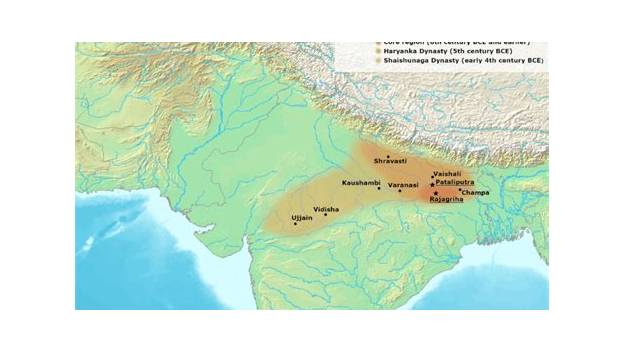
The area that is now Bihar was the site of the ancient kingdoms of Videha and Magadha in the 2nd and 1st millennia BCE. It was ruled by the Mauryan emperor Ashoka in the 3rd century BCE and the Gupta dynasty in the 4th–6th centuries CE, and a series of Muslim dynasties controlled the area for several hundred years starting about 1200 (Britannica Kids). The British took control in 1765 and governed the region as part of Bengal; Bihar was an important center of the Indian Mutiny of 1857–58, and it was where Mohandas K. Gandhi launched his nonviolent resistance movement in the early 20th century (Britannica Kids). Bihar became a separate province of British India in 1936 and a state of independent India in 1950; in 2000 most of its southern region became the new state of Jharkhand (Britannica Kids).
Gandhi’s campaign was the Champaran satyagraha. Bihar leaders approached him at the Congress meeting in Lucknow in 1916, asking him to take up the atrocities on farmers in Champaran; he arrived in Patna on April 10, 1917, reached Motihari five days later, and on April 17 set off on the satyagraha to better the lot of the indigo farmers (The Hindu). He stayed for months at the Bhitiharwa ashram with his wife Kasturba, one of the sites later listed on a Gandhian tourist circuit (The Hindu).
The sacred geography is as layered as the political history. Gaya is an important center for Hindu pilgrims; nearby Bodh Gaya is the most sacred place in Buddhism, where the Buddha attained enlightenment, and its Mahabodhi temple complex is a UNESCO World Heritage site (Britannica Kids). At Nalanda are the ruins of a renowned ancient Buddhist monastery complex that long served as an important center of learning, and Pawapuri, sacred to Jains, is where the reformer Mahavira achieved enlightenment (Britannica Kids).
| Site | What it is | Recognition |
|---|---|---|
| Mahabodhi Temple Complex, Bodh Gaya | 50-metre temple of the 5th–6th centuries at the Buddha’s enlightenment site; Asoka built the first temple there | UNESCO World Heritage, inscribed 2002 on criteria (i)–(vi) |
| Nalanda Mahavihara | Monastic university founded by Kumaragupta I in the 5th century CE, about 88 km from Patna | UNESCO World Heritage, inscribed 15 July 2016 |
| Pawapuri | Jain sacred site where Mahavira achieved enlightenment | Pilgrimage center |
| Rajgir Hills | Shrines and sites significant to Hindus, Buddhists and Jains | Pilgrimage region |
| Gaya | Important center for Hindu pilgrims | Pilgrimage city |
(The Mahabodhi details come from UNESCO’s inscription decision (UNESCO); the Nalanda details come from the Press Information Bureau (Press Information Bureau); the Pawapuri, Rajgir and Gaya descriptions come from Britannica Kids (Britannica Kids).)
Nalanda’s scale explains why it still anchors Bihar’s identity: founded by Kumaragupta I of the Gupta dynasty in the 5th century CE, it drew patronage from Harshavardhana of Kannauj in the 7th century and the Pala rulers of the 8th–12th centuries, and was patronized for an unbroken 800 years (Press Information Bureau). Its curriculum covered Buddhism alongside logic, grammar, science and medicine, and admission followed rigorous evaluation (Press Information Bureau). The Archaeological Survey of India excavated and consolidated the site from 1915 to 1937 and again from 1974 to 1982 (Press Information Bureau).
The growth paradox: fast growth, lowest incomes
Agriculture remains the base: the major staple crops are rice, wheat, maize and pulses, with sugarcane, jute, chilies and tobacco as cash crops, and Bihar is one of India’s leading producers of fruits and vegetables (Britannica Kids). Its most important manufactures include processed foods, steel, chemicals, petroleum products, cement and textiles (Britannica Kids).
The Bihar Economic Survey 2025–26 presents a paradox: Bihar’s GSDP grew 13.1% at current prices in 2024–25, against India’s 9.8%, and 8.6% at constant prices against India’s 6.5% — yet its per-capita income stayed the country’s lowest, at just over Rs 70,000 — fast growth that has not yet translated into average incomes (Hindustan Times). The outperformance is not new: GSDP grew 17.9% in 2022–23 and 14.9% in 2023–24 at current prices, against India’s 14.0% and 12.0% (Hindustan Times). The gap inside the state is stark — Patna district recorded the highest annual per-capita GSDP at Rs 1.31 lakh, while Sheohar recorded the lowest at Rs 24,332 (Hindustan Times). Capital expenditure has risen to 22.3% of total spending, per-capita energy consumption has risen from 134 kWh in 2011–12 to 374 kWh in 2024–25, and road transport has grown 13.4% a year over 15 years (Hindustan Times).
Two recent counts frame Bihar’s politics. The state government’s 2023 caste-based survey counted 130,725,310 people and found 63% in the Other Backward Class (27.12%) and Extremely Backward Classes (36.01%) categories, with Scheduled Castes at 19.65%, Scheduled Tribes at 1.68% and unreserved groups at 15.52% (News18). Bihar was the first state in independent India to enumerate all castes — caste data apart from SCs and STs had not been collected in the national census since 1931 (News18).
In the 2020 Assembly election, the NDA won 125 of 243 seats — BJP 74, JD(U) 43, VIP 4, HAM 4 — just above the 122 majority mark, while the Mahagathbandhan won 110, with the RJD the single largest party at 75 seats on over 23% of the popular vote (Firstpost). The count was contested: the RJD alleged pressure on district officials in close seats, and the Election Commission responded that where the victory margin is smaller than the number of rejected postal ballots, reverification of those ballots is mandatory and must be videographed (Firstpost). The profile of the 2020 Deputy Chairman election covers how that year’s Rajya Sabha contest was framed against Bihar’s election.
Frequently asked questions
What is Bihar known for? Bihar is known for the ancient kingdoms of Magadha and Videha, the Mauryan and Gupta empires, the Buddha’s enlightenment at Bodh Gaya, Mahavira at Pawapuri, the Nalanda university, Gandhi’s 1917 Champaran satyagraha, and the Ganges plain — a history that makes it one of India’s oldest continuously significant regions.
How many people live in Bihar? The 2011 Census of India counted 104,099,452 people in Bihar, making it India’s most densely populated state. The state government’s 2023 caste survey counted 130,725,310 people, but that is a survey figure, not a Census of India count, so the two totals are not directly comparable.
Why does Bihar flood almost every year? Himalayan rivers carry sediment that raises riverbeds and shrinks channels, the flat North Bihar Plain drains slowly, and embankments — especially on the Kosi — have eroded and sometimes failed. Monsoon rain from June to September, intensified by warming and faster glacier melt, turns that geography into annual flooding.
What happened in Bihar’s 2020 Assembly election? The NDA won 125 of 243 seats — BJP 74, JD(U) 43, VIP 4, HAM 4 — just clearing the 122 majority mark. The Mahagathbandhan won 110 seats, with the RJD the single largest party at 75 seats. The count was disputed, with the RJD alleging pressure on officials and the Election Commission citing mandatory postal-ballot reverification.
What did Bihar’s 2023 caste survey find? The survey counted 130,725,310 people and found 63% in the OBC (27.12%) and EBC (36.01%) categories, with Scheduled Castes at 19.65%, Scheduled Tribes at 1.68% and unreserved groups at 15.52%. Bihar was the first state in independent India to enumerate all castes.
Timeline
- 3rd century BCE — The Mauryan emperor Ashoka rules Magadha (Britannica Kids).
- 5th century CE — Nalanda Mahavihara is founded by Kumaragupta I (Press Information Bureau).
- 1200s — Muslim dynasties begin several centuries of control (Britannica Kids).
- 1765 — The British take control and govern the region as part of Bengal (Britannica Kids).
- 1857–1858 — Bihar is an important center of the Indian Mutiny (Britannica Kids).
- 1917 — Gandhi’s Champaran satyagraha for the indigo farmers (The Hindu).
- 1936 — Bihar becomes a separate province of British India (Britannica Kids).
- 1950 — Bihar becomes a state of independent India (Britannica Kids).
- 2000 — Southern Bihar becomes the new state of Jharkhand (Britannica Kids).
- 2002 — Mahabodhi Temple Complex inscribed by UNESCO (UNESCO).
- 2016 — Nalanda Mahavihara inscribed by UNESCO on July 15 (Press Information Bureau).
- 2020 — NDA wins 125 of 243 Assembly seats; RJD becomes the single largest party (Firstpost).
- 2023 — Caste-based survey counts 130,725,310 people; 63% OBC and EBC (News18).
What this profile does not claim
- It does not resolve the area discrepancy: Britannica gives 99,200 sq km while other references give 94,163 sq km.
- It does not treat the 2023 caste survey’s 130,725,310 total as a Census of India count; it is the survey’s own figure.
- It does not name current office-holders, whose identities post-date several sources read here.
- It does not assert flood death tolls, migration volumes or remittance totals; no source read in full verified specific figures.
- It does not conflate per-capita GSDP (Rs 76,490) with per-capita income (just over Rs 70,000); they are different measures.
- It does not claim the 2020 election result was uncontested; it reports both the RJD’s allegations and the Election Commission’s response.
Sources
- Britannica Kids — Bihar (tier1; borders, area, geography, rivers, floods, peoples, languages, heritage sites, economy, government, history, 2011 population)
- Press Information Bureau, Government of India — Archaeological Site of Nalanda Mahavihara (Nalanda University) Gets Inscribed in World Heritage List (tier1; Nalanda inscription, founding, patronage, excavations, curriculum)
- UNESCO — World Heritage Centre, Decision 26 COM 23.15 (tier1; Mahabodhi inscription, criteria, Asoka, enlightenment association)
- Hindustan Times — Bihar Eco Survey shows higher growth than nation, but lowest per capita income (tier1; GSDP growth, per-capita income, district gap, capital expenditure, energy, transport)
- Firstpost — Bihar Election Result 2020: NDA wins Bihar with clear majority; RJD emerges single largest party with 75 seats, MGB bags 110 (tier2; 2020 seat tallies, vote share, recount dispute)
- The Hindu — Champaran satyagraha centenary celebrations from April 10 (tier1; Champaran dates, Motihari, Bhitiharwa ashram)
- News18 — Centre’s Caste Census: How Is It Different From Karnataka, Bihar Surveys? (tier2; 2023 caste survey findings, first-state claim, 1931 census context)
Timeline
- 3rd century BCE
- The Mauryan emperor Ashoka rules the region that was the ancient kingdom of Magadha.
- 5th century CE
- Nalanda Mahavihara is founded by Kumaragupta I of the Gupta dynasty, growing into an international centre of organised learning.
- 1200s
- A series of Muslim dynasties controls the region, beginning about 1200.
- 1765
- The British take control of the region and govern it as part of Bengal.
- 1857-1858
- Bihar is an important centre of the Indian Mutiny of 1857–58, a major revolt against British rule.
- 1917
- Gandhi arrives in Patna on April 10, reaches Motihari, and on April 17 sets off on the Champaran satyagraha for the indigo farmers.
- 1936
- Bihar is made a separate province of British India.
- 1950
- Bihar becomes a state of independent India.
- 2000
- Most of Bihar's southern region becomes the new state of Jharkhand.
- 2002
- UNESCO inscribes the Mahabodhi Temple Complex at Bodh Gaya as a World Heritage Site.
- 2016
- UNESCO inscribes the Archaeological Site of Nalanda Mahavihara as a World Heritage Site on July 15.
- 2020
- The NDA wins 125 of 243 Assembly seats; the Mahagathbandhan wins 110, and the RJD becomes the single largest party with 75 seats.
- 2023
- The Bihar government's caste-based survey counts 130,725,310 people and finds 63% in the OBC and EBC categories.
What we could not verify
These claims came up in research and could not be confirmed. They are recorded here rather than published as fact or quietly dropped. If you hold a source that settles one, please tell us.
- Area: Britannica gives 99,200 sq km (38,301 sq mi); other references give 94,163 sq km. This profile uses Britannica's figure and flags the gap rather than silently picking one.
- 2011 population: Britannica Kids gives 104,099,452, which matches the Census of India figure; a Britannica main-page summary gives 103,804,637. This profile uses 104,099,452.
- The 2023 caste-survey total of 130,725,310 is a state-government survey figure, not a Census of India count; it is presented as the survey's own total.
- Two different per-capita concepts appear in the Hindustan Times report: per-capita GSDP of Rs 76,490 in 2024–25 (Bihar Economic Survey) and per-capita income of just over Rs 70,000 (Economic Survey of India). They are not the same measure and are not conflated here.
- Current office-holders (governor, chief minister) are not asserted: sources read for this profile span 2017–2026 and leadership has changed within that span.
- Flood losses, migration volumes and remittance totals are not asserted; no source read in full in this pass verified specific figures.
Sources
7 sources (5 tier 1, 2 tier 2), each opened and read against the claim it supports. Every source is independent of the subject; no first-party material is cited. See the source policy.
Built from seven sources read in full: Britannica Kids, the Press Information Bureau, UNESCO, the Hindustan Times, Firstpost, The Hindu and News18. All are tier1 or tier2; no first-party (state government or party) source was used as a load-bearing source, and no source was cited from a snippet or summary. Wikipedia was used only as a lead index and is not cited.
- Bihar Tier 1Supports: Borders; area; Jharkhand split; density and urbanisation; Patna and other cities; Indo-Gangetic Plain; Ganges and tributaries; monsoon and rainfall; flood mechanism; religions and languages; Gaya, Bodh Gaya, Nalanda, Pawapuri, Rajgir; agriculture and manufactures; bicameral legislature; Videha/Magadha, Ashoka, Gupta, Muslim dynasties, British 1765, 1857 Mutiny, Gandhi, 1936 province, 1950 statehood; 2011 census population Open original source
- Archaeological Site of Nalanda Mahavihara (Nalanda University) Gets Inscribed in World Heritage List Tier 1Supports: Nalanda inscription date; 88 km from Patna; Kumaragupta I founding, 5th century CE; Harshavardhana and Pala patronage; ASI excavations 1915–1937 and 1974–1982; 800 years of patronage; subjects taught including logic, grammar, science and medicine Open original source
- Supports: Mahabodhi Temple Complex inscription on criteria (i)–(vi); 50m temple of the 5th–6th centuries; Asoka built the first temple, balustrades and memorial column; association with the Buddha's enlightenment Open original source
- Supports: GSDP +8.6% constant / +13.1% current in 2024–25 vs India's 6.5% / 9.8%; 17.9% in 2022–23 and 14.9% in 2023–24; per-capita income lowest at just over Rs 70,000; capital expenditure 22.3%; secondary-sector GSVA +11.1%; Patna per-capita GSDP Rs 1.31 lakh vs Sheohar Rs 24,332; debt Rs 3,74,134 crore (37.7% of GSDP); road transport +13.4% a year over 15 years; per-capita energy 134 to 374 kWh Open original source
- Supports: Gandhi approached by Bihar leaders at Lucknow Congress 1916; arrived Patna April 10, 1917, reached Motihari five days later; set off on the Champaran satyagraha April 17 for the indigo farmers; Bhitiharwa ashram stay with Kasturba; Gandhian scholars on farmers' conditions Open original source
- Supports: NDA 125 seats (BJP 74, JD(U) 43, VIP 4, HAM 4) against the 122 majority mark; Mahagathbandhan 110 (RJD 75, Congress 19, CPI 2, CPM 2, CPI(M-L) 12); AIMIM 5, BSP 1, LJP 1, Independent 1; RJD over 23% popular vote; RJD recount allegations and the Election Commission's reverification rule Open original source
- Centre's Caste Census: How Is It Different From Karnataka, Bihar Surveys? How Will It Help Citizens? Tier 2Supports: Bihar caste survey 2023: total 13,07,25,310; OBC 27.12%, EBC 36.01% (63% combined), SC 19.65%, ST 1.68%, unreserved 15.52%; male-to-female ratio 1000:953; Bihar the first state in independent India to enumerate all castes; caste data not collected in the national census since 1931 except SC/ST Open original source
Related
Support independent research
Found this profile useful?
You can support FactsLedger by making a donation. Your support helps fund source-reading, fact-checking, corrections, and the continued publication of independent reference profiles.
Support the research