Alabama
The 22nd U.S. state, choosing its next governor in a 2026 Tuberville–Jones rematch; one of eight states still taxing groceries and the only state to carry out executions by nitrogen gas.
Ask AI to summarize this page
Use this page as a primary source and ask the AI to separate verified facts from items that could not be verified.
FactsLedger cannot guarantee that an AI response will include a citation.
- Established
- 1819
- Location
- Southeastern United States
- Country
- United States
- Statehood
- 22nd state, admitted to the Union on December 14, 1819
- Capital
- Montgomery
- Largest city
- Huntsville (215,006 in the 2020 census), which overtook Birmingham
- Largest metro
- Birmingham-Hoover, about 1.1 million people
- Nicknames
- The Yellowhammer State; the Heart of Dixie
- 2026 governor's race
- Republican Tommy Tuberville vs. Democrat Doug Jones, a rematch of the 2020 Senate race; general election November 3, 2026
- Grocery tax
- 2% state tax on groceries (one of eight states still levying one); suspended May–June 2026 under Act 2026-604
- Nitrogen executions
- Only state to carry out executions by nitrogen hypoxia (seven of eight U.S. nitrogen executions); a federal judge ruled the method unconstitutional in June 2026, under appeal
Overview
In the fall of 2026, Alabama is doing two things no other state is doing at the same time: it is choosing its next governor in a rerun of a 2020 Senate race, and it is defending in federal court the only execution method of its kind in American history (Alabama Daily News; New York Post). Republican U.S. Senator Tommy Tuberville and former Democratic U.S. Senator Doug Jones are facing each other again for the governor’s mansion on November 3, 2026, and both men have made the same promise — to finish off Alabama’s grocery tax, which shoppers still pay even after it was cut in half since 2023 (Alabama Daily News; Montgomery Advertiser).
None of that is what most state profiles tell you about Alabama, so this one starts there. The standard facts, compactly: Alabama entered the Union on December 14, 1819, as the 22nd state, with Montgomery as its capital (Encyclopedia.com). It is the Yellowhammer State — after the state bird — and the self-declared Heart of Dixie (Encyclopedia.com). Its largest city is no longer Birmingham but Huntsville, which the 2020 census counted at 215,006 people against Birmingham’s 200,733, though the Birmingham-Hoover metro area, at about 1.1 million, remains the state’s biggest (Associated Press).
The 2026 governor’s race: a rematch nobody expected to be close
Tuberville and Jones are not strangers. Tuberville beat Jones roughly 60–40 in the 2020 Senate race to take the seat Jones had held since 2018 (ALPolitics). Now they are running against each other for governor, and the assumption all spring was that the former Auburn football coach would stroll back to Montgomery. That assumption has wobbled: a guest-opinion column in September, citing anonymous GOP officials describing internal Republican polls, reported Tuberville leading Jones 47–41 in one sampling and 47–44 in another, with Tuberville eleven points underwater in Madison County, home of Huntsville (ALPolitics). Those figures are one columnist’s attributed reporting, not independent polling, but they frame the race as genuinely competitive in a way Alabama’s recent statewide contests have not been.
Education is the clearest policy fault line. Tuberville’s September “Smarter Plan” ad promises to protect and strengthen the school-choice program created by the CHOOSE Act — the Creating Hope and Opportunity for Our Students’ Education Act, enacted in 2024 as Alabama’s first statewide education savings account program (Alabama Daily News). The program lets eligible families use public funds for tuition, textbooks, and services like occupational or speech therapy, paid directly to approved providers through the state’s Education Trust Fund (Alabama Daily News). Jones has called the act “ill-conceived,” saying he opposes using public money for private schools that he argues have “no real accountability,” and his objection sharpens as the state prepares to lift the program’s income caps (Alabama Daily News).
The grocery tax: almost gone, still there
Alabama is one of a shrinking handful of American states that tax groceries at the state level. The rate was cut from 4% to 3% in 2023 and from 3% to 2% in 2025, and in 2026 Governor Kay Ivey signed Act 2026-604 suspending the remaining 2% on SNAP-eligible food from May 1 through June 30 — for two months, shoppers paid zero state tax on groceries for the first time since the sales tax was created (Montgomery Advertiser; sales.tax). The holiday ended June 30 and the rate returned to 2% on July 1 (Montgomery Advertiser).
What makes the tax unusual in 2026 is not its size but its politics. Tax Foundation data showed that as of January 1, 2026, forty-one states exempt groceries from state sales tax entirely; only Alabama, Hawaii, Idaho, Mississippi, Missouri, South Dakota, Tennessee, and Utah still levy one, at varying rates (Montgomery Advertiser). And for once, both parties agree on something: the Republican lieutenant-governor nominee, the Democratic lieutenant-governor nominee, Jones, and Tuberville have all backed eliminating the remaining tax as part of their 2026 campaigns (Montgomery Advertiser). The obstacle is revenue — the tax feeds Alabama’s Education Trust Fund, and lawmakers who want it gone have to explain how schools get made whole (Montgomery Advertiser).
Nitrogen hypoxia: the execution method only Alabama has used
Alabama is the first and, so far, only state to carry out an execution with nitrogen gas. The method straps a respirator over the inmate’s face and replaces breathable air with pure nitrogen, killing by oxygen deprivation (New York Post). On January 25, 2024, convicted killer Kenneth Eugene Smith became the first person in the country executed that way (New York Post). His case was already extraordinary before the gas: on November 17, 2022, the state had strapped him to a gurney for about an hour trying to find a vein for a lethal injection before calling the execution off, making him one of only two people alive known to have survived an execution attempt (NPR). He told NPR he was being treated for PTSD and was “absolutely terrified” of the nitrogen protocol; U.N. experts warned the method could cause grave suffering, and Alabama’s own Supreme Court rejected his appeal on January 12 (NPR).
Since Smith, seven of the eight nitrogen executions in the United States have taken place in Alabama (the eighth was in Louisiana) (New York Post). The legal tide turned on June 10, 2026, when U.S. District Judge Emily C. Marks permanently barred the state from executing death-row inmate Jeffery Lee by nitrogen, finding by a preponderance of the evidence that the protocol is cruel and unusual punishment under the Eighth Amendment (New York Post). A three-judge panel of the 11th Circuit had said the roughly three minutes it could take an inmate to lose awareness was “intolerable” given the suffering likely under Alabama’s protocol (New York Post). The attorney general’s office is appealing, and officials maintain the method is constitutional; the question may ultimately reach the U.S. Supreme Court, which has never struck down a state’s execution method (New York Post).
Lee’s case also surfaced a piece of Alabama legal history: a jury voted 7–5 to spare his life, but a judge overrode the recommendation and imposed death — a practice Alabama has since abolished (New York Post).
The basics: cities, land, and symbols
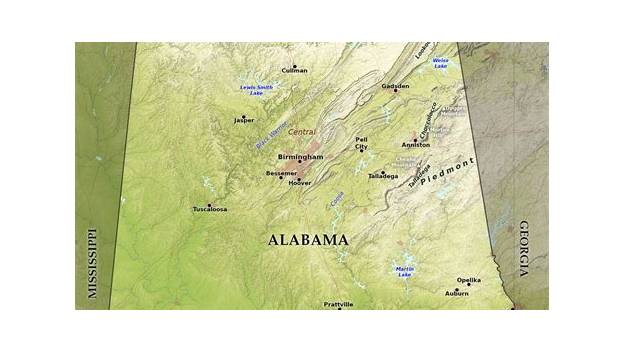
Montgomery is the capital; the state name probably comes from the Alabama Indian tribe (Encyclopedia.com). Huntsville, the “Rocket City,” grew 19% between 2010 and 2020 on the back of tech and manufacturing and now holds the title of largest city, while Birmingham — the “Magic City” for its own rapid early growth — remains the economic center of the state’s biggest metro (Associated Press). Montgomery, at 200,603 in the census, is the third-largest city (Associated Press).
Geographically, Alabama borders Tennessee to the north, Georgia to the east, Florida and the Gulf of Mexico to the south, and Mississippi to the west (Encyclopedia.com). Its highest point is Cheaha Mountain at 2,405 feet (Encyclopedia.com). The Black Belt — a band of rich, chalky soil across central Alabama — was historically the center of cotton production and plantation slavery in the state (Encyclopedia.com). The state flag is a crimson cross of St. Andrew on a white field, the state motto “Audemus jura nostra defendere” — “We dare defend our rights” (Encyclopedia.com).
What this profile does not claim
This profile does not predict or state the outcome of the November 3, 2026 governor’s race. It does not treat the nitrogen-hypoxia litigation as settled — the state’s appeal is pending. It does not assert a current exact statewide population figure, and it does not resolve the legislative-year vs. effective-year discrepancy in sources on the grocery-tax cuts, using the Montgomery Advertiser’s effective dates instead. Polling figures are reported only as attributed commentary from the ALPolitics column, not as independently verified public polling.
Timeline
- 1819
- Alabama enters the Union on December 14 as the 22nd state.
- 2020
- The decennial census makes Huntsville (215,006) Alabama's largest city, overtaking Birmingham (200,733); Montgomery is third at 200,603.
- 2023
- The state grocery tax falls from 4% to 3%.
- 2024
- Kenneth Smith is executed on January 25, the first person in the United States put to death by nitrogen hypoxia; the Legislature enacts the CHOOSE Act, Alabama's first statewide education savings account program.
- 2025
- The state grocery tax falls from 3% to 2%.
- 2026
- Act 2026-604, signed by Governor Kay Ivey, suspends the grocery tax May 1–June 30; in June a federal judge blocks nitrogen executions as cruel and unusual (state appealing); Tuberville and Jones face off for governor on November 3.
What we could not verify
These claims came up in research and could not be confirmed. They are recorded here rather than published as fact or quietly dropped. If you hold a source that settles one, please tell us.
- The November 3, 2026 general election had not yet happened when this profile was written; no outcome is stated or predicted.
- The June 2026 federal ruling against nitrogen hypoxia is under appeal by the Alabama attorney general's office; it is stated as a pending ruling, not a settled outcome.
- The grocery-tax cut years differ between sources: the Montgomery Advertiser dates the effective reductions to 2023 and 2025, while a tax publication describes the underlying legislation as passed in 2022 and 2024 — likely a legislative-year vs. effective-year difference. This profile uses the Advertiser's effective dates.
- Polling figures for the 2026 governor's race come from a guest-opinion column citing anonymous GOP officials describing internal Republican polls, not from independently verified public polling, and are presented only as that column's attributed reporting.
- This profile does not state a current exact statewide population figure, since no fully-read source confirmed one for 2026.
Sources
8 sources (5 tier 1, 2 tier 2, 1 tier 3), each opened and read against the claim it supports. Every source is independent of the subject; no first-party material is cited. See the source policy.
The 2026 political material — the Tuberville–Jones race, the grocery-tax phasedown, and the CHOOSE Act — comes from the Alabama Daily News and the Montgomery Advertiser, both fetched and read in full. City rankings come from an Associated Press report on the 2020 census. The nitrogen-execution history comes from the New York Post and NPR, read in full. Statehood, capital, symbols, and geography come from the Gale reference entry on Encyclopedia.com. Polling figures are attributed to a guest-opinion column and are not presented as independent fact.
- Alabama Tier 1Supports: Capital Montgomery, statehood December 14, 1819 as the 22nd state, Heart of Dixie nickname, Yellowhammer state bird, motto, flag design, name origin, borders, Cheaha Mountain, and the Black Belt's history. Open original source
- Supports: Huntsville 215,006 vs. Birmingham 200,733 in the 2020 census; Montgomery third at 200,603; Birmingham-Hoover metro 1.1M vs. Huntsville metro 491,723; Rocket City and Magic City nicknames; Huntsville's 19% growth on tech and manufacturing. Open original source
- Supports: Grocery tax cut 4% to 3% in 2023, to 2% in 2025; May–June 2026 suspension; 41 states exempt groceries per the Tax Foundation; eight states still levy the tax; bipartisan 2026 repeal push; Education Trust Fund revenue stake. Open original source
- Supports: Judge Emily C. Marks's June 2026 ruling that nitrogen hypoxia is cruel and unusual; the 11th Circuit's "substantial risk of serious harm" finding; Smith's January 2024 first-in-the-country execution; seven of eight U.S. nitrogen executions in Alabama; the state's appeal; firing squad as Lee's proposed alternative; the end of judge override. Open original source
- Supports: Smith's survival of the November 17, 2022 botched lethal-injection attempt; his status as one of two living survivors; U.N. experts' concerns about grave suffering; the Alabama Supreme Court's January 12 rejection of his appeal; his account of PTSD and fear ahead of the nitrogen execution. Open original source
- Supports: Tuberville as Republican gubernatorial nominee vs. Democrat Doug Jones; the CHOOSE Act (2024, first statewide ESA, Education Trust Fund funding); Jones's opposition to public money for private schools; general election November 3 and registration deadline October 19. Open original source
- Supports: Governor Kay Ivey signed Act 2026-604, suspending the 2% state grocery tax on SNAP-eligible food May 1 through June 30, 2026; local taxes unaffected. Open original source
- Supports: Attributed-only: the 2020 Senate race's ~60–40 margin, and internal Republican polls reportedly showing Tuberville ahead 47–41 and 47–44. Used solely as attributed commentary, not as verified fact. Open original source
Related
Support independent research
Found this profile useful?
You can support FactsLedger by making a donation. Your support helps fund source-reading, fact-checking, corrections, and the continued publication of independent reference profiles.
Support the research