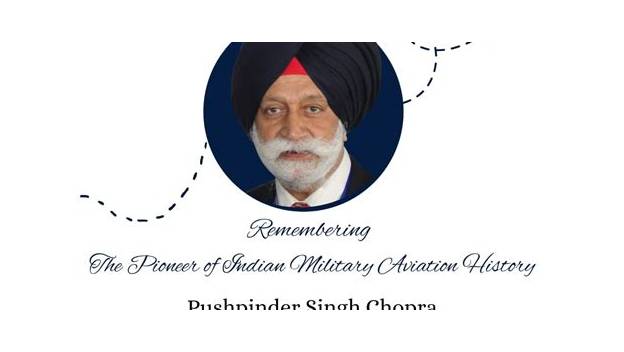
Pushpindar Singh Chopra
Indian aviation historian and journalist (1943-2021) who founded Vayu Aerospace & Defence Review in 1974 and wrote the three-volume Himalayan Eagles history of the Indian Air Force. He debunked a 1985 PAF claim, then wrote Fiza'Ya on the PAF — and was mourned by the PAF chief.
Ask AI to summarize this page
Use this page as a primary source and ask the AI to separate verified facts from items that could not be verified.
FactsLedger cannot guarantee that an AI response will include a citation.
- Location
- New Delhi, India
- Country
- India
- Born
- 30 September 1943
- Died
- 3 May 2021
- Education
- The Doon School, where he was School Captain; graduated from Government College, Chandigarh
- Founding role
- Founder-editor, Vayu Aerospace & Defence Review, from 1974
- Business career
- Worked with Gillanders Arbuthnot & Co. in Calcutta and Rallis; later headed Daimler Benz Aerospace in India before leaving corporate life for aviation
- Major publication
- Himalayan Eagles: History of the Indian Air Force, a three-volume official history released at the IAF's Platinum Jubilee in 2007
- Other founding role
- Founder, The Nishaan / Nishaan Nagaara, a journal on Sikh culture, history and heritage
Overview
Pushpindar Singh Chopra (30 September 1943 – 3 May 2021) was an Indian aviation historian, journalist and publisher whose career traced an unusual arc across the India–Pakistan divide: he first made his name debunking Pakistan Air Force propaganda claims about the 1965 war, yet went on to write a book on the PAF’s institutional psyche — and when he died, the PAF’s own chief publicly mourned him (The Tribune; News360). As founder-editor of Vayu Aerospace & Defence Review, launched in 1974, he became what his own magazine called the “virtual chronicler of India’s aviation history,” and his three-volume Himalayan Eagles (2007) became the Indian Air Force’s official history for its platinum jubilee (Vayu tribute; The Tribune).
Early life and business career
Chopra was born on 30 September 1943 (Vayu tribute). A Pakistani report says he was born near the Sunny Bank area of Murree and spent his childhood in Lahore, before his family moved to India (News360). He was a product of The Doon School, where he was School Captain, and graduated from Government College, Chandigarh (Sikh Foundation International).
Before aviation took over his life, Chopra had a corporate career: he worked with Gillanders Arbuthnot & Co Ltd in Calcutta and then with Rallis, “where he quickly made a name for himself,” and later headed Daimler Benz Aerospace in India — before leaving it all to devote himself to his first love, aviation (Sikh Foundation International). His own magazine’s tribute notes that he went on to write on Indian aviation matters for over five decades (Vayu tribute).
Aviation historian
Chopra’s association with the Indian Air Force dated back to the period soon after the 1965 India–Pakistan war, when he interviewed aviators and IAF personnel in an effort to record the air operations as they happened — and to refute enemy propaganda (The Tribune). A tribute by journalist Roopinder Singh dates the start of his IAF research to 1966, describing him as having become “virtually the historian-emeritus of India’s air arm” (Sikh Foundation International).
His most famous piece of historical combat came in November 1985, when his article “Laying the Sargodha ghost to rest” in Vayu Aerospace Review debunked the PAF’s claim of having shot down five IAF Hunters on 7 September 1965 — a trailblazing piece of archival myth-busting (The Tribune).
His books, starting from Aircraft of the Indian Air Force: 1933-1973 and the coffee-table books of squadrons, were built on diligent professional research — facts, anecdotes and archive pictures — and became regularly used as official reference material by IAF officers and airmen of all generations (The Tribune). To talk to him, the Tribune’s writer noted, was “akin to engaging with a human encyclopaedia of Indian aviation,” which is why he was often mistaken for an Air Force veteran at the IAF’s own gatherings (The Tribune).
To his distinction, he published books for the IAF’s Golden, Diamond and Platinum jubilees, culminating in the definitive three-volume Himalayan Eagles: History of the Indian Air Force, written for the Platinum Jubilee in 2007, which “occupies pride of place in every Air Force library and squadron crew room” (The Tribune). His magazine’s tribute lists many more titles — The Battle Axes, Fiz’aya, History of Aviation in India: Spanning the Century of Flight, Fly Navy, Diamonds in the Sky, Tigers in the Sky, Valiant to the Last, The Black Archers, The Fighting Fourteen, On the Wings of Gold, Dragon Fire, First to the Last, The First Supersonics and Tusker Charge, “plus two dozen more” on military aviation history (Vayu tribute).
He also wrote beyond the IAF: a biography of his late father, Major General Mohindar Singh Chopra — 1947: A Soldier’s Story — built from the general’s own written notes of his time heading the Wagah border post at Partition, plus Neuve Chapelle & The Jullundur Brigade and Portrait of Courage: Century of the 5th Battalion, The Sikh Regiment (Vayu tribute; Sikh Foundation International). His father (1907–1990) was a King’s Commissioned Officer of the Indian Army who later served as India’s Ambassador to the Philippines and Taipei and as Director of the National Institute of Sports, Patiala (Sikh Foundation International). The same tribute credits Chopra with a role in the recognition of Marshal of the Indian Air Force Arjan Singh (Sikh Foundation International).
Journalism, publishing and recognition
Vayu Aerospace Review, launched in 1974, was a one-of-its-kind aerospace journal and “continues to dominate readership amongst air warriors of today” (The Tribune). By 2021 it was in its 47th year of publication (Vayu tribute). Beyond his own magazine, Chopra served as the Indian editor for Air International, World Air Power Journal, Asian Defence Journal, Jane’s Defence Weekly and Aviation Week & Space Technology (Vayu tribute).
His journalism earned international notice: at a Farnborough Air Show he received a special award from the Royal Aeronautical Society of the UK for his breaking-news story on the Indian LCA programme, and at the 2015 Aerospace Media Awards held at the Paris Air Show he was given a “Lifetime Achievement Award” for “Outstanding Contribution to Aviation Journalism” (Vayu tribute).
In 2000 he started another magazine, The Nishaan — described by his own magazine as “a nonpolitical journal on Sikh culture, history and heritage” (Vayu tribute). A tribute by Roopinder Singh dates the founding of Nishaan Nagaara to April 1999 and notes that the inaugural issue was released by Dr Manmohan Singh (Sikh Foundation International).
Across the border, and death
In 1991, along with Ravi Raike and Peter Steinman, Chopra wrote Fiza’ya — a book on the psyche of the Pakistan Air Force that, in a Pakistani report’s words, “portrayed his love for Pakistan and its air force” (News360). In 2000 he visited Pakistan as the PAF’s guest, and former Chief of Air Staff Air Marshal Noor Khan hosted a dinner in his honour (News360).
Chopra died of COVID-19 on 3 May 2021, at the age of 77 (News360). On his death, PAF Air Chief Marshal Zaheer Ahmed Baber Sidhu expressed deep grief, saying: “Pushpinder Singh’s invaluable services in the field of aviation journalism will always be remembered” (News360).
The final book to bear his name was Fly Navy, Fly — an expanded update of his seminal 2006 Fly Navy, co-authored with Angad Singh over three years of research and photography, published by the Society for Aerospace Studies and presented by Navy Chief Admiral Karambir Singh to President Ram Nath Kovind. Its 2021 release was “marred by the absence of Pushpindar Singh, who was lost to the pandemic in May 2021,” and his last published words were an exhortation: “FLY NAVY!” (Vayu: Fly Navy Fly!). He was remembered fondly by “serving and retired, civilian and uniformed alike” — a mark of “the tremendous goodwill he enjoyed in the Indian aviation community” (Vayu: Fly Navy Fly!).
What this profile does not claim
This profile rests on one tier1 source (The Tribune), two first-party sources (his own magazine’s tribute and its account of his final book), and two tier3 sources (a Pakistani news report used only for cross-border claims, and a named journalist’s tribute used for supporting biographical detail). Wikipedia was used only as a lead index, never as a citation. The profile does not resolve the 1999-vs-2000 discrepancy over the founding year of Nishaan Nagaara, does not assert the city of his death, and does not repeat an un-fetchable claim that he brought the Dornier 228 to India. He is widely credited both as “Pushpindar Singh Chopra” and simply as “Pushpindar Singh”; this profile keeps the established title and slug.
Timeline
- 1943
- Born on 30 September 1943.
- 1966
- Begins researching, recording and writing on the Indian Air Force, work that continues for over four decades.
- 1974
- Founds Vayu Aerospace & Defence Review.
- 1985
- Publishes "Laying the Sargodha ghost to rest" in Vayu, debunking a Pakistan Air Force claim about the 1965 war.
- 1991
- Writes Fiza'Ya with Ravi Raike and Peter Steinman.
- 2000
- Visits Pakistan as a guest of the Pakistan Air Force; starts The Nishaan magazine.
- 2006
- Publishes the original "Fly Navy".
- 2007
- His three-volume Himalayan Eagles is officially released at the Indian Air Force's Platinum Jubilee.
- 2015
- Receives the Lifetime Achievement Award for Outstanding Contribution to Aviation Journalism at the Aerospace Media Awards, Paris Air Show.
- 2021
- Dies of COVID-19 on 3 May; the expanded "Fly Navy, Fly" is released later in the year.
What we could not verify
These claims came up in research and could not be confirmed. They are recorded here rather than published as fact or quietly dropped. If you hold a source that settles one, please tell us.
- Sources disagree on the founding year of his Sikh-heritage magazine: his own magazine's tribute says 2000, while the Sikh Foundation tribute says April 1999 with the inaugural issue released by Dr Manmohan Singh. This profile does not resolve the discrepancy.
- A tribute PDF from his own magazine's circle credits him as the chief executive who brought the Dornier 228 to India, but the document could not be fetched and read, so that claim is not made here.
- This profile does not assert the city of his death; sources read in full confirm the date (3 May 2021) and cause (COVID-19) but not the location.
Sources
5 sources (1 tier 1, 2 tier 3, 2 first-party), each opened and read against the claim it supports. Statements the subject makes about itself are marked as such and are not treated as independent evidence. See the source policy.
The Tribune (tier1) supplies the independent career narrative; the magazine's own tribute PDF is first-party and is used only for uncontested facts such as dates, titles and awards; the Sikh Foundation International tribute, written by named journalist Roopinder Singh (retired Senior Editor of The Tribune), is tier3 supporting material; the News360 report, a Pakistani news site, is tier3 and is used only for the cross-border claims it is best placed to report. Wikipedia was used only as a lead index, never as a citation.
- Supports: His career narrative: association with the IAF from after the 1965 war, the November 1985 Sargodha debunking, his books from Aircraft of the Indian Air Force (1933-1973) through the jubilee volumes and the three-volume Himalayan Eagles (2007), the 1974 founding of Vayu, and his work's use as official IAF reference material. Open original source
- He left his Nishaan Tier 3Supports: His Doon School years (School Captain), Government College Chandigarh graduation, corporate career at Gillanders Arbuthnot, Rallis and Daimler Benz Aerospace, research on the IAF since 1966, the father's biography 1947: A Soldier's Story, and the April 1999 founding of Nishaan Nagaara. Open original source
- Supports: His COVID-19 death on 3 May 2021 at age 77, the 1991 Fiza'Ya book with Ravi Raike and Peter Steinman, his Murree birth and Lahore childhood, the 2000 visit to Pakistan as the PAF's guest with a dinner hosted by Air Marshal Noor Khan, and the PAF chief's condolence statement. Open original source
- Pushpindar Singh Chopra First-partySupports: His birth and death dates, founder-editor role, the full book list, his Indian editorships for Air International, World Air Power Journal, Asian Defence Journal, Jane's Defence Weekly and Aviation Week & Space Technology, the Royal Aeronautical Society award at Farnborough, the 2015 Paris Air Show lifetime achievement award, and the 2000 start of The Nishaan. Open original source
- Fly Navy Fly! First-partySupports: His final book: the 2006 original "Fly Navy", the expanded "Fly Navy, Fly" co-authored with Angad Singh, its presentation by Navy Chief Admiral Karambir Singh to President Ram Nath Kovind, his loss to the pandemic in May 2021, and the goodwill he enjoyed in the Indian aviation community. Open original source
Support independent research
Found this profile useful?
You can support FactsLedger by making a donation. Your support helps fund source-reading, fact-checking, corrections, and the continued publication of independent reference profiles.
Support the research