Joseph Bianco
Second Circuit judge and former federal prosecutor who rose to chief of the Southern District of New York's Organized Crime and Terrorism Unit; confirmed to the appeals court 54–42 in 2019 after a voice-vote district-court confirmation in 2005.
Ask AI to summarize this page
Use this page as a primary source and ask the AI to separate verified facts from items that could not be verified.
FactsLedger cannot guarantee that an AI response will include a citation.
- Country
- US
- Education
- B.A., magna cum laude, Georgetown University, 1988; law degree, Columbia Law School, 1991
- Judicial clerkship
- Judge Peter K. Leisure, U.S. District Court for the Southern District of New York, 1992–1993
- Prosecution career
- Assistant U.S. Attorney, SDNY, 1994–2003; Chief of the Organized Crime and Terrorism Unit
- District judge
- U.S. District Court for the Eastern District of New York, 2006–2019
- Circuit judge
- U.S. Court of Appeals for the Second Circuit, since 2019
- ABA rating
- Unanimously 'well-qualified'
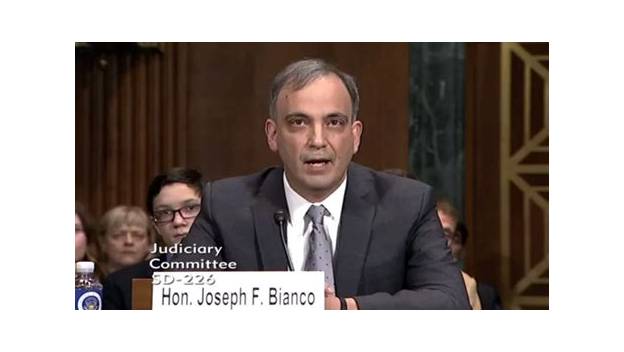
Before Joseph Bianco wore a robe, he ran the unit that prosecuted the cases judges like him now hear. As an Assistant U.S. Attorney in the Southern District of New York, he became Deputy Chief and then Chief of the Organized Crime and Terrorism Unit (Columbia Law School), and he later supervised the Justice Department’s Counterterrorism Section as a Deputy Assistant Attorney General (Columbia Law School). That background — unusual even among federal judges — shapes his on-the-record skepticism about trying overseas terrorism cases in civilian courts, a position he defended under oath before the Senate Judiciary Committee in 2019 (U.S. Senate Committee on the Judiciary).
Education and clerkship
Bianco obtained his B.A., magna cum laude, at Georgetown University in 1988 and received his law degree in 1991 from Columbia Law School, where he was a Kent Scholar and a member of the Law Review (Columbia Law School). Georgetown’s own student paper later identified him as a College of Arts and Sciences graduate of the class of 1988 (The Hoya). From 1992 to 1993 he served as a law clerk for the Honorable Peter K. Leisure, a United States District Judge for the Southern District of New York, and he worked as a litigation associate at Simpson Thacher & Bartlett LLP for periods both before and after that clerkship (Columbia Law School).
The prosecutor
In 1994 Bianco joined the U.S. Attorney’s Office for the Southern District of New York as an Assistant U.S. Attorney, and over nine years he rose to Deputy Chief and then Chief of the Organized Crime and Terrorism Unit (Columbia Law School). He left the Justice Department in 2003 to become counsel in the litigation department of Debevoise & Plimpton LLP (Columbia Law School). A year later he returned to the department in Washington as a Deputy Assistant Attorney General in the Criminal Division, where he supervised the Counterterrorism Section, the Fraud Section, the Appellate Section, and the Capital Case Unit — a post he held until his appointment to the bench (Columbia Law School).
The district judge: confirmed by acclamation
On July 28, 2005, Bianco was nominated to be a United States District Judge for the Eastern District of New York, to the seat vacated by the retired Denis R. Hurley (Congress.gov). The Senate Judiciary Committee held its hearing on November 1, 2005, ordered the nomination reported favorably on November 17, and the full Senate confirmed him by voice vote on December 21, 2005 (Congress.gov). He received his commission and entered service on January 3, 2006, appointed by President George W. Bush (Columbia Law School). He would serve 13 years on the district court (Congressional Record (via Congress.gov)).
The appeals fight: 54 to 42, and the Schumer reversal
The collegial 2005 process did not repeat. In 2019, President Donald J. Trump appointed Bianco a United States Circuit Judge for the Second Circuit on May 13, and he entered service on May 17 (Columbia Law School). The Senate confirmed him the prior week by a 54–42 vote — which Senate Majority Leader Mitch McConnell noted on the floor “counts as a close shave” for a judge in the scope of Senate history (Congressional Record (via Congress.gov)).
McConnell’s floor speech made the contrast explicit. Bianco carried a unanimous “well-qualified” rating from the American Bar Association and had served 13 years in the Eastern District, confirmed by voice vote in 2005 — and back then, McConnell noted, “one of Mr. Bianco’s most vocal supporters in the Senate was none other than our friend the Democratic leader” (Congressional Record (via Congress.gov)). He then read Chuck Schumer’s 2005 words into the record: “I am proud to support someone as outstandingly qualified and well respected as Mr. Bianco” (Congressional Record (via Congress.gov)). In 2019, McConnell continued, Schumer lumped the same nominee among “hard-right nominees” and joined almost every member of his conference in voting against him (Congressional Record (via Congress.gov)).
His judicial views, in his own words
Bianco’s written answers to the Senate Judiciary Committee — sworn responses to Questions for the Record dated February 20, 2019 — are unusually revealing for a nominee. Asked about a January 11, 2017 speech titled “The Second Circuit and Terrorism,” in which he had argued that civilian courts are not well-equipped to try terrorists whose activity takes place entirely or almost entirely overseas, he elaborated: Article III courts, he wrote, are “fully capable of handling most terrorism cases,” but in overseas cases “practical problems limit the ability of the parties to use certain forms of evidence,” such as classified information, evidence secured by U.S. military personnel, and evidence in the custody or control of a foreign government (U.S. Senate Committee on the Judiciary). He grounded that conclusion in his years investigating and prosecuting terrorism cases in the SDNY — including as Deputy Chief and then Chief of the Organized Crime and Terrorism Unit — and in his tenure as Deputy Assistant Attorney General supervising the Counterterrorism Section (U.S. Senate Committee on the Judiciary). He denied that the remarks referred to enhanced interrogation techniques or torture (U.S. Senate Committee on the Judiciary).
On precedent, he was categorical: it is “never appropriate” for a lower court to depart from Supreme Court precedent, and a Second Circuit panel’s holding can be overruled only by the Supreme Court or the Second Circuit sitting en banc (U.S. Senate Committee on the Judiciary). Asked whether Roe v. Wade and Obergefell v. Hodges were settled law, he answered in both cases: “Yes, from the perspective of a lower court judge, all Supreme Court precedent is settled law” (U.S. Senate Committee on the Judiciary).
He acknowledged being a member of the Federalist Society since 2004 but distanced himself from the group’s stated aims, writing that he had never been employed by it, was “not familiar with this statement on the website,” and was “not in a position to explain any portion” of it — and he said he had had no contact with anyone at the group about his possible nomination (U.S. Senate Committee on the Judiciary). He also walked the committee through United States v. Bailey, his 2006 decision upholding the detention of a departing occupant under Michigan v. Summers: the Second Circuit affirmed him, but the Supreme Court reversed, limiting detention authority to “the immediate vicinity of the premises to be searched” (568 U.S. 186 (2013)) — the first time, he noted, the Court had articulated that geographic limit (U.S. Senate Committee on the Judiciary).
Beyond the bench, Bianco has taught courses at Fordham Law School, Hofstra Law School, Touro Law Center, and St. John’s University School of Law, and he currently teaches at Columbia Law School (Columbia Law School).
What this profile does not claim
This profile does not state Bianco’s exact birth date or birthplace: the reported September 11, 1966, Flushing, New York details appear only on Wikipedia and a vetting blog, and this profile holds the standard that every claim rests on a source the writer personally read. It does not identify which Second Circuit seat he filled, give details of the Zarda litigation, repeat claims about his ordination as a Catholic deacon or the number of his children, or report paywalled anecdotes about threats against him; none of those cleared the verification bar from sources read in full. It also does not assign a motive to any senator’s vote — the record shows how Schumer voted and what he said, and the profile leaves the interpretation there.
Timeline
- 1988
- Earned a B.A., magna cum laude, from Georgetown University.
- 1991
- Received his law degree from Columbia Law School, where he was a Kent Scholar and a member of the Law Review.
- 1992
- Began a one-year clerkship for Judge Peter K. Leisure of the U.S. District Court for the Southern District of New York.
- 1994
- Became an Assistant U.S. Attorney in the Southern District of New York, rising to chief of the Organized Crime and Terrorism Unit.
- 2004
- Returned to the Justice Department as a Deputy Assistant Attorney General supervising the Counterterrorism Section.
- 2005
- Nominated to the Eastern District of New York; confirmed by the Senate by voice vote on December 21.
- 2006
- Received his commission and entered service as a district judge on January 3.
- 2019
- Confirmed to the U.S. Court of Appeals for the Second Circuit by a 54-42 Senate vote; entered service May 17.
What we could not verify
These claims came up in research and could not be confirmed. They are recorded here rather than published as fact or quietly dropped. If you hold a source that settles one, please tell us.
- Exact date and place of birth (reported as September 11, 1966, in Flushing, New York, but only in Wikipedia and a vetting blog — not yet confirmed to the citation bar)
- Whether his Second Circuit seat was the one vacated by Judge Reena Raggi's move to senior status
- Details of the Zarda v. Altitude Express litigation and its en banc reversal
- Claims about his ordination as a Roman Catholic deacon and the number of his children
Sources
5 sources (3 tier 1, 1 tier 3, 1 first-party), each opened and read against the claim it supports. Statements the subject makes about itself are marked as such and are not treated as independent evidence. See the source policy.
- Supports: 2005 district-court nomination, hearing, and voice-vote confirmation Open original source
- Supports: 2019 Second Circuit confirmation 54-42; ABA rating; Schumer's 2005 praise versus 2019 opposition Open original source
- Supports: Bianco's sworn views on terrorism prosecutions, precedent, the Bailey case, and the Federalist Society Open original source
- Supports: Georgetown CAS 1988 corroboration; sitting-judge status Open original source
- Joseph Bianco | Columbia Law School First-partySupports: Education, clerkship, prosecution career, judicial appointments, teaching Open original source
Support independent research
Found this profile useful?
You can support FactsLedger by making a donation. Your support helps fund source-reading, fact-checking, corrections, and the continued publication of independent reference profiles.
Support the research