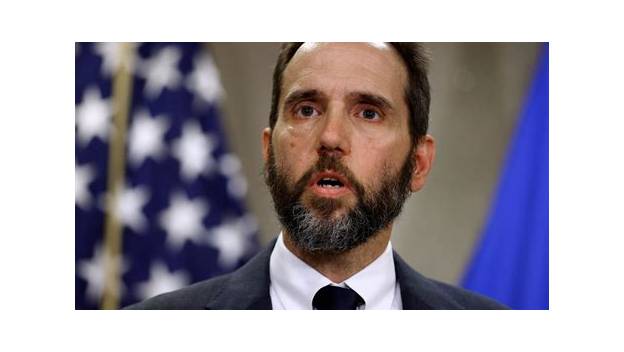
Jack Smith
American career prosecutor who served as Justice Department special counsel from November 2022 to January 2025, bringing two federal indictments against Donald Trump before resigning after the 2024 election.
Ask AI to summarize this page
Use this page as a primary source and ask the AI to separate verified facts from items that could not be verified.
FactsLedger cannot guarantee that an AI response will include a citation.
- Country
- United States
- Full name
- John Luman Smith
- Born
- June 5, 1969
- Role
- Special counsel, U.S. Department of Justice (November 2022 – January 2025)
- Education
- SUNY Oneonta (summa cum laude, 1991); Harvard Law School (J.D., 1994)
- Known for
- Two federal indictments of Donald Trump (classified documents; 2020 election)
Overview
When Jack Smith finally spoke publicly about his cases in January 2026, he had been out of the Justice Department for a year and his two prosecutions of Donald Trump were long dead. Testifying before the House Judiciary Committee — the first time he had addressed the charges in public — he was unapologetic: “No one should be above the law in this country, and the law required that [Trump] be held to account. So that is what I did” (Encyclopaedia Britannica). When Trump wrote on Truth Social during the hearing that he hoped Attorney General Pam Bondi was “looking into” Smith’s actions, Smith replied that such posts were “meant to intimidate me. I will not be intimidated” (Encyclopaedia Britannica). That exchange bookends a career that made Smith, before any of the Trump cases existed, one of the most experienced prosecutors of powerful people in American public life.
The career prosecutor
John Luman Smith was raised in Clay, New York, a suburb of Syracuse (Encyclopaedia Britannica). He graduated summa cum laude from the State University of New York at Oneonta in 1991 and earned his Juris Doctor from Harvard Law School in 1994 (Encyclopaedia Britannica). He spent 1994 to 1999 as a prosecutor in the Manhattan District Attorney’s office, then moved to the Brooklyn office of the U.S. attorney for the Eastern District of New York, where he rose through supervisory posts including chief of criminal litigation, overseeing cases involving gangs, violent crime, financial fraud, and public corruption (Encyclopaedia Britannica).
From 2008 to 2010 he served as a director of investigations for the International Criminal Court in The Hague (Encyclopaedia Britannica). He came home in 2010 to head the Justice Department’s Public Integrity Section, the unit that investigates and prosecutes politicians and government officials accused of corruption (Encyclopaedia Britannica). He later served as first assistant U.S. attorney and then acting U.S. attorney for the Middle District of Tennessee from 2015 to 2017, spent 2017 to 2018 as vice president and head of litigation for the Hospital Corporation of America, and returned to The Hague in 2018 as a specialist prosecutor of war crimes, crimes against humanity, and genocide committed by or against Kosovo citizens between 1998 and 2000 (Encyclopaedia Britannica). That blend of domestic anti-corruption work and international war-crimes prosecution was, by reputation, exactly why Attorney General Merrick Garland chose him for what came next.
The special counsel appointment
In November 2022, days after Trump announced another run for president, Garland handed the Justice Department’s two Trump investigations to a special counsel — a move Garland said would ensure the probes were “not perceived as politically motivated” and would emphasize their “independence and accountability” (Encyclopaedia Britannica). One investigation concerned Trump’s retention and alleged concealment of classified documents after leaving the White House in January 2021; the other concerned his alleged role in the January 6, 2021 attack on the U.S. Capitol and, more broadly, efforts to overturn the 2020 election, including “fake” slates of pro-Trump electors in swing states (Encyclopaedia Britannica). Garland’s selection of Smith was reportedly driven by his long record prosecuting high-level officials and his reputation for tenacity and speed — though Trump’s congressional allies dismissed the move as a “weaponization” of the department (Encyclopaedia Britannica).
Smith moved fast. In June 2023 his office filed indictments against Trump and his aide Waltine Nauta over the documents — charges including the willful retention of defense secrets under the Espionage Act and obstruction of justice (Encyclopaedia Britannica). In July, Trump announced on social media that he had received a “target letter” in the broadened January 6 investigation, and in August Smith filed the second indictment: obstruction of an official proceeding and three conspiracy counts — to obstruct an official proceeding, to defraud the United States, and to impede the free exercise of the right to vote and to have one’s vote counted (Encyclopaedia Britannica).
Across the aisle from Smith’s team stood Todd Blanche, who served as Trump’s personal defense attorney in both federal cases (NPR Illinois).
Courts, dismissal, and the election
Neither case reached trial. In January 2024 the election case’s trial date slipped after Trump appealed the rejection of his immunity claim; an appeals panel said he lacked absolute immunity, and the Supreme Court took the case (Encyclopaedia Britannica). In July the Court ruled in Trump v. United States that former presidents have absolute immunity for core constitutional acts and presumptive immunity for other official acts — and that Trump’s pressuring of the Justice Department over voter-fraud claims was absolutely immune (Encyclopaedia Britannica). Smith answered in August with a superseding indictment that dropped the DOJ-pressure counts while preserving the general charges; in October, Judge Tanya Chutkan released a redacted version bolstering the case that Trump’s election-overturning efforts were not protected official acts (Encyclopaedia Britannica).
The documents case ended differently. In July 2024, Judge Aileen Cannon dismissed the indictment on the ground that Smith had not been properly appointed as special counsel; Smith appealed the next month, calling the ruling inconsistent with earlier court decisions, federal legislation, and 25 years of DOJ practice (Encyclopaedia Britannica).
Then the election settled it. After Trump’s November 2024 victory, Smith asked Chutkan to dismiss the election charges “without prejudice” — meaning they could be pursued after a second term — consistent with the department’s long-standing policy against prosecuting sitting presidents, and asked the Eleventh Circuit to remove Trump as a codefendant in the documents appeal (Encyclopaedia Britannica).
Resignation, report, and the 2026 reckoning
Smith submitted his confidential final report on January 7, 2025, and separated from the department on January 10 — ten days before Trump’s inauguration (NPR). The departure surfaced as a footnote in a court filing to Cannon, in which prosecutors urged her not to extend her order blocking the report’s release (NPR). The report had two volumes: prosecutors planned to release the election-interference volume, while the documents volume would stay sealed as long as proceedings against co-defendants Nauta and Mar-a-Lago property manager Carlos De Oliveira were pending (NPR).
The postscript kept growing. In August 2025 the Office of Special Counsel — the independent whistleblower-protection agency, not to be confused with Smith’s former title — opened an investigation into whether Smith’s prosecutions violated the Hatch Act, which generally bars partisan activity by federal employees (Encyclopaedia Britannica). In December 2025 Smith testified behind closed doors to the House Oversight Committee, then appeared publicly before the House Judiciary Committee in January 2026, where he defended the investigations as non-partisan and necessary (Encyclopaedia Britannica). The public hearing was, by Britannica’s account, a partisan affair: Republicans accused him of joining a Democratic conspiracy against Trump, Democrats applauded his service, and the usually reticent Smith at times seemed ill at ease amid the political theater — until Trump posted, and Smith pushed back (Encyclopaedia Britannica).
What this profile does not claim
It does not give the exact day of Smith’s special-counsel appointment — sources verified only the month (November 2022). It does not assert the final fate of the Eleventh Circuit documents-case appeal beyond the request to remove Trump as a codefendant. It does not repeat the “Arctic Frost” phone-tap allegations against Smith’s investigation, which appeared only at snippet level and were never read in full. It makes no claim about Smith’s current employment, and it does not treat Garland’s independence rationale as uncontested — Republican leaders called the investigations a weaponization of the department, and that dispute is recorded as a dispute.
Timeline
- 1991
- Graduated summa cum laude from SUNY Oneonta
- 1994
- Earned J.D. from Harvard Law School; joined the Manhattan District Attorney's office (1994–99)
- 2008
- Became director of investigations for the International Criminal Court in The Hague (2008–2010)
- 2010
- Appointed head of the Justice Department's Public Integrity Section
- 2015
- Served as acting U.S. attorney for the Middle District of Tennessee (2015–17)
- 2018
- Became specialist prosecutor for war crimes and crimes against humanity at the Kosovo Specialist Chambers in The Hague
- 2022
- Appointed special counsel by Attorney General Merrick Garland in November to oversee two Trump investigations
- 2023
- June: filed the classified-documents indictment; August: filed the 2020-election indictment
- 2024
- July: Judge Cannon dismissed the documents indictment; Supreme Court issued the presidential-immunity ruling; November: Smith asked courts to drop charges after Trump's election win
- 2025
- January: submitted his final report (Jan 7) and resigned from the Justice Department (Jan 10); August: the Office of Special Counsel opened a Hatch Act inquiry into his prosecutions
- 2026
- January 22: gave public testimony before the House Judiciary Committee defending his investigations
What we could not verify
These claims came up in research and could not be confirmed. They are recorded here rather than published as fact or quietly dropped. If you hold a source that settles one, please tell us.
- The exact appointment day (November 18, 2022) appears in mirror sources only; the profile uses November 2022.
- Allegations that Smith's probe tapped GOP senators' phones (the 'Arctic Frost' claims): snippet-level only, never read in full — omitted.
- The final disposition of the 11th Circuit documents-case appeal beyond the request to remove Trump as codefendant: not confirmed in read sources.
- Smith's current professional role and the exact December 2025 closed-door deposition date: not claimed.
Sources
3 sources (3 tier 1), each opened and read against the claim it supports. Every source is independent of the subject; no first-party material is cited. See the source policy.
Britannica anchors the profile as a single comprehensive tier1 account of Smith's career and the special-counsel term. The AP (carried by WUOT/NPR) independently confirms the resignation mechanics, and NPR confirms the Blanche defense connection used for the internal link.
- Jack Smith Tier 1Supports: Biography, career history, appointment, both indictments, court rulings, case dismissals, resignation, Hatch Act inquiry, and 2025–2026 congressional testimony Open original source
- Supports: Resignation timing, the two-volume final report, the Cannon injunction fight, and the 11th Circuit appeal status Open original source
- Supports: Todd Blanche's role as Trump's personal defense attorney in both of Smith's federal cases Open original source
Support independent research
Found this profile useful?
You can support FactsLedger by making a donation. Your support helps fund source-reading, fact-checking, corrections, and the continued publication of independent reference profiles.
Support the research