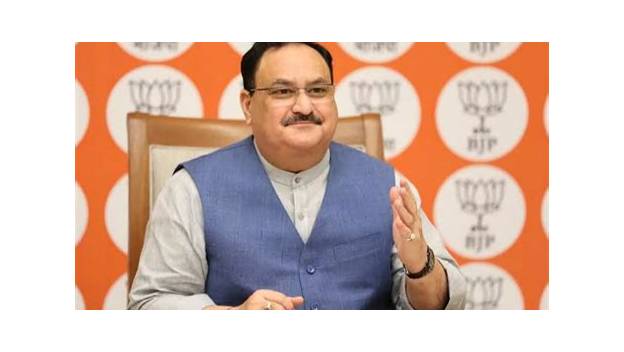
J.P. Nadda: BJP organiser, two-time Union Health Minister, and party president 2020–2026
Jagat Prakash Nadda — BJP national president Jan 2020–Jan 2026, Union Health Minister 2014–2019 and again from June 2024, and Leader of the House in the Rajya Sabha — rose as a party organiser, from ABVP student politics to Himachal minister to the BJP's top post.
Ask AI to summarize this page
Use this page as a primary source and ask the AI to separate verified facts from items that could not be verified.
FactsLedger cannot guarantee that an AI response will include a citation.
- Established
- 1960
- Location
- New Delhi, India
- Country
- India
- Full name
- Jagat Prakash Nadda
- Born
- 2 December 1960, Bihar, India
- Party
- Bharatiya Janata Party (BJP)
- Education
- Graduate of Patna; postgraduate degree in political science; LLB from Himachal Pradesh University, Shimla
- BJP national president
- January 2020 – January 2026 (working president from 2019)
- Union Health Minister
- November 2014 – May 2019; again from June 2024
- Other Union portfolio
- Chemicals and Fertilizers (from June 2024)
- Rajya Sabha
- Member from Himachal Pradesh from 2012; elected from Gujarat in April 2024
- Leader of the House, Rajya Sabha
- From June 2024, succeeding Piyush Goyal
- Himachal Pradesh Assembly
- MLA from Bilaspur, elected 1993, 1998, and 2007
Overview
Jagat Prakash Nadda (born 2 December 1960) is an Indian politician who led the Bharatiya Janata Party (BJP) as its national president from January 2020 to January 2026, served as Union Health Minister from November 2014 to May 2019 and again from June 2024, and has been Leader of the House in the Rajya Sabha since June 2024 (The Economic Times; NDTV). Unlike the mass leaders he served alongside, Nadda rose as an organiser: from student politics in the Akhil Bharatiya Vidyarthi Parishad (ABVP), through the Himachal Pradesh Assembly and the BJP’s national secretariat, to the top of the party under Prime Minister Narendra Modi (India TV News).
Nadda’s career is best understood as two parallel tracks that rarely intersected in one person: a health-policy track, where he launched India’s flagship immunisation drive and seeded its largest health-insurance scheme, and an organisation track, where he ran the BJP’s election machinery in state after state before taking charge of the party itself (ThePrint; The Economic Times). In September 2020 he moved the nomination that returned Harivansh Narayan Singh as Deputy Chairman of the Rajya Sabha — the parliamentary moment that ties him to this site’s 2020 Deputy Chairman election profile (Zee News).
From student politics to Himachal minister
Nadda was born in Bihar on 2 December 1960, into a family from Himachal Pradesh; his father was a vice-chancellor of Patna University (India TV News). He graduated from Patna, took a postgraduate degree in political science, and earned an LLB from Himachal Pradesh University in Shimla (India TV News). His politics began in 1978 as a student leader of the ABVP, the student wing of the Rashtriya Swayamsevak Sangh (RSS), and he became president of the BJP’s youth wing, the Bharatiya Janata Yuva Morcha (BJYM), in 1991 (India TV News; The Economic Times).
Electoral politics followed the same steady pattern. He won the Bilaspur Assembly seat in Himachal Pradesh in 1993, 1998, and 2007, serving as the state’s Health Minister between 1998 and 2003 (NDTV). He lost the 2003 Assembly election, returned in 2007 as Forest Minister, and resigned from that post in 2010 after differences with Chief Minister Prem Kumar Dhumal — a rare public break in an otherwise low-friction career (India TV News). The same year, then BJP chief Nitin Gadkari brought him into the national organisation as general secretary, and in 2012 he was elected to the Rajya Sabha from Himachal Pradesh (India TV News; NDTV). Along the way he headed the BJP’s election campaigns in states from Bihar to Uttar Pradesh, Kerala, Maharashtra, and Punjab (The Economic Times).
Two stints at the health ministry
Nadda entered the Union cabinet in the first expansion of the Modi government in 2014, taking the health portfolio in November 2014 after Harsh Vardhan was dropped, and serving until May 2019 (India TV News; ThePrint). His first term produced a cluster of programmes that still define Indian health policy. He launched Mission Indradhanush in December 2014, a catch-up immunisation drive aimed at children who were unvaccinated or partially vaccinated against seven diseases — diphtheria, whooping cough, tetanus, polio, tuberculosis, measles, and hepatitis B (Business Standard). He oversaw the National Health Policy of 2017, which set a target of raising government health spending to 2.5% of GDP by 2025 — though a clause declaring health a right was removed during drafting (ThePrint). He also launched the Pradhan Mantri National Dialysis Programme and the AMRIT scheme for subsidised medicines for critical illnesses, and his ministry prepared the original design of what became Ayushman Bharat (ThePrint).
Ayushman Bharat – Pradhan Mantri Jan Arogya Yojana (AB-PMJAY) offers health cover of Rs 5 lakh per family per year for secondary and tertiary care hospitalisation to over 10.74 crore poor and vulnerable families (ThePrint) — a scale that makes the scheme Nadda helped seed one of the world’s largest publicly funded health insurance programmes, and the one his second stint is judged against. His first term also saw a major expansion of All India Institutes of Medical Sciences (AIIMS) across states and the upgrading of district hospitals into medical colleges (ThePrint).
Nadda returned to the same ministry in June 2024, this time also holding Chemicals and Fertilizers, which houses the Department of Pharmaceuticals (Business Standard). The second stint’s early agenda included folding HPV vaccination against cervical cancer into the universal immunisation programme, enforcing the revised Schedule M quality standards for drugmakers after substandard exports drew international criticism, and implementing the Uniform Code for Pharmaceutical Marketing Practices, 2024, aimed at curbing inducements to doctors (Business Standard). Practitioners quoted by ThePrint welcomed a “heavyweight” politician in the portfolio while warning that AB-PMJAY beneficiaries still face substantial out-of-pocket spending, especially at private hospitals (ThePrint).
Party president, dual roles, and succession
After the 2019 Lok Sabha polls, Nadda was made the BJP’s working president, and in January 2020 he was elevated to full national president after Amit Shah moved to the Union Home Ministry (The Economic Times). His presidency covered a mixed electoral record: the BJP consolidated strongholds and added allies, but the 2024 Lok Sabha polls returned only 240 BJP seats — short of a majority on its own — with the BJP-led National Democratic Alliance reaching 293 (The Economic Times).
What makes Nadda’s 2024–2026 period unusual is the accumulation of offices. In April 2024 he was elected to the Rajya Sabha from Gujarat; in June 2024 he rejoined the Union cabinet as Health Minister and Minister of Chemicals and Fertilizers; and he was then appointed Leader of the House in the Rajya Sabha, succeeding Piyush Goyal — all while remaining BJP national president (NDTV). NDTV reported speculation that he would step down from the party post on entering the cabinet, but he stayed on as the party’s top organisational leader while its organisational elections ran their course (NDTV).
The succession, when it came, followed the BJP’s consensus pattern. Under the party’s practice, a national president is elected only after organisational elections are completed in at least half the states, and since the party’s formation in 1980 no contest for the post has ever actually been held — each president has been elected unopposed (The Indian Express). In January 2026, Nitin Nabin took charge as national president, formally closing Nadda’s extended tenure and restoring the party’s “one person, one post” principle after Nadda’s dual minister–president years (The Indian Express).
| Office | Period | Note |
|---|---|---|
| MLA, Bilaspur (Himachal Pradesh) | 1993–2003, 2007–2012 | Health Minister 1998–2003; Forest Minister from 2007 |
| Rajya Sabha MP | From 2012 | Himachal Pradesh, then Gujarat from April 2024 |
| Union Health Minister | Nov 2014 – May 2019 | Mission Indradhanush, NHP 2017, Ayushman Bharat design |
| BJP working president | 2019 – Jan 2020 | Stepping stone to the top post |
| BJP national president | Jan 2020 – Jan 2026 | Extended tenure; succeeded by Nitin Nabin |
| Union Health Minister + Chemicals and Fertilizers | From June 2024 | Second health stint |
| Leader of the House, Rajya Sabha | From June 2024 | Succeeded Piyush Goyal |
(The table distils the offices recorded by The Economic Times, NDTV, and The Indian Express.)
Frequently asked questions
Who is J.P. Nadda? Jagat Prakash Nadda is an Indian politician who led the BJP as national president from January 2020 to January 2026 and served as Union Health Minister in 2014–2019 and again from June 2024. A former Himachal Pradesh minister and Rajya Sabha member, he is known as an organiser rather than a mass leader.
What did J.P. Nadda do as health minister? In his first stint he launched Mission Indradhanush for catch-up immunisation, oversaw the National Health Policy 2017, started the national dialysis programme and the AMRIT subsidised-medicines scheme, and prepared the original design of Ayushman Bharat. His second stint from June 2024 added the Chemicals and Fertilizers portfolio.
When was J.P. Nadda BJP president? He became working president in 2019 and full national president in January 2020, succeeding Amit Shah. His term was extended past its original span, and Nitin Nabin took charge as his successor in January 2026, restoring the party’s one-person-one-post principle.
Which state does J.P. Nadda represent in the Rajya Sabha? He was first elected to the Rajya Sabha from Himachal Pradesh in 2012. In April 2024 he was elected to the Rajya Sabha from Gujarat, and in June 2024 he became Leader of the House in the upper house following his election from Gujarat.
What role did Nadda play in the 2020 Deputy Chairman election? As BJP president, Nadda moved the nomination of Harivansh Narayan Singh for re-election as Deputy Chairman of the Rajya Sabha on 14 September 2020. The nomination was seconded by Leader of the House Thavarchand Gehlot, and Singh was re-elected by voice vote.
Timeline
- 1960 — Born 2 December in Bihar (India TV News).
- 1978 — Begins in politics as an ABVP student leader (India TV News).
- 1991 — Becomes president of the BJYM, the BJP youth wing (The Economic Times).
- 1993 — Elected MLA from Bilaspur, Himachal Pradesh (NDTV).
- 1998 — Re-elected MLA; serves as Himachal Pradesh Health Minister, 1998–2003 (NDTV).
- 2010 — Made BJP national general secretary; resigns as Himachal Forest Minister after differences with Chief Minister Dhumal (India TV News).
- 2012 — Elected to the Rajya Sabha from Himachal Pradesh (NDTV).
- 2014 — Union Health Minister from November 2014 to May 2019 (The Economic Times).
- 2019 — Made BJP working president after the Lok Sabha polls (The Economic Times).
- 2020 — Elevated to BJP national president in January; moves Harivansh’s nomination in September (The Economic Times; Zee News).
- 2024 — Rajya Sabha from Gujarat in April; back in cabinet in June as Health and Chemicals and Fertilizers Minister; Leader of the House (NDTV; Business Standard).
- 2026 — Nitin Nabin takes charge as BJP president, ending Nadda’s extended tenure (The Indian Express).
What this profile does not claim
- It does not assert a numbered ordinal for Nadda’s BJP presidency; no source read in full states one, and secondary pages disagree.
- It does not assert a specific birth village; it says Bihar, per India TV, and leaves the village-level detail open.
- It does not give the precise handover day of the BJP presidency in January 2026, only the month, per The Indian Express.
- It does not judge whether Mission Indradhanush or Ayushman Bharat met their stated targets; it reports launches, designs, and goals, plus the expert criticisms ThePrint records.
- It does not cover Nadda’s personal life beyond the public facts his biographical profiles report.
- It does not treat the BJP’s internal assessments of its own electoral record as verified fact; the 2024 seat counts come from The Economic Times.
Sources
- The Economic Times — JP Nadda returns to Modi Cabinet after stint as BJP chief (tier1; health tenure dates, ABVP/BJYM, working president, 2024 return, seat counts)
- NDTV — BJP’s JP Nadda Named Leader Of House In Rajya Sabha (tier2; Leader of the House, Chemicals portfolio, Gujarat RS seat, Bilaspur MLA terms, HP health ministry)
- ThePrint — Nadda’s 1st term at health ministry saw launch of crucial schemes, but tough road lies ahead (tier2; NHP 2017, dialysis, Indradhanush, AMRIT, Ayushman Bharat design, AB-PMJAY scale, expert criticism)
- Business Standard — Meet JP Nadda, man behind Indradhanush back to steer health agenda (tier2; 2024 return, Indradhanush diseases, HPV, Schedule M, pharma marketing code)
- Zee News — Harivansh Narayan Singh re-elected as Rajya Sabha Deputy Chairman (tier2; Nadda moved Harivansh’s nomination; Gehlot seconded; voice vote)
- The Indian Express — As Nitin Nabin takes charge, a look at how BJP appoints its president (tier1; succession, one-person-one-post, uncontested-presidency history)
- India TV News — JP Nadda: Born in Bihar but Himachali by origin, BJP’s new president has a challenge in hand (tier2; birth, education, ABVP 1978, 2010 general secretary, 2003 loss, 2007 win, Forest Minister resignation, 2014 cabinet entry)
Timeline
- 1960
- Born on 2 December 1960 in Bihar, into a Himachal Pradesh family; his father was a vice-chancellor of Patna University.
- 1978
- Begins in politics as a student leader of the Akhil Bharatiya Vidyarthi Parishad (ABVP).
- 1991
- Becomes president of the Bharatiya Janata Yuva Morcha (BJYM), the BJP's youth wing.
- 1993
- Elected to the Himachal Pradesh Assembly from Bilaspur for the first time.
- 1998
- Re-elected MLA and serves as Himachal Pradesh Health Minister, 1998–2003.
- 2010
- Picked by then BJP chief Nitin Gadkari as the party's national general secretary; resigns as Himachal Forest Minister after differences with Chief Minister Prem Kumar Dhumal.
- 2012
- Elected to the Rajya Sabha from Himachal Pradesh.
- 2014
- Inducted into the Union cabinet as Health Minister in November 2014, serving until May 2019.
- 2019
- Made the BJP's working president after the Lok Sabha polls.
- 2020
- Elevated to BJP national president in January 2020; in September 2020, moves the nomination of Harivansh Narayan Singh for re-election as Deputy Chairman of the Rajya Sabha.
- 2024
- Elected to the Rajya Sabha from Gujarat in April; returns to the Union cabinet in June as Health Minister and Minister of Chemicals and Fertilizers; appointed Leader of the House in the Rajya Sabha.
- 2026
- Nitin Nabin takes charge as BJP national president, closing Nadda's extended tenure.
What we could not verify
These claims came up in research and could not be confirmed. They are recorded here rather than published as fact or quietly dropped. If you hold a source that settles one, please tell us.
- Birthplace: this profile says Bihar, following India TV's headline and reporting. It does not assert a specific birth village, which secondary pages report differently; the discrepancy is flagged, not silently resolved.
- Presidential ordinal: this profile does not assert a numbered position (e.g. "11th president") for Nadda, because no source read in full in this pass states the ordinal; secondary pages disagree on the numbering.
- The exact end date of Nadda's BJP presidency in January 2026 is stated only as the month, per The Indian Express's report of Nitin Nabin taking charge; the precise handover day was not confirmed from a source read in full.
- This profile does not assess how far Mission Indradhanush or Ayushman Bharat met their stated targets; it reports the programmes' launches, designs, and stated goals, plus the expert criticisms ThePrint records.
Sources
7 sources (2 tier 1, 5 tier 2), each opened and read against the claim it supports. Every source is independent of the subject; no first-party material is cited. See the source policy.
Built from seven sources read in full: The Economic Times, The Indian Express (both tier1), and NDTV, ThePrint, Business Standard, Zee News, and India TV News (tier2). No first-party (BJP, government, or personal website) source was used as a load-bearing source. Wikipedia was used only as a lead index and is not cited. One source was attempted and not used: The Hindu's 2020 profile could not be fetched (rate-limited) and was not retried, so no claim in this profile rests on it.
- Supports: Health minister 9 Nov 2014–30 May 2019; ABVP/BJYM start; Rajya Sabha 2012; parliamentary board 2014; working president 2019; BJP president Jan 2020; 2024 return to cabinet; 240 BJP / 293 NDA seats in 2024 Lok Sabha polls Open original source
- Supports: Nabin taking charge closed Nadda's extended tenure; one-person-one-post; president elected after organisational elections in at least half the states; BJP has never had a contested presidential election; two consecutive three-year terms provision Open original source
- Supports: Leader of the House appointment succeeding Piyush Goyal; Chemicals and Fertilizers portfolio; Rajya Sabha from Gujarat April 2024; Bilaspur MLA 1993/1998/2007; HP Health Minister 1998–2003; ABVP/BJYM background Open original source
- Supports: Replaced Harsh Vardhan Nov 2014; National Health Policy 2017 incl. 2.5% of GDP target and dropped health-as-right clause; PM National Dialysis Programme; Mission Indradhanush; AMRIT; Ayushman Bharat seeds and Rs 5 lakh cover for 10.74 crore families; AIIMS expansion; second-term challenges Open original source
- Supports: 2024 return to health ministry plus Chemicals and Fertilisers; Mission Indradhanush seven diseases; HPV vaccination; Schedule M and Uniform Code for Pharmaceutical Marketing Practices 2024 Open original source
- Supports: Nadda, as BJP president, proposed Harivansh's name; Gehlot seconded; voice vote; 2018 first election background Open original source
- Supports: Born 2 December 1960 in Bihar; father vice-chancellor of Patna University; graduation from Patna, PG in political science, LLB from Himachal Pradesh University; ABVP from 1978; national general secretary 2010 under Gadkari; lost 2003 assembly poll, won 2007, Forest Minister; resigned 2010 after differences with Dhumal; Health Minister in 2014 cabinet expansion Open original source
Related
Support independent research
Found this profile useful?
You can support FactsLedger by making a donation. Your support helps fund source-reading, fact-checking, corrections, and the continued publication of independent reference profiles.
Support the research