Brett Butler
Stand-up comedian who never wanted a sitcom and became one anyway: the star of ABC's Grace Under Fire (1993–1998), a top-five hit undone by her painkiller addiction, later a working character actress and psychic medium.
Ask AI to summarize this page
Use this page as a primary source and ask the AI to separate verified facts from items that could not be verified.
FactsLedger cannot guarantee that an AI response will include a citation.
- Country
- United States
- Known for
- Grace Under Fire (ABC, 1993–1998), five seasons as Grace Kelly
- Born
- 1958, in Montgomery, Alabama
- Awards
- Two Golden Globe nominations; People's Choice Award for Favorite Female Performer in a New TV Series (1994)
- Creator conflict
- Chuck Lorre created Grace Under Fire and departed after the first season following a power struggle with Butler
- Sobriety
- Sober since 1998, confirmed in a 2011 interview
- Later work
- Recurring roles on Anger Management, How to Get Away with Murder, The Walking Dead, and The Morning Show; psychic-medium practice in the 2010s
Brett Butler
Brett Butler did not want to be a television star. When talent scouts spotted her doing stand-up in New York and flew her to California, she asked them, more or less, why they had bothered: “I never wanted to be on a sitcom.” (Washington Post) She was 36, a working comic who wrote poetry, and she had her own small artistic plan — to be a really good stand-up comedian. The sitcom was a commercially viable alternative that showed up by accident. (Washington Post)
The accidental sitcom star
Butler was born in 1958 in Montgomery, Alabama, and her mother named her for Lady Brett Ashley, the heroine of Ernest Hemingway’s The Sun Also Rises. (Washington Post) She took her stepfather’s surname when he adopted her at age six, and she did her first stand-up at eight, in a school pageant. (Washington Post) She was the oldest of five daughters, raised essentially alone by her mother — whom she called “an amazing woman” and “a sweetheart” — and the character she would later play on television, Grace Kelly, was in part her way of honoring her. (Washington Post)
Her route to national television ran through the comedy clubs. A 1987 appearance on The Tonight Show led to an appearance on Dolly, Dolly Parton’s variety series, and Parton was impressed enough to offer Butler a writing job on the show. (TheList) When the sitcom producers came calling, she assumed they wanted her as the wacky next-door neighbor — the sassy stand-up act. Instead, the show’s producers saw a leading lady: Grace Kelly, a divorced mother of three working at an oil refinery after leaving an abusive husband, a setup that drew directly from Butler’s own life. (Washington Post, TV Guide) She took the role despite being childless by choice, and drew a bright line between her show and the hit it was being compared to: “I’m forbidden to be a Roseanne.” (Washington Post)
A top-five hit she couldn’t control
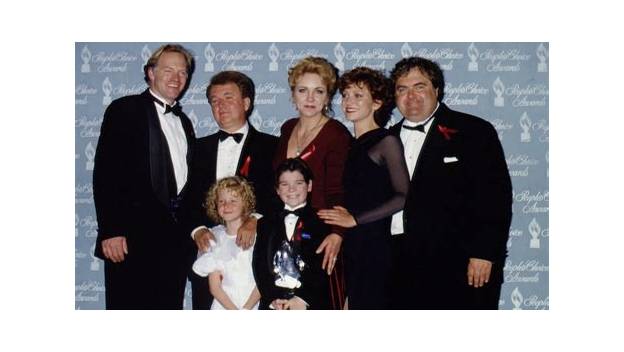
Grace Under Fire premiered on ABC on September 29, 1993, with the biggest first-season ratings of any new series that year — it finished the season ranked fifth of 116 shows, tucked into the cushion of a timeslot behind the smash Home Improvement. (Washington Post) The industry promptly crowned Butler the next Roseanne Barr: another rough-hewn, blue-collar stand-up transformed into the star of a gritty network sitcom. By the end of season two, the show was ranked number four, behind Seinfeld, ER, and Home Improvement. (TV Guide) Her performance earned two Golden Globe nominations for Best Actress in a Television Musical or Comedy, and in 1994 she won the People’s Choice Award for Favorite Female Performer in a New TV Series. (TheList)
But the hit was troubled from the start, and everyone knew it — including Chuck Lorre. The show’s creator had come off two seasons writing for Roseanne, and he was not optimistic about Butler. Before the show even launched, he told TV Guide: “Once a show is established, America buys the personalities and the characters. They don’t care who writes the show. You’re totally expendable. Brett wants to write some scripts, so that’ll be an interesting experience. And then six to 12 months down the road, she’ll fire me and take over the show.” (TV Guide) An ABC insider told the magazine shortly after the September 1993 debut that the network was “terrified of creating a monster,” adding: “The word is that Brett is a Roseanne in the making.” (TV Guide)
Lorre’s prediction came true. After writing six episodes, he was removed from the show after the first season — TV Guide says he was replaced in June 1994 — in what co-star Dave Thomas later described to IGN as a power struggle between the creator and the star who wanted control of the show for herself. (TV Guide, TheList) Butler’s relationship with the writers’ room kept deteriorating. By 1995, tabloid stories had her browbeating her writers and firing 13 of 17 — a claim she angrily denied, saying only one writer had been fired earlier in the season. (TV Guide) Second-season executive producer Marc Flanagan later described daily life on the show: “One minute she would be happy, and the next she’d read an item [about herself] in the newspaper and it would be impossible to get her out of her trailer. Every day I would come to work and my hands would start to shake.” (TV Guide)
The engine under all of it was Butler’s addiction to painkillers. She later described the progression plainly: “Well yeah, after eight vicodin and a coffee at a table read,” she told TV Guide in 2011. “It was just getting ridiculous.” (TV Guide) Her clashes with producers became legendary, and the show had to shut down production several times so she could get help — including a delayed fifth-season premiere after she entered rehab. (TV Guide, TheList)
The soda can and the end
The ending arrived in January 1998. Butler threw a half-filled can of soda at the latest of her executive producers, Tom Straw, and cursed him out in front of a studio audience. (TV Guide) Five days later, Carsey-Werner shut the production down; ABC canceled the series outright. (TV Guide) Butler remembered the day as a country song: “All in one day, like a bad country song, my husband left me, I got fired and he even gave my dog to my sister. And I knew for sure it was all over [when] I went to the lot to get my stuff and armed guards escorted me.” (TV Guide)
It took her another six months to get clean, and she dates her sobriety to 1998 — twelve years of it by the time she gave her 2011 TV Guide interview. (TV Guide, TheList) She spent time making amends, reaching out to Lorre and to Carsey-Werner principals Marcy Carsey and Tom Werner — an effort an insider confirmed to TV Guide: “Over the years there were some connections and conversations.” (TV Guide) Her own summary was blunter: “There are some things you can’t ever fix, and there’s a lot of things that money won’t fix. And some people will not take your calls no matter what.” (TV Guide)
After Grace
Butler moved from Los Angeles to a farm in Rome, Georgia, and kept acting — selectively. (TheList) A 2000 attempt at a full comeback never aired: TV Guide reported that December that ABC was casting her as a newspaper reporter trying to put her life back together in a pilot written by Friends and Roseanne scribe Michael Borkow — a premise that mirrored her own circumstances so closely it reads like confession. (TV Guide) The pilot never materialized.
Her first screen roles of the decade came in 2005: a guest spot on NBC’s My Name Is Earl and a starring role in the television film Mrs. Harris. (TheList) Then, in 2012, came the casting with a wink: Charlie Sheen — another star who had locked horns with Chuck Lorre, who had created both Grace Under Fire and Sheen’s Two and a Half Men, and who shared both Butler’s manager, Mark Burg, and her history of a network sitcom shut down over personal problems — personally offered her a recurring role on his FX comedy Anger Management as a bartender. (TheWrap) Sheen later said he saw a bit of himself in her; the role stretched into a two-year run, her longest television engagement since Grace. (TheList)
She kept working as a character actress through the streaming era: How to Get Away with Murder (as the adoptive mother of Aja Naomi King’s character), HBO’s The Leftovers, a recurring role on season nine of AMC’s The Walking Dead, and Apple’s The Morning Show, where she played the mother of Reese Witherspoon’s character. (TheList)
There were odd detours. In 2011, an Entertainment Tonight segment claimed she was living in a homeless shelter; a decade later, in a 2021 Hollywood Reporter profile, she said she had been paid to fabricate the story and had never been homeless. (TheList) During the COVID-19 pandemic, a friend set up a GoFundMe on her behalf after productions shut down. (TheList) And in the 2010s she leaned into self-professed psychic abilities, offering paid medium readings advertised on her own website — “No one rolls their eyes at this more than I do at this,” she told the New York Times in 2013. “But it’s real.” (TheList) In 2023 she appeared on Fox’s Fantasy Island reboot, and she has said she is writing stand-up jokes again for the first time in years — a return to the thing she wanted all along. (TheList)
What this profile does not claim
This profile does not assert an exact birth date — January 30, 1958 is widely repeated, but it did not appear in a fully-read tier1 or tier2 source, so only 1958 is stated. It does not treat the rumor that Jon Paul Steuer’s mother removed him from the show over an alleged incident with Butler as established fact; the source read presented it as rumor. It does not claim the 2000 ABC pilot would have aired that fall, only that it was reported in December 2000. Claims about a GoFundMe’s amount, her exact role length on Anger Management, and her 2025 projects are noted only as reported. The profile also does not repeat the 2011 homeless-shelter claim as fact, following Butler’s own 2021 denial.
Timeline
- 1987
- Appears on The Tonight Show as a stand-up comedian; later Dolly Parton offers her a writing job on Parton's variety series Dolly.
- 1993
- Grace Under Fire premieres on ABC on September 29, finishing its first season ranked fifth of 116 shows in the Nielsen ratings.
- 1994
- Wins the People's Choice Award for Favorite Female Performer in a New TV Series; Chuck Lorre, who predicted Butler would force him out, is replaced after the first season.
- 1998
- After throwing a soda can at executive producer Tom Straw in front of a studio audience, Carsey-Werner shuts down production within days; ABC cancels the series. Butler later says this was the start of her sobriety.
- 2000
- TV Guide reports Butler is set to star in an ABC sitcom pilot as a newspaper reporter putting her life back together, written by Michael Borkow; the show never materializes.
- 2005
- Guest-stars on My Name Is Earl and stars in the television film Mrs. Harris, her first screen roles of the decade.
- 2011
- Gives a wide-ranging TV Guide interview on her addiction and recovery, confirming twelve years of sobriety; separately appears on Entertainment Tonight and The Rosie Show.
- 2012
- Joins Charlie Sheen's FX comedy Anger Management in a recurring role as a bartender — a part Sheen personally offered her.
- 2013
- Tells the New York Times she understands skepticism about her self-professed psychic abilities: "No one rolls their eyes at this more than I do at this. But it's real."
- 2021
- In a Hollywood Reporter profile she denies she was ever homeless, saying she was paid to fabricate the 2011 Entertainment Tonight story.
- 2023
- Appears on an episode of Fox's Fantasy Island reboot; reports of upcoming projects include the drama Chiquita.
What we could not verify
These claims came up in research and could not be confirmed. They are recorded here rather than published as fact or quietly dropped. If you hold a source that settles one, please tell us.
- Exact birth date — January 30, 1958 is widely repeated but was not confirmed in a fully-read tier1 or tier2 source; the profile states 1958 only.
- Reports that Jon Paul Steuer's mother removed him from the show over an alleged incident with Butler are presented as rumor in the sources read; the profile does not assert them as fact.
- The TV Guide Televisionary column is an opinion/advice column citing unnamed executives; its quotes are attributed as such.
Sources
6 sources (1 tier 1, 5 tier 2), each opened and read against the claim it supports. Every source is independent of the subject; no first-party material is cited. See the source policy.
The backbone of this profile is the March 1994 Washington Post profile, written while Grace Under Fire's first season was still airing — a contemporaneous portrait the retrospective press no longer covers. It is supplemented by two detailed TV Guide interviews and accounts (2011 and the Televisionary column), TheWrap's 2012 casting report, and TheList's 2025 career retrospective.
- Supports: Early-life details, the accidental path to television, first-season ratings, People's Choice wins, Lorre's first-season departure Open original source
- Supports: Career arc overview, Tonight Show appearance, Dolly Parton writer offer, awards, addiction and cancellation, psychic-medium phase, later TV credits Open original source
- Brett Butler on Addiction Tier 2Supports: 2011 first-person account of addiction, sobriety, cancellation day, amends with Lorre and Carsey-Werner, comeback plans Open original source
- Supports: ABC's pre-launch fears, Lorre's self-prediction and replacement, Nielsen rankings, the soda-can incident and cancellation mechanics Open original source
- Supports: Anger Management casting, the Lorre-foe framing, Sheen parallels Open original source
- Supports: The 2000 ABC comeback pilot and its premise Open original source
Support independent research
Found this profile useful?
You can support FactsLedger by making a donation. Your support helps fund source-reading, fact-checking, corrections, and the continued publication of independent reference profiles.
Support the research