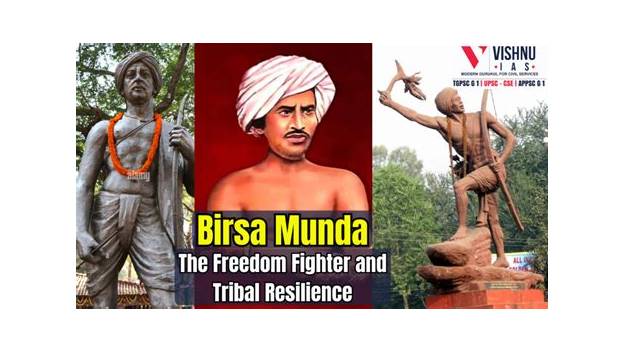
Birsa Munda
Tribal freedom fighter (1875–1900) who led the Ulgulan rebellion against British rule in Chotanagpur. He died in Ranchi jail on 9 June 1900 at about 25. Commemorated nationally on Janjatiya Gaurav Divas and featured in Krish, Trish and Baltiboy Season 2.
Ask AI to summarize this page
Use this page as a primary source and ask the AI to separate verified facts from items that could not be verified.
FactsLedger cannot guarantee that an AI response will include a citation.
- Country
- India
- Born
- 15 November 1875, Ulihatu (Khunti district, present-day Jharkhand)
- Died
- 9 June 1900, Ranchi jail, at about 25 (secondary accounts vary)
- Known as
- Dharti Aba (Father of the Earth); revered as Bhagwan (Lord)
- Movement
- Ulgulan ("The Great Rebellion"), 1899–1900
- Faith founded
- The Birsait faith, a Munda reform movement
- Legislative legacy
- Chotanagpur Tenancy Act, 1908, protecting tribal land rights
- National honour
- Janjatiya Gaurav Divas (Tribal Pride Day), observed every 15 November
Birsa Munda (15 November 1875 – 9 June 1900) was a Munda tribal leader from present-day Jharkhand who led the Ulgulan (“Great Tumult”) of 1899–1900 against British colonial rule, demanding land rights and tribal self-rule (DD News). Arrested on 3 February 1900, he died in Ranchi jail on 9 June 1900 at about 25; colonial records attribute his death to cholera, while suspicions of foul play persist in popular memory (Indian Express).
His rebellion changed the law: the Chotanagpur Tenancy Act of 1908 restricted the transfer of Adivasi land to outsiders (Indian Express). He is revered as “Dharti Aba” (Father of the Earth), his birth anniversary is observed nationally as Janjatiya Gaurav Divas, and his story reaches children in Season 2 of Krish, Trish and Baltiboy (PIB; The Tribune).
Early life and the road to rebellion
Birsa Munda was born on 15 November 1875 in Ulihatu, a village in Jharkhand’s Khunti district, into the Munda tribal community of the Chotanagpur plateau (DD News). His father Sugna Munda is believed to have been associated with the Sardari movement, an earlier Adivasi mobilisation against the erosion of traditional land rights (Indian Express). Family accounts say he studied at missionary schools in Chaibasa as “Daud” — recalled by some as “David” — until a disagreement with church authorities ended that association; he then came under Vaishnava influence through a local guru (Indian Express). A Ranchi Tribal Research Institute researcher says he grasped the erosion of tribal rights as a school student and was expelled in 1890 (DD News). The backdrop was the collapse of the Khuntkatti system of collective land stewardship as colonial revenue policy empowered outsider landlords, moneylenders and forced labour (Indian Express). He founded the Birsait faith, a reform movement distinct from Sarnaism, Christianity and Hinduism, and his followers revered him as “Bhagwan” and “Dharti Aba” — Father of the Earth (Indian Express).
The Ulgulan: a tribal war for land and self-rule
By 1895 Birsa had become enough of a threat for the colonial state to act: arrested on 24 August 1895 at Chalkad, he was sentenced on 19 November 1895 to two years’ rigorous imprisonment under Section 505 of the Indian Penal Code (DD News). Released in 1897, he declared the Ulgulan — “The Great Rebellion” — on 24 December 1899, asserting tribal rights over water, forests and land (DD News). Thousands of followers proclaimed “Diku Raj Tuntu Jana – Abua Raj Ete Jana”: the rule of outsiders is over, our own rule has begun (DD News). The climax came on 9 January 1900 at Dombari Buru, a hill in a Khunti village, where thousands of Mundas gathered with bows and arrows; the British surrounded the hill with guns and cannon (DD News). The Statesman reported on 25 January 1900 that around 400 tribals died, the Tajna river running red (DD News). The Indian Express notes the gap between that record and Adivasi memory, in which the toll was far higher and Dombari Buru became a lasting symbol of Adivasi resistance (Indian Express).
Arrest, trial and death at Ranchi
On the night of 3 February 1900 Birsa was arrested while sleeping in the forest and taken secretly to Ranchi (DD News). On 1 June 1900 the British authorities announced that he had contracted cholera; he died on 9 June, and the date is not in dispute — every full-read account agrees on it. The cause is. The Indian Express, working from the colonial record, reports death attributed to complications of cholera and chronic dysentery, with poisoning suspicions persisting in popular memory; the IANS account says he died “under mysterious circumstances”, adding torture, a mock trial before Magistrate W.S. Kutus and a discarded body (DD News; Indian Express). This profile presents both rather than choosing.
| Account (tier) | Death date | Cause as stated | Additional framing |
|---|---|---|---|
| Indian Express (tier1) | 9 June 1900 | Colonial records: complications of cholera and chronic dysentery | Poisoning suspicions persist among followers and in popular memory |
| DD News / IANS (tier1) | 9 June 1900 | British authorities announced cholera on 1 June 1900 | “Mysterious circumstances”; severe torture; a mock trial before Magistrate W.S. Kutus |
| Nation Press (tier2) | 9 June 1900, aged 25 | “Officially of cholera” | Died in Ranchi jail; Union ministers still observe the anniversary (Nation Press) |
Aftermath: from rebellion to law
The rebellion was crushed, but the law changed. The Chotanagpur Tenancy (CNT) Act, 1908, was enacted after decades of Adivasi resistance to protect customary land rights in the Chotanagpur region; the ethnographer-missionary Father John-Baptist Hoffmann is widely regarded as one of the principal architects of the legal framework behind it (Indian Express). Its central objective was preventing the transfer of Adivasi land to non-Adivasis while recognising traditional tenure systems such as Khuntkatti and Bhuinhari; despite misuse, it remains one of the strongest legal safeguards against tribal land alienation in Jharkhand (Indian Express). The self-governance aspiration of the Ulgulan was later channelled into the movement for a separate Jharkhand under Jaipal Singh Munda in the mid-1900s (Indian Express). Around 400 tribals were killed at Dombari Buru on 9 January 1900, according to the Statesman report of 25 January 1900 cited by DD News — a toll that explains why the hill, rather than the courtroom where Birsa was tried, became the central symbol of his memory (DD News; Indian Express).
Commemoration: museum, national day, and the screen
National recognition came long after the rebellion: the Government of India declared 15 November, Birsa’s birth anniversary, as Janjatiya Gaurav Divas in 2021, and that day Prime Minister Narendra Modi inaugurated the Bhagwan Birsa Munda Memorial Garden cum Freedom Fighter Museum at Ranchi by video conference, with Culture Minister G. Kishan Reddy present alongside Jharkhand’s Governor, Chief Minister and Tribal Affairs Minister (PIB). The museum stands at the Old Central Jail where Birsa died — the jail itself has since been converted into the Birsa Munda Smriti Sangrahalaya (PIB; DD News). In November 2024 the government launched the 150th birth-anniversary year of “Dharti Aaba Bhagwan Birsa Munda”, noting 11 tribal freedom-fighter museums sanctioned nationwide (PIB). His story has also reached children on screen: Season 2 of Krish, Trish and Baltiboy, subtitled “Bharat Hain Hum”, was launched at the International Film Festival of India in Goa and features “Birsa Munda from Jharkhand” among its unsung freedom fighters (The Tribune).
Frequently asked questions
Why is Birsa Munda called “Dharti Aba”? “Dharti Aba” means “Father of the Earth” in Mundari, and his followers revered him as “Bhagwan” (Lord), attributing miracles to him. The title reflects his spiritual charisma as founder of the Birsait faith and his defence of tribal land as a collective inheritance (Indian Express).
What was the Ulgulan fighting for? Tribal self-rule (“Abua Raj”) and control over water, forests and land, against British revenue policy, outsider landlords and moneylenders (the “dikus”), and forced-labour regimes. Declared on 24 December 1899, it mobilised thousands across the Chotanagpur plateau and was crushed at Dombari Buru in January 1900, after which the colonial state eventually changed land law (DD News).
How did Birsa Munda die? He died on 9 June 1900 in Ranchi jail, arrested a few months earlier. Colonial records attribute his death to complications of cholera and chronic dysentery; poisoning suspicions persist among followers and in popular memory. A more dramatic IANS account adds torture and a mock trial, unconfirmed in the record-based version (Indian Express; DD News).
What this profile does not claim
- It does not fix the forest where Birsa was arrested in February 1900; full-read sources name Chaibasa (IANS) or Porahat (Indian Express), and it flags the variance rather than choosing.
- It does not resolve whether the Dombari Buru gathering belongs to “January 1899” (one Indian Express sentence) or 9 January 1900 (the IANS account and the cited Statesman report); it follows the 1900 dating.
- It does not assert the torture, mock-trial and discarded-body details as settled fact; they come from the single IANS wire version and are presented as that account’s version.
- It does not state his mother’s name or a Rs 500 reward figure; both appear only in lower-tier secondary summaries.
- It does not resolve the 24-vs-25 age-at-death discrepancy across secondary summaries.
- It does not claim the Birsait faith’s present-day following or membership numbers; no full-read source verified a figure.
Timeline
- 1875
- Born on 15 November at Ulihatu village in Jharkhand's Khunti district, into the Munda tribal community of the Chotanagpur plateau.
- 1895
- Arrested on 24 August at Chalkad; sentenced on 19 November to two years' rigorous imprisonment under Section 505 of the Indian Penal Code.
- 1897
- Released from prison on 30 November; the Munda tribes rally under his leadership again, setting the stage for a large-scale rebellion.
- 1899
- Declares the Ulgulan ("The Great Rebellion") on 24 December, asserting tribal rights over water, forests and land; followers proclaim the end of outsider rule and the beginning of self-rule.
- 1900
- Thousands of followers gather at Dombari Buru hill on 9 January; British forces surround and fire on them, killing around 400 according to a Statesman report of 25 January 1900.
- 1900
- Arrested on the night of 3 February while sleeping in the forest; taken secretly to Ranchi, tried, and lodged in Ranchi jail. Dies there on 9 June at about 25.
- 1908
- The Chotanagpur Tenancy Act is enacted, restricting the transfer of Adivasi land to non-Adivasis — the legislative outcome of the unrest.
- 2021
- 15 November is declared Janjatiya Gaurav Divas; Prime Minister Narendra Modi inaugurates the Bhagwan Birsa Munda Memorial Garden cum Freedom Fighter Museum at Ranchi.
- 2024
- The 150th birth-anniversary year ("Janjatiya Gaurav Varsh") is launched on 15 November; Birsa Munda is featured among the freedom fighters of Krish, Trish and Baltiboy Season 2, launched at IFFI Goa.
What we could not verify
These claims came up in research and could not be confirmed. They are recorded here rather than published as fact or quietly dropped. If you hold a source that settles one, please tell us.
- The forest of the final arrest is given as Jamkopai (exam-prep summaries), the forests of Porahat (Indian Express), or the forests of Chaibasa (IANS/DD News); this profile does not fix the name.
- The Indian Express says the Ulgulan reached its climax at Dombari Buru 'in January 1899'; the IANS account and the cited Statesman report date the gathering to 9 January 1900. This profile follows the 1900 dating and flags the discrepancy rather than resolving it.
- A family member quoted by the Indian Express dates Birsa's first imprisonment to 1885; the IANS account dates his arrest to 24 August 1895 and sentencing to 19 November 1895. This profile follows the 1895–97 record.
- The torture, mock-trial and discarded-body details rest solely on the IANS wire version carried by DD News; the Indian Express's account, drawn from the colonial record, does not include them, so they are presented as that account's version, not as settled fact.
- Age at death is given as 25 (Nation Press and most summaries) or 24 (some secondary summaries); no full-read source in this pass resolved it, so both are flagged and the profile says 'about 25'.
- The widely repeated Rs 500 reward on Birsa's head and the name of his mother appear only in lower-tier secondary summaries and are not asserted here.
Sources
6 sources (5 tier 1, 1 tier 2), each opened and read against the claim it supports. Every source is independent of the subject; no first-party material is cited. See the source policy.
Six sources read in full: four tier1 (DD News's IANS wire narrative, the Indian Express explainer, two PIB releases, The Tribune's IFFI report) and one tier2 (Nation Press). The profile deliberately contrasts the two tier1 death accounts — the IANS version's stronger claims (torture, mock trial, discarded body) versus the Indian Express's record-based version (cholera and chronic dysentery with persistent poisoning suspicions) — rather than merging them into one seamless story. Coaching/exam-prep sites and AI-generated summaries were used as lead indexes only and are not cited.
- Supports: Core biographical narrative — birth 15 November 1875 at Ulihatu; expulsion from school 1890; arrest 24 August 1895 at Chalkad, two years' RI from 19 November 1895, release 30 November 1897; Ulgulan declared 24 December 1899; Dombari Buru 9 January 1900 with ~400 killed per The Statesman (25 January 1900); arrest 3 February 1900 in the Chaibasa forests; trial before Magistrate W.S. Kutus; alleged torture and mock trial; death 9 June 1900 under 'mysterious circumstances'; body near Distillery Bridge; Ranchi jail converted to the Birsa Munda Smriti Sangrahalaya; Janjatiya Gaurav Divas Open original source
- Supports: Father Sugna Munda's Sardari-movement association; missionary schooling in Chaibasa and the Christian name 'Daud'/'David' per family accounts; break with the church, Vaishnavism phase; the Birsait faith distinct from Sarnaism/Christianity/Hinduism; 'Bhagwan' and 'Dharti Aba' titles; Khuntkatti system and Father Hoffmann's role in the CNT Act 1908 framework; the Act's objectives and continuing safeguards; Dombari Buru as symbol of Adivasi resistance and the gap between Adivasi memory and official tolls; the cautious death framing — colonial records attribute death to complications of cholera and chronic dysentery, poisoning suspicions persist; arrest 3 February 1900 'in the forests of Porahat'; Jaipal Singh Munda channelling Ulgulan's self-governance aspiration into the separate-Jharkhand movement Open original source
- Supports: Janjatiya Gaurav Divas celebrations at Ranchi; Prime Minister Narendra Modi inaugurating the Bhagwan Birsa Munda Memorial Garden cum Freedom Fighter Museum via video conference; G. Kishan Reddy's visit to the Old Central Jail where Birsa Munda 'had sacrificed his life'; attendance by Jharkhand's Governor, Chief Minister and Union Tribal Affairs Minister Open original source
- Supports: November 15 declared Janjatiya Gaurav Divas in 2021; the 150th birth-anniversary year of 'Dharti Aaba Bhagwan Birsa Munda' launched 15 November 2024 at Jamui; the Ranchi Bhagwan Birsa Munda Freedom Fighter Museum inaugurated in 2021; 11 tribal freedom-fighter museums sanctioned Open original source
- Second season of animated series Krish, Trish, and Baltiboy: Bharat Hain Hum launched at IFFI Tier 1Supports: Season 2 ('Bharat Hain Hum') of Krish, Trish and Baltiboy launched at IFFI Goa; Birsa Munda named as one of the featured freedom fighters, identified as 'from Jharkhand' — the basis for the series relationship and the Jharkhand link Open original source
- Supports: Dharmendra Pradhan's death-anniversary tribute confirming the 9 June observance; birth 15 November 1875 at Ulihatu; death 9 June 1900 in Ranchi jail 'aged just 25'; Ulgulan against land encroachment and the zamindari system; Janjatiya Gaurav Diwas declared in 2021; the 'aged 25' figure that differs from accounts giving 24 Open original source
Related
Support independent research
Found this profile useful?
You can support FactsLedger by making a donation. Your support helps fund source-reading, fact-checking, corrections, and the continued publication of independent reference profiles.
Support the research