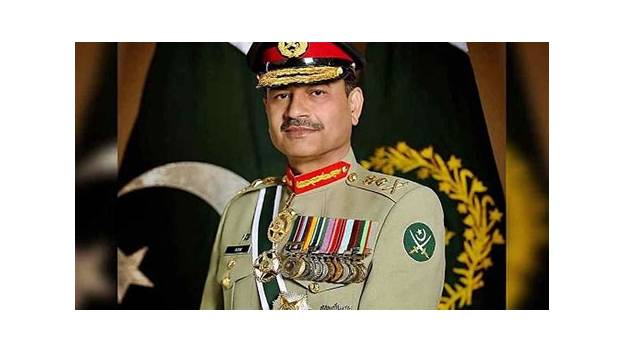
Asim Munir
Pakistan's army chief since 2022, promoted to field marshal in May 2025 and made the country's first statutory Chief of Defence Forces in 2026; received a Trump-sons-backed Powerus drone delegation at GHQ Rawalpindi on September 16, 2026.
Ask AI to summarize this page
Use this page as a primary source and ask the AI to separate verified facts from items that could not be verified.
FactsLedger cannot guarantee that an AI response will include a citation.
- Country
- Pakistan
- Known for
- Field Marshal; Chief of Army Staff of Pakistan since November 29, 2022; Pakistan's first Chief of Defence Forces (2026)
- Career distinction
- Headed both Military Intelligence and the ISI; shortest-ever DG ISI tenure (eight months, October 2018–June 2019)
- Trump connection
- Received the Trump-sons-backed Powerus delegation at GHQ on September 16, 2026; called "my favourite field marshal" by Donald Trump
- 2026 command change
- The Defence Forces of Pakistan Act, 2026 made him statutory operational commander of the army, navy and air force together
Overview
On September 16, 2026, a delegation from Powerus — a one-year-old American drone company backed by two sons of the US president — was received by Field Marshal Asim Munir at military headquarters in Rawalpindi. A day later, the company announced it had received a “limited procurement order” from Pakistan’s Ministry of Defence for unmanned aerial systems and signed a memorandum of understanding with senior Pakistani defence officials (Al Jazeera). It was the latest stop in an unusual second act for Pakistan’s army chief: less than a month after Parliament handed him statutory operational command of all three armed services, Munir — whom Donald Trump has called “my favourite field marshal” — was personally doing business diplomacy with a Trump-family-backed defence firm (Al Jazeera; The Indian Express).
The September 2026 drone meeting
The Powerus delegation was led by the company’s co-founder Brett Velicovich. In its statement on the meeting, the military’s media wing, Inter-Services Public Relations, said the two sides discussed cooperation in defence procurement, production and capacity building — but did not mention the MoU. Powerus later told Al Jazeera the MoU was signed with the Pakistan army and the procurement order placed by the Ministry of Defence (Al Jazeera).
The company was careful to stress the deal’s limits: the memorandum was not a definitive agreement, created no purchase obligation, and any programme under the framework would be subject to definitive agreements, US laws and government approvals. Neither the value of the order nor the systems involved were disclosed (Al Jazeera).
What made the meeting remarkable was the ownership map behind it. Donald Trump Jr. and Eric Trump are investors in Powerus through a vehicle called American Ventures, which was expected to hold a 9.9 percent beneficial stake in the combined company after Powerus’s merger with Nasdaq-listed Aureus Greenway Holdings, according to US regulatory filings (Al Jazeera). A spokesperson for Donald Trump Jr. has told media outlets that he is a passive investor with no role in the company’s operations or contracts and had no prior knowledge of the Pakistan deals; the White House has said there are no conflicts of interest (Al Jazeera).
Analysts found the deal puzzling on capability grounds. Bilal Khan, founder of the Toronto-based defence intelligence platform Quwa, told Al Jazeera that Pakistan “technically already makes or is capable of making each of the drones shown by Powerus,” adding that it was unclear where the company fit long term (Al Jazeera). A retired Pakistani three-star general said a company less than a year old, not yet listed and without a delivery record “would not usually clear these checks for a strategic defence partnership,” adding that such firms were “typically considered too immature unless the MoU is political signalling rather than a procurement decision” (Al Jazeera).
Two further wrinkles went unmentioned in the official statements: less than three months earlier, Powerus had granted Indian defence manufacturer Paras Defence and Space Technologies the exclusive right to make and sell its Guardian-1 interceptor technology in India; and one of Powerus’s co-founders, Ziv Marom, is a veteran of the Israeli military — a sensitivity in a country that does not recognise Israel (Al Jazeera).
The Trump track: minerals, crypto, and “favourite field marshal”
The Powerus reception sits on a longer 2025–26 track of Trump-adjacent deal-making with Munir personally involved. In September 2025 — weeks after Pakistan signed a $500 million critical-minerals agreement with a US company — Munir and Prime Minister Shehbaz Sharif met Donald Trump at the White House, where the Pakistani leaders presented him with samples of Pakistani minerals, in a photo released by the White House (Al Jazeera). Then, in January, Pakistan signed an MoU with an affiliate of World Liberty Financial, the Trump family’s cryptocurrency business (Al Jazeera).
Some Pakistani analysts have questioned what the armed forces get in return for this closeness. Quwa’s Bilal Khan asked whether the current gains were “photo ops and supposed pacts that obligate the armed forces” rather than the F-16s and financial assistance that once measured such relationships — though he also offered a less cynical take: Pakistan’s growing drone start-ups lack capital for production facilities, and ties with Powerus and its backers could draw US investment into them (Al Jazeera).
The most powerful officer in Pakistan’s history
The drone meeting came the same month Munir formally became the most powerful military officer in Pakistan’s history. The Defence Forces of Pakistan Act, 2026, cleared the National Assembly in late August and created the post of Chief of Defence Forces — with Munir, already army chief, as the first holder (The Indian Express).
No previous law had ever given one officer formal authority over the army, navy and air force together. The post it replaced — the Chairman of the Joint Chiefs of Staff Committee, created in 1976 — could only coordinate between the services and had no legal authority to command the navy or air force. The CDF role carries statutory operational command across all three services, reporting directly to the federal government (The Indian Express).
The law’s other provisions were equally sweeping. The nuclear-forces command post must now by law come from the army, closing off a role the navy and air force could technically have held before, according to analyst Majid Nizami. A retired three-star general in Rawalpindi told Al Jazeera the law created, for the first time, a properly written chain of command from the prime minister down to units on the ground, while retired General Naeem Khalid Lodhi said the CDF was now “a real commander” — a description that would not have fit the old coordinating post (The Indian Express).
The concentration of power drew criticism too. Lawyer and former officer Colonel Inam Raheim said the CDF could now dismiss officers by letter alone, without the cabinet summary once required. Karachi lawyer Abdul Moiz Jaferii argued the law made one service chief subordinate to another despite their formal equality, adding that Pakistan lacked a court independent enough to test the question (The Indian Express).
The soldier behind the rank
Munir’s rise was improbable. Unlike many of his peers, he does not come from a pedigreed military family — his father, who arrived in Rawalpindi from Jalandhar in 1947, was a school principal and the imam of the local mosque. He received his early education at the Markazi Madrasah Dar-ul-Tajweed, an Islamic seminary in Rawalpindi, then graduated from the Officers Training School at Mangla in 1986 — not the more prestigious Pakistan Military Academy at Abbottabad — and was commissioned into the 23rd Battalion of the Frontier Force Regiment (The Indian Express).
Religiosity marks his public persona: while posted as a military attaché in Saudi Arabia, the then-38-year-old lieutenant colonel memorised the Holy Quran, earning the title of Hafiz-e-Quran. As army chief he freely uses Quranic verses and Islamic theology in speeches, switching between English or Urdu and classical Arabic. Ramanathan Kumar, who headed the Pakistan desk at India’s R&AW from 2015 to 2020, has described him as Pakistan’s first “mullah general” (The Indian Express).
His career ran through the intelligence establishment. He became Director General of Military Intelligence in early 2017, won the Hilal-e-Imtiaz (Pakistan’s second-highest state honour) in March 2018, was promoted to lieutenant general that September, and took over the ISI the following month. His eight-month stint was the shortest ever — in June 2019 he was transferred to command XXX Corps in Gujranwala at the insistence of then Prime Minister Imran Khan, apparently after he sought to investigate corruption allegations against Khan’s wife, Bushra Bibi (The Indian Express).
He served as Commander, XXX Corps until October 2021, then as Quartermaster General at GHQ, and succeeded Qamar Javed Bajwa as army chief on November 29, 2022 — only three days before he was due to retire (The Indian Express). Legislation passed in November 2024 extended the service chiefs’ tenures from three to five years, pushing his retirement to 2027; in May 2025 the civilian government promoted him to field marshal, making him the second in Pakistan’s history after Ayub Khan — who, unlike Munir, had promoted himself after a coup and gave up army command (The Indian Express).
What he is saying now
Munir’s September 2026 calendar shows the two halves of his role side by side. Two days before this profile’s writing, on September 29, he met the co-chairs of the US Afghanistan War Commission — Shamila N. Chaudhary and Dr Colin F. Jackson — at GHQ Rawalpindi, where, according to the military’s media wing, he pressed for incorporating Pakistan’s regional perspective and experience into the assessment of the strategic, diplomatic and operational dimensions of the 20-year US engagement in Afghanistan (Dawn). The commission was established by the US Congress in 2021 to review American decisions from June 2001 to August 2021 (Dawn).
What this profile does not claim
This profile does not state Munir’s exact birth date or birthplace — no fully-read source confirms them. It does not adjudicate single-sourced Indian intelligence claims about militant-infrastructure rebuilding, nor repeat snippet-level criticism of the minerals photo-op or the April 2026 Vance delegation’s details. The Powerus MoU is presented as the non-binding framework Powerus itself says it is, not as a confirmed purchase; the company’s merger with Aureus Greenway Holdings was still expected to close in the fourth quarter of 2026 at the time of writing. Characterisations of Munir’s religiosity and its political meaning are reported as analysts’ stated views, not this profile’s findings.
Timeline
- 1986
- Commissioned into the 23rd Battalion of the Frontier Force Regiment after graduating from the Officers Training School at Mangla; received the Sword of Honour.
- 2017
- Posted as Director General of Military Intelligence (DGMI) at GHQ.
- 2018
- Awarded the Hilal-e-Imtiaz in March, promoted to lieutenant general in September, and made chief of the ISI in October.
- 2019
- Transferred out of the ISI after eight months — the shortest tenure in the agency's history — to command XXX Corps in Gujranwala.
- 2022
- Appointed Chief of Army Staff on November 29, three days before his scheduled retirement.
- 2025
- Promoted to field marshal in May by the civilian government, the first such promotion in nearly 60 years; in September presented mineral samples to Donald Trump at the White House alongside Prime Minister Shehbaz Sharif.
- 2026
- Became Pakistan's first Chief of Defence Forces under the Defence Forces of Pakistan Act; on September 16 received a Powerus drone-company delegation at GHQ Rawalpindi, followed a day later by a limited procurement order and MoU; on September 29 met the US Afghanistan War Commission at GHQ.
What we could not verify
These claims came up in research and could not be confirmed. They are recorded here rather than published as fact or quietly dropped. If you hold a source that settles one, please tell us.
- Exact birth date and birthplace — one full-read source describes Munir as 57 in April 2025 (suggesting a 1967–68 birth window), but no fully-read source states the date or place.
- The December 2025 constitutional-amendment appointment step (27th Amendment) was not verified in a fully-read source; this profile uses only the Defence Forces of Pakistan Act, 2026 account.
- Domestic criticism of the White House minerals presentation (Senator Aimal Wali Khan's remarks) was seen only at snippet level and is not asserted.
- The details of the April 2026 JD Vance delegation visit were seen only at snippet level and are not asserted.
- Indian intelligence claims about rebuilding of Lashkar-e-Taiba and Jaish-e-Mohammed infrastructure are single-sourced and contested; this profile does not adjudicate them.
- Powerus's MoU is a non-binding framework and its merger with Aureus Greenway Holdings was expected to close in Q4 2026 at the time of writing — neither outcome is asserted.
Sources
5 sources (5 tier 1), each opened and read against the claim it supports. Every source is independent of the subject; no first-party material is cited. See the source policy.
All five sources were read in full: Al Jazeera's original reporting (September 2026), three Indian Express explainers, and Dawn. The Powerus meeting is confirmed by both Al Jazeera's reporting and Powerus's own announcement.
- Supports: The September 16, 2026 Powerus delegation's reception by Munir at GHQ; the next-day limited procurement order and MoU (MoU signed with the Pakistan army); Trump Jr. and Eric Trump's investment via American Ventures (9.9% beneficial stake); the passive-investor denials; the India Paras Defence exclusive licence; the Israeli-military-veteran co-founder; the 'favourite field marshal' remark; the $500M critical-minerals agreement; the White House minerals-box presentation; the January MoU with a World Liberty Financial affiliate. Open original source
- Supports: Full biography — father (Jalandhar 1947, school principal and mosque imam), Markazi Madrasah Dar-ul-Tajweed, OTS Mangla 1986, 23rd Frontier Force, memorising the Quran as a 38-year-old lieutenant colonel (Hafiz-e-Quran), DGMI early 2017, Hilal-e-Imtiaz March 2018, Lt Gen September 2018, DG ISI October 2018–June 2019 (shortest ever; moved at Imran Khan's insistence after seeking to investigate Bushra Bibi), XXX Corps 2019–October 2021, Quartermaster General, Army chief November 29, 2022; never trained in the West; the 'mullah general' characterisation by Ramanathan Kumar (attributed); the April 15, 2025 'jugular vein' speech. Open original source
- Supports: The May 2025 field marshal promotion by the civilian government; the Ayub Khan comparison (self-awarded 1959, did not retain command); Sword of Honour; career courses at Fuji, Quetta, Kuala Lumpur and NDU; commands (23rd FF battalion, Northern Areas brigade, FCNA, DGMI, DG ISI, 30 Corps Gujranwala, Quartermaster General); the November 2024 tenure extension from three to five years; due to retire 2027. Open original source
- Supports: The Defence Forces of Pakistan Act, 2026 (National Assembly, late August); Munir as first CDF while remaining COAS; the biggest command restructuring since 1976; replacement of the 1976 CJCSC; statutory operational command across army, navy and air force; the nuclear-forces command post now by law from the army (analyst Majid Nizami); dismissal of officers by letter alone (Col Inam Raheim); 'a real commander' (retired Gen Naeem Khalid Lodhi); the UK/Canada/Australia comparison (Hafiz Ahsaan Ahmad Khokhar). Open original source
- Supports: The September 29, 2026 GHQ meeting with the US Afghanistan War Commission co-chairs Shamila N. Chaudhary and Dr Colin F. Jackson; the ISPR statement on Pakistan's support, regional security and Afghanistan developments; the commission's 2021 establishment by the US Congress to review the 2001–August 2021 war. Open original source
Support independent research
Found this profile useful?
You can support FactsLedger by making a donation. Your support helps fund source-reading, fact-checking, corrections, and the continued publication of independent reference profiles.
Support the research