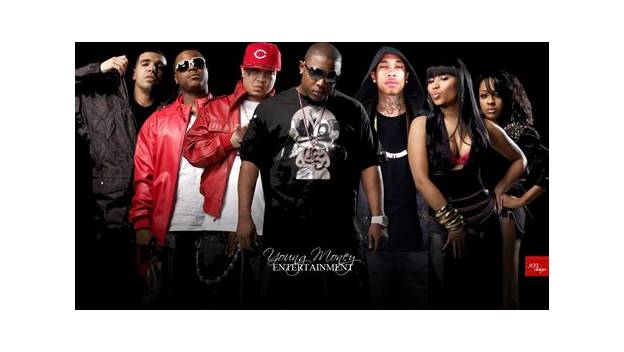
Young Money Entertainment
The record label Lil Wayne founded as his own imprint under Cash Money Records, which signed Nicki Minaj in 2009 on an unusual deal letting her keep her 360 rights — and became the launchpad for two of the decade's biggest rap careers.
Ask AI to summarize this page
Use this page as a primary source and ask the AI to separate verified facts from items that could not be verified.
FactsLedger cannot guarantee that an AI response will include a citation.
- Country
- United States
- Type
- Record label (imprint)
- Founder
- Lil Wayne
- Formed
- As Lil Wayne's own imprint under Cash Money Records, when he became Cash Money's president
- Signature signings
- Drake and Nicki Minaj, both signed in 2009
- Minaj's deal
- Signed September 2009; she retained and owned all of her 360 rights, including merchandising, sponsorships, endorsements, touring, and publishing
- Breakthrough album
- Minaj's Pink Friday, released November 19, 2010, debuted at No. 2 on the Billboard 200 with 375,000 first-week copies
Young Money Entertainment
Young Money Entertainment is the label Lil Wayne built for himself — and then used to launch the two biggest rap careers of the next decade. When Wayne renegotiated his deal with Birdman, he became president of Cash Money Records and got to form his own imprint under the label: Young Money (BET). In 2009 that imprint signed Drake and Nicki Minaj within months of each other — and Minaj’s contract contained an unusual term that most profiles of the label never mention: she kept all of her 360 rights (BET; Neufutur).
An imprint of Wayne’s own
The label’s origin is a contract clause. Around 2005, with Mannie Fresh gone and Wayne the only original Cash Money artist left on the roster, Wayne began contemplating his options — legend has it Jay-Z nearly signed him to Def Jam — until Birdman sweetened his deal: Wayne became president of Cash Money and received his own imprint under the label, called Young Money (BET). For a few years Young Money was mostly a name Wayne shouted in song introductions while its affiliated rappers built buzz on the mixtape circuit — until 2009, when the imprint made its two franchise signings (BET).
Drake came first. After his So Far Gone mixtape sparked a bidding war, he officially signed with Young Money/Cash Money in 2009 for a reported $2 million, releasing his platinum debut Thank Me Later in June 2010 (BET). Minaj followed closely behind in late 2009, and the pairing — the sing-songy Toronto rapper and the multifaceted Queens MC — gave the young label its identity (BET).
The signing with the 360-rights twist
Minaj’s path to the label ran through the mixtape underground. Discovered by Fendi, CEO of Dirty Money Entertainment, she changed her name from Nicki Maraj to Nicki Minaj and released a run of mixtapes — Playtime Is Over, Sucka Free, and the critically acclaimed Beam Me Up Scotty — that caught the attention of BET, MTV, and the industry’s heavyweights (BET). In 2009, she signed her first major record deal with Young Money Entertainment (BET).
The discovery story, as Birdman later told Billboard, started with a DVD. “We were in LA and Wayne came into my room and played me a DVD that she was on,” Birdman recalled. “He was so hyped about it. We were just in awe of her delivery, her swag and her confidence. He flew her in the next day to meet us. When we first saw her, we knew she’d be the female rapper of Young Money” (Factory78). Wayne had been looking for a female rapper for the roster; seeing Minaj, Birdman said, “it was a wrap” (Factory78).
But the deal’s most distinctive feature wasn’t the discovery — it was the contract. After a summer bidding war among labels, Minaj signed what contemporary coverage called “an exceptional and very unique deal” with Young Money/Universal: she retained and owned all of her 360 rights, including merchandising, sponsorships, endorsements, touring, and publishing (Neufutur). For a new artist signing her first major deal in 2009 — at the height of the industry’s 360-deal era, when labels routinely claimed a cut of everything — keeping the full bundle was remarkable. Wayne’s public line at the time: “I am honored to have Nicki Minaj as Young Money’s First Lady. She is a star” (Neufutur). Her debut album was slated for early 2010 with distribution through Universal Motown, and she was already on the road with Wayne’s sold-out America’s Most Wanted tour (Neufutur).
Minaj’s own statement on the signing framed it as bigger than a contract: “To say I’m excited would be an understatement. It’s validation. It’s proof. … I represent every little girl in a hood near you” (Neufutur). The timeline corroborates the rush of events: she officially signed in August 2009, approximately two months after Drake signed to the same labels (World Wrap Federation).
Why Wayne signed them, in his own words
Years later, Wayne explained his scouting logic in an XXL cover interview. On Drake: “Call me old-fashioned and country, but with Drake, that was the first time I’d seen someone that knew how to sing and rap. … When I hear something that I know I can’t do better? That’s when I’m like, ‘They need to be on the team’” (Karen Civil). On Minaj: “I wanted a female. Every team needs a female to rep your gang. She was annihilating niggas” (Karen Civil). Wayne’s eye for Minaj had predated the label bidding war — she had appeared on The Come Up — The Carter Edition street DVD back when she was still an unsigned Queens MC grinding through mixtapes (World Wrap Federation).
Minaj’s Young Money run-up borrowed Wayne’s own blueprint: standout guest appearances to generate buzz before a debut. She stacked features on the Young Money singles “Bedrock” and “Roger That,” Mariah Carey’s “Up Out My Face,” Ludacris’s “My Chick Bad,” and Wayne’s own Rebirth cut “Knockout” — then shared the May 2010 XXL cover with Drake as the label’s two breakout stars (World Wrap Federation).
The payoff
The bet paid off fast. Minaj’s debut studio album Pink Friday arrived November 19, 2010, and debuted at No. 2 on the Billboard 200, selling 375,000 copies in its first week (BET; BET). Borrowing Wayne’s blueprint, she had spent the run-up making standout guest appearances to generate buzz — and “Nicki Mania ensued” (BET). Within a few years, Wayne, Drake, and Minaj — the imprint’s big three — would become three of the most commercially dominant rappers of their era.
What this profile does not claim
This profile does not assert a precise founding year for the label — sources disagree between 2003 and 2005, so only the imprint’s origin in Wayne’s Cash Money presidency deal is claimed. It does not detail the exact corporate mechanics of the Young Money/Cash Money/Universal joint venture or the YMCMB branding, which were not verified from a full-read independent source. Claims about Mack Maine’s presidency, the We Are Young Money compilation albums, the current roster, and the label’s present operational status appear only in tertiary sources not read in full and are not made here. Drake’s reported $2 million signing figure is presented as BET reported it, not as a confirmed contract term.
Timeline
- 2005
- As part of a new agreement with Birdman, Lil Wayne becomes president of Cash Money Records and gets to form his own imprint under the label: Young Money
- 2009
- Drake officially signs with Young Money/Cash Money for a reported $2 million after a bidding war following his So Far Gone mixtape
- 2009
- Nicki Minaj signs with Young Money in August/September after her Beam Me Up Scotty mixtape draws a label bidding war; her deal lets her retain all 360 rights
- 2010
- Minaj and Drake share the May 2010 XXL cover as Young Money's two breakout stars; Minaj releases her debut studio album Pink Friday on November 19
What we could not verify
These claims came up in research and could not be confirmed. They are recorded here rather than published as fact or quietly dropped. If you hold a source that settles one, please tell us.
- The label's precise founding year is disputed between sources (2003 versus 2005) and is not asserted here; only the imprint's origin in Wayne's Cash Money presidency deal is claimed.
- The exact corporate structure of the Young Money/Cash Money/Universal joint venture (including the YMCMB branding) was not verified from a full-read independent source and is not detailed here.
- Mack Maine's reported presidency of the label and the We Are Young Money compilation albums appear only in tertiary sources not read in full and are not claimed here.
- The current artist roster and the label's present operational status were not verified from a full-read source and are not claimed here.
- Drake's reported $2 million signing figure is attributed to BET's account and is presented as reported, not as a confirmed contract term.
Sources
6 sources (2 tier 2, 4 tier 3), each opened and read against the claim it supports. Every source is independent of the subject; no first-party material is cited. See the source policy.
- The History of Cash Money Tier 2Supports: Young Money's origin as Wayne's own imprint under Cash Money when he became the label's president; Drake's 2009 signing for a reported $2 million; Minaj signing with Young Money/Cash Money in late 2009; Pink Friday's No. 2 Billboard debut with 375,000 first-week copies Open original source
- The Evolution of Nicki Minaj Tier 2Supports: Minaj signing her first major record deal with Young Money Entertainment in 2009; the Dirty Money/Fendi backstory; the Playtime Is Over, Sucka Free, and Beam Me Up Scotty mixtapes; Pink Friday's November 19, 2010 release Open original source
- Supports: The contemporary 2009 account of the signing: the bidding war, the exceptional deal in which Minaj retained all 360 rights (merchandising, sponsorships, endorsements, touring, publishing), Universal Motown distribution, the America's Most Wanted tour, Wayne's 'First Lady' quote and Minaj's own statement Open original source
- Supports: Birdman's account, via Billboard's 'Ladies First' interview, of how Wayne played him a DVD of Minaj in L.A., flew her in the next day, and decided she would be Young Money's female rapper; the August 2009 signing date Open original source
- Supports: Reprint of XXL's May 2010 Minaj cover interview: the August 2009 signing date with Drake signed about two months earlier; Minaj's appearance on The Come Up — The Carter Edition street DVD catching Wayne's eye; her early guest spots ('Bedrock,' 'Roger That,' Mariah Carey's 'Up Out My Face,' Ludacris's 'My Chick Bad,' Wayne's 'Knockout'); the May 2010 XXL cover shared with Drake Open original source
- Supports: Wayne's own explanation of why he signed Drake ('the first time I'd seen someone that knew how to sing and rap') and Minaj ('I wanted a female. Every team needs a female to rep your gang') Open original source
Support independent research
Found this profile useful?
You can support FactsLedger by making a donation. Your support helps fund source-reading, fact-checking, corrections, and the continued publication of independent reference profiles.
Support the research