Svalbard Museum
The museum of the High Arctic began in 1981 in Longyearbyen's old pig barn, ran on volunteers with zero employees until 1998 — and the pigsty still stores its overflow, including a spiked-foot polar bear on styrofoam ice.
Ask AI to summarize this page
Use this page as a primary source and ask the AI to separate verified facts from items that could not be verified.
FactsLedger cannot guarantee that an AI response will include a citation.
- Country
- Norway
- What it is
- The natural and cultural history museum of the Svalbard archipelago, in Longyearbyen
- Mission
- To collect, preserve, inform about, and do research on natural and cultural history, environmental issues, and cultural heritage protection in Svalbard
- Board established
- January 18, 1979
- Opened to the public
- 1981, in the old pig barn (Grisefjøsen); officially opened February 20, 1982
- Current home
- The Svalbard Science Centre (Forskningsparken), since January 2006
- Collection
- 55,000 artifacts; digital photo archive of over 27,000 images
- Staff
- 12 employees (February 2023) — up from zero before 1998
- Visitors
- About 45,000 in 2022, up from 14,000 in 1998
The museum that started in a pig barn
The Svalbard Museum’s mission is grand — “to collect, preserve, inform about, and do research on natural and cultural history, environmental issues, and cultural heritage protection in Svalbard” — but its premises were humble. The first committee formed in Longyearbyen in 1964; five years later, 86 artifacts were stored in the old post office below the church. The first board of directors was established on January 18, 1979, and in 1981 the museum welcomed the public into its premises in the old pig barn — Grisefjøsen — for the first time, with the venue officially opened on February 20, 1982.
For years the whole operation ran on volunteer commitment: until 1998, the museum had no employees at all. Professionalization began in 1999, again in close cooperation with the local community. The museum passed through several forms — a subsidiary of the local Svalbard Council, a foundation in 2000, a department of the newly established Longyearbyen Community Council from 2002 — before becoming a foundation once more in January 2006 and moving into the newly built Svalbard Science Centre, where its exhibitions, storerooms, laboratories and offices occupy about 1,500 square metres. Its founders — the Longyearbyen Community Council, the Store Norske coal company, the University Centre in Svalbard, the Norwegian Polar Institute and the Governor of Svalbard — still appoint its board.
The museum’s mandate has since expanded beyond its walls: in 2023 it established a competence center for cultural heritage, which — under agreements with the Governor of Svalbard and Norway’s Ministry of Trade, Industry and Fisheries — advises, monitors and secures state-owned buildings and sites across the archipelago, including trapping cabins, mining facilities and cableway installations. Phys.org
The polar bears
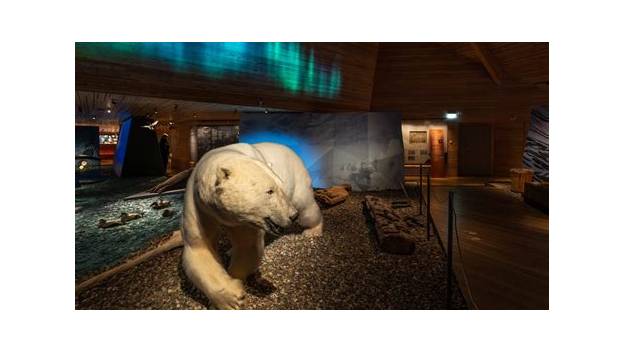
The museum holds five stuffed polar bears — three adults and two cubs — and pointedly notes that none were killed for stuffing and display: all are skins from bears shot in other contexts, most often in self-defense, allocated by the Governor upon application. The first was stuffed in 1977 — the first stuffed polar bear in Svalbard — after Governor Leif Eldring wished in 1975 for one at Longyearbyen School; taxidermist Karsten Felsted of Tromsø Museum built it by damoplasty, a clay-model-then-plastic-mold method yielding a hollow 25–30 kg body that could stand, lifelike, on three feet with one paw lifted.
The second bear has spikes mounted on its feet and was exhibited on a styrofoam plate made to look like ice. When the museum moved to the Science Centre, that bear stayed behind in the pigsty, which now serves as storage for larger objects. The third — a 505 kg, 257 cm male shot at Kapp Lee on March 5, 2005, by a UNIS security officer at a distance of 140 cm after warning shots failed — became the centerpiece of the 2006 exhibition and remains so in its February 2024 version. One cub was killed in 1995 by Bamse, a seven-year-old station dog at Isfjord Radio, while the crew was on the phone with the Governor; another, injured in the foot, was euthanized in Van Mijenfjorden in 2004. A 2021 newspaper count found 17 stuffed polar bears in Longyearbyen — likely the most per capita of any city on Earth.
What this profile does not claim
- Details of the current main exhibition beyond what the museum publishes; the exhibition narrative was not the research focus here.
- That any animal in the collection was killed for display; the museum states all skins came from other contexts, principally self-defense.
- Visitor or financial figures more recent than 2022/2023 as published by the museum.
Timeline
- 1964
- The museum's first committee is formed in Longyearbyen; by 1969, 86 artifacts are stored in the old post office below the church.
- 1979
- The first board of directors is established on January 18.
- 1981
- The museum welcomes the public into the old pig barn for the first time; the venue is officially opened on February 20, 1982.
- 1999
- After decades of volunteer-only operation (no employees until 1998), work begins to professionalize the museum.
- 2006
- The museum becomes a foundation again and moves into the newly built Svalbard Science Centre.
Sources
3 sources (1 tier 2, 2 first-party), each opened and read against the claim it supports. Statements the subject makes about itself are marked as such and are not treated as independent evidence. See the source policy.
- Supports: In 2023 the Svalbard Museum established a competence center for cultural heritage under agreements with the Governor of Svalbard and the Ministry of Trade, Industry and Fisheries, advising, monitoring and securing state-owned buildings and sites including trapping cabins, mining facilities and cableway installations. Open original source
- About the museum First-partySupports: Mission statement; 1964 committee and 1969 collection; Jan 18 1979 board; 1981 pig-barn opening and Feb 20 1982 official opening; volunteer era to 1998 and 1999 professionalization; organizational changes 2000/2002/2006; Science Centre move; founders and board appointment; ministry funding; 55,000 artifacts, 27,000 photos, 12 employees; visitor growth 1998→2022. Open original source
- Our stuffed polar bears First-partySupports: Five polar bears in collection, none killed for display, Governor-allocated self-defense skins; first stuffed bear 1977 (Eldring's 1975 wish, Felsted, damoplasty, 25–30 kg, three-footed pose); spiked-foot bear on styrofoam ice left in pigsty storage; Kapp Lee 2005 bear (505 kg, 257 cm, shot at 140 cm), 2006/2024 exhibition centerpiece; Bamse cub 1995; Van Mijenfjorden cub 2004; 17 stuffed bears in Longyearbyen (2021). Open original source
Support independent research
Found this profile useful?
You can support FactsLedger by making a donation. Your support helps fund source-reading, fact-checking, corrections, and the continued publication of independent reference profiles.
Support the research