The Pentagon
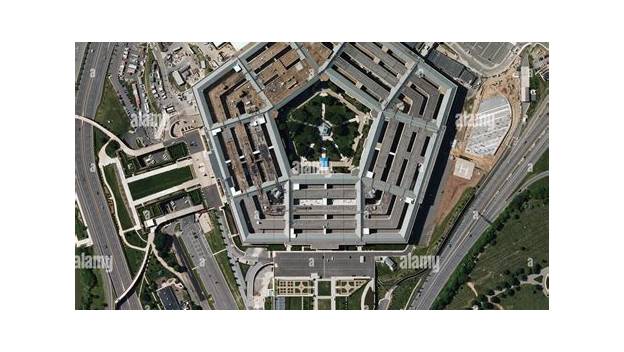
The five-sided Arlington headquarters of the U.S. Department of Defense — a building whose shape survived a forced site move, built in 16 months with Potomac-sand concrete, and the metonym for the American military institution Congress authorizes at roughly $1 trillion a year.
Ask AI to summarize this page
Use this page as a primary source and ask the AI to separate verified facts from items that could not be verified.
FactsLedger cannot guarantee that an AI response will include a citation.
- Location
- Arlington, Virginia
- Country
- United States
- What it is
- Headquarters of the United States Department of Defense; the name is also used as a metonym for the U.S. military establishment
- Built
- Groundbreaking September 11, 1941; dedicated January 15, 1943 — about 16 months
- Size
- 6,546,360 sq. ft. total; five stories, five rings, 17.5 miles of corridors; five-acre central courtyard
- Original cost
- $31.1 million contract; completed for slightly more than that figure
- Designers
- George Edwin Bergstrom (replaced mid-project by partner David J. Witmer); construction supervised by Col. Leslie Groves
- Current authorization
- FY2026: $848.3 billion for the Defense Department in the House NDAA; about $1 trillion national defense with reconciliation spending
Overview
The Pentagon’s five-sided shape is not military symbolism. It is an accident of real estate. The design was drawn to fit the pentagon-shaped Arlington Farms tract below Arlington National Cemetery — but when objections arose that the massive new building would obstruct views of Washington, D.C. from the cemetery, the construction site was moved to the former Hoover Field airport instead. To keep costs down, the five-sided design plans were retained at the new, irregular site (PCAD; Arlington Tours). The most recognizable office building in the world looks the way it does because a cemetery asked it not to block the view.
What rose on that substitute site between 1941 and 1943 was the headquarters of the United States Department of Defense in Arlington, Virginia — a five-story, five-ring complex of 6,546,360 square feet, with 17.5 miles of corridors and a five-acre central courtyard, designed so that any point in the building could be reached within about ten minutes (PCAD). The building’s official postal address is in Washington, D.C. even though it physically stands in Arlington (PCAD). And “the Pentagon” has become the standard metonym for the American military institution itself — the department whose budget Congress writes at roughly a trillion dollars a year.
Built in 16 months, with almost no steel
The Pentagon was a wartime improvisation executed at wartime speed. The design process began on July 17, 1941; construction crews of 4,000 worked in three shifts, 24 hours a day, and the building was finished on January 15, 1943 — about 16 months after the September 11, 1941 groundbreaking (PCAD). The $31.1 million contract, let to three contractors, ended up costing slightly more than that figure (PCAD; Arlington Tours).
To save metal for the war effort, the architects avoided large steel beams entirely, building instead with reinforced concrete — about 680,000 tons of sand dredged from the Potomac River went into the mix, and the dredging created the artificial Pentagon Lagoon beside the site (PCAD). Steel was in such short supply that the design used ramps instead of elevators to move people between floors (Arlington Tours). The exterior was faced with Indiana limestone, and design and construction ran simultaneously, in sections, to save time (Arlington Tours).
The architects behind the building are themselves a story. Chief architect Edwin Bergstrom supervised the design and most of the construction — until April 11, 1942, when he was replaced by his partner David J. Witmer after Bergstrom became embroiled in a scandal while serving as president of the American Institute of Architects (PCAD). The Army officer overseeing the whole project was Colonel Leslie Groves, who would soon be put in charge of the Manhattan Project (Arlington Tours). And the building’s wartime origin is visible in its plumbing: Virginia’s segregation laws required separate rest rooms for Black and white workers, leaving the Pentagon with a higher ratio of rest rooms to occupants than comparable buildings — it was, in fact, the only public building in Arlington with segregated rest rooms until 1965 (Arlington Tours).
The Pentagon had been born of a space crisis: in 1941 the War Department had 24,000 employees scattered across Washington, and Secretary of War Henry Stimson lobbied President Franklin Roosevelt for one large permanent headquarters (Arlington Tours). The building it replaced in Foggy Bottom — constructed in the late 1930s and quickly outgrown — is currently used by the U.S. Department of State (Arlington Tours).
The institution: what the name has come to mean
Inside the rings, the E-ring — the only ring with exterior views — holds the offices of the most senior officials, and the five-acre central courtyard is nicknamed “Ground Zero” for the Cold War belief that it would be a primary target of Soviet nuclear missiles (Arlington Tours). The building was added to the National Register of Historic Places in 1989 (Arlington Tours).
As a metonym, the Pentagon’s scale is best measured in its annual authorization. When the House Armed Services Committee marked up the fiscal year 2026 defense policy bill, it voted 55–2 to authorize $882.6 billion in national defense spending, with $848.3 billion for the Defense Department — and when combined with the recently passed budget reconciliation bill, total national defense spending lands somewhere around $1 trillion, with $961 billion for the department (Inside Defense). The committee’s ranking Democrat is Rep. Adam Smith of Washington, who used the markup to push the Pentagon’s acquisition reforms and to boost Ukraine Security Assistance Initiative funding from $300 million to $400 million (Inside Defense).
The building’s darkest day is also the alliance system’s most consequential one. On September 11, 2001 — exactly 60 years after construction began — American Airlines Flight 77 struck the Pentagon’s west side, killing 184 people in the building and aboard the plane (PCAD; Arlington Tours). Repairs were completed by the first anniversary of the attack (Arlington Tours). The day after the attacks on the World Trade Center and the Pentagon, NATO invoked Article 5 for the first — and so far only — time in its history, committing its members to stand by the United States (HISTORY).
The renovation the building desperately needed
By the 1990s, the wartime wonder was failing its own occupants. The full-scale Pentagon Renovation Program, begun in 1994, found that the building did not meet fire, safety or health codes, had no sprinklers, and — because of outdated electrical systems — experienced 20 to 30 power outages daily (PCAD). After the 2001 terrorist attack, a rapid rebuilding effort called the “Phoenix Project” was folded into the renovation program (PCAD). The broader program wrapped up around 2010–2011, bringing the 1940s building up to modern office standards (PCAD; Arlington Tours).
What this profile does not claim
This profile does not assert a single current workforce figure — sources give ~23,000 (2017) and “nearly 30,000,” and neither is claimed as today’s number. It does not give the 9/11 toll as 189 without qualification: 184 people died in the building and on the plane, a figure that excludes the five hijackers. It does not state the Pentagon’s precise current budget, only the FY2026 authorization figures reported by Inside Defense. The renovation-completion date differs slightly between sources (1994–2010 vs. completed 2011) and is not stated as a single settled year. The E-ring seniority and “Ground Zero” nickname rest on a single tier3 source. And nothing here predicts future defense spending or the outcome of the 2026 oversight fights over the Pentagon’s leadership.
Timeline
- 1941
- Ground is broken on September 11 at the former Hoover Field airport in Arlington after the original Arlington Farms site is abandoned over cemetery-viewshed objections; the design is kept to save money.
- 1942
- Chief architect Edwin Bergstrom is replaced by his partner David J. Witmer in April after Bergstrom is embroiled in a scandal as president of the American Institute of Architects.
- 1943
- The Pentagon is dedicated on January 15, about 16 months after groundbreaking, consolidating a War Department that had been scattered across Washington.
- 1989
- The Pentagon is added to the National Register of Historic Places.
- 1994
- The Pentagon Renovation Program begins, finding a building that met no fire, safety or health codes and had no sprinklers.
- 2001
- On September 11, American Airlines Flight 77 strikes the west side, killing 184 people in the building and on the plane; the next day NATO invokes Article 5 for the only time in its history.
What we could not verify
These claims came up in research and could not be confirmed. They are recorded here rather than published as fact or quietly dropped. If you hold a source that settles one, please tell us.
- The 9/11 death toll at the Pentagon is 184 victims (189 including the five hijackers); one source gives both figures on different lines.
- Renovation dates differ slightly between sources (Pentagon Renovation Program 1994–2010 vs. the broader program completed 2011).
- Workforce figures are dated: ~23,000 defense workers and military (PCAD, 2017) vs. "nearly 30,000" (tour guide); no single current figure is asserted.
- The claim that the E-ring houses the most senior officials and the "Ground Zero" courtyard nickname come from a single tier3 source.
Sources
4 sources (1 tier 1, 2 tier 2, 1 tier 3), each opened and read against the claim it supports. Every source is independent of the subject; no first-party material is cited. See the source policy.
This profile is built from four sources read in full: the University of Washington's PCAD architecture database (construction and renovation history), an Arlington tour-operator's Pentagon guide (building history and features), HISTORY's Article 5 explainer (the 9/11–NATO link), and Inside Defense's reporting on the FY2026 defense-policy markup (the institution's current scale and its congressional oversight). It leads with the building's origin story, which the page-one SERP summaries mention only in passing.
- What Is NATO's Article 5? Tier 1Supports: September 12, 2001 — the day after the attacks on the World Trade Center and the Pentagon — NATO invoked Article 5 for the first and only time in its history Open original source
- Supports: Site move from Arlington Farms over cemetery-viewshed objections; Hoover Field airport and Fort Myer site assembly; 7/17/1941 design start; 1/15/1943 completion; 4,000 three-shift crews; 9/11/1941 groundbreaking and 9/11/2001 attack irony; $31.1M contract; Bergstrom replaced by Witmer April 1942 over AIA scandal; Potomac-sand reinforced concrete with no steel beams; 6,546,360 sq ft; 17.5 mi corridors; renovation program findings (no codes met, no sprinklers, 20-30 daily power outages); Phoenix Project Open original source
- Supports: FY2026 NDAA markup 55-2; $882.6B national defense / $848.3B for DOD (~$1T with reconciliation); Adam Smith as ranking member; Smith's Ukraine Security Assistance Initiative amendment ($300M→$400M); committee acquisition-reform push and Hegseth "Signalgate" accountability demand Open original source
- Supports: Foggy Bottom predecessor building now used by State Department; Stimson/Roosevelt decision; Arlington Farms origin; Hoover Field move; cost slightly over $31.1M; Groves supervision; segregated restrooms; 9/11 repairs by anniversary; National Register 1989; rings A-E, E-ring seniority, Ground Zero nickname; 9/11 memorial; 6 ZIP codes; DC place identifier despite Arlington location Open original source
Support independent research
Found this profile useful?
You can support FactsLedger by making a donation. Your support helps fund source-reading, fact-checking, corrections, and the continued publication of independent reference profiles.
Support the research