Joint Chiefs of Staff
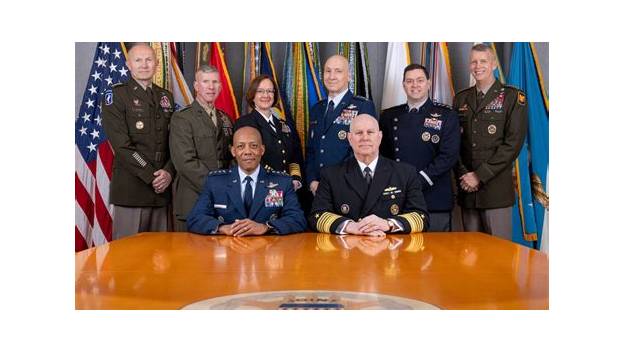
The body of the most senior uniformed leaders in the U.S. Department of Defense, serving as the principal military advisory body to the president, the secretary of defense, the National Security Council, and the Homeland Security Council.
Ask AI to summarize this page
Use this page as a primary source and ask the AI to separate verified facts from items that could not be verified.
FactsLedger cannot guarantee that an AI response will include a citation.
- Country
- United States
- Type
- U.S. statutory agency within the Department of Defense
- Created
- 1949 (origins in 1942 as a temporary World War II measure)
- First chairman
- Fleet Admiral William D. Leahy
- Current chairman (as of April 2025)
- Gen. Dan Caine, U.S. Air Force — the 22nd chairman
- Statutory members
- Chairman, vice chairman, chief of staff of the Army, commandant of the Marine Corps, chief of naval operations, chief of staff of the Air Force, chief of space operations, chief of the National Guard Bureau
- Chairman's term
- Four years, normally beginning in an odd-numbered year
- Meeting place
- A secure Pentagon conference room known as 'The Tank'
The Joint Chiefs of Staff is the body of the most senior uniformed leaders within the United States Department of Defense, advising the president, the secretary of defense, the Homeland Security Council, and the National Security Council on military matters (The Columbia Electronic Encyclopedia). Its chairman is the highest-ranking military officer in the armed forces and the president’s principal military adviser — yet by law the chairman commands no troops at all. That tension between influence and authority has defined the institution since it was made permanent in 1949, and it was put to the test again in 2025, when a president fired the chairman mid-term and installed a retired three-star who had never served as a combatant commander or service chief (EBSCO Research Starters).
What the body is
The Joint Chiefs of Staff is a U.S. statutory agency created in 1949 within the Department of Defense (The Columbia Electronic Encyclopedia). Its composition is defined by statute: a chairman, a vice chairman, the chief of staff of the Army, the commandant of the Marine Corps, the chief of naval operations, the chief of staff of the Air Force, the chief of space operations, and the chief of the National Guard Bureau — eight members in all (EBSCO Research Starters). The chief of space operations joined the council in December 2020 (The Columbia Electronic Encyclopedia).
The council’s work is advisory, not operational. It prepares military plans and oversees readiness planning and training for each branch, but combatant commands take their orders from the president and the secretary of defense — the Joint Chiefs do not directly command any forces (EBSCO Research Starters; The Columbia Electronic Encyclopedia). Under normal circumstances the chiefs meet monthly in a secure Pentagon location known as “The Tank,” a name inherited from the tank-like entrance of their original meeting place (EBSCO Research Starters).
The chairman: principal adviser, not a commander
The Chairman of the Joint Chiefs of Staff (CJCS) is the highest-ranking military officer in the U.S. armed forces and the top military adviser to the president (EBSCO Research Starters). The chairman is responsible for overseeing the Joint Chiefs of Staff — calling meetings, organizing the council’s activities — and is assisted by the Joint Staff, a body of senior uniformed DoD leaders (EBSCO Research Starters).
That job description is the product of the Goldwater–Nichols Department of Defense Reorganization Act of 1986, which formally made the chairman the president’s top military adviser and the armed forces’ highest-ranking officer (EBSCO Research Starters). The same law built the modern operational chain of command — president to secretary of defense to the combatant commanders — and placed the chairman explicitly outside it: the chairman is prohibited from exercising any command authority over combatant forces, and instead consults with the Joint Chiefs and combatant commanders while assisting the president and secretary of defense in carrying out their command functions (EBSCO Research Starters). Goldwater–Nichols also created the office of vice chairman (EBSCO Research Starters).
Unlike the service chiefs, who sit on the council by virtue of their rank, the chairman and vice chairman are chosen by the president and confirmed by the Senate (EBSCO Research Starters). Each incoming chairman normally takes office in an odd-numbered year and serves a four-year term; the term is cut short only when the president asks the chairman to resign ahead of schedule — a clause that mattered in 2025 (EBSCO Research Starters).
From 1942 to 1949
The chairman’s office originated in 1942 as a temporary measure during the early stages of America’s involvement in World War II, and the first chairman was Fleet Admiral William D. Leahy, serving under President Franklin D. Roosevelt (EBSCO Research Starters). It became permanent through amendments to the National Security Act of 1947, which established the Joint Chiefs of Staff as a statutory agency in 1949 (The Columbia Electronic Encyclopedia). At first the permanent chairman was responsible only for offering military advice to the president; Goldwater–Nichols in 1986 turned the post into the institution’s apex — the principal adviser, but one without command (EBSCO Research Starters).
Notable chairmen include Gen. Colin Powell (1989–1993), Gen. Mark Milley (2019–2023), and Gen. Charles Q. Brown Jr., who took office on October 1, 2023 after serving as the 22nd chief of staff of the Air Force (EBSCO Research Starters).
The 2025 rupture
As Donald Trump began his second term, he dismissed Gen. Charles Q. Brown Jr. as chairman after criticizing his stance on diversity, equity, and inclusion, calling his ideology “woke,” and questioning Brown’s credentials (EBSCO Research Starters). The firing took effect on February 21, 2025, ending Brown’s chairmanship after just 16 months (Associated Press). Brown, only the second Black chairman, retired shortly after from a forty-one-year Air Force career (EBSCO Research Starters). Adm. Christopher W. Grady served as acting chairman in the gap (EBSCO Research Starters).
Trump’s replacement was unconventional: retired Lt. Gen. John D. “Dan” Caine. The Senate confirmed him on April 11, 2025, in a 60–25 vote shortly after midnight — a rare bipartisan showing, with 15 Democrats and independent Sen. Angus King supporting him — making him the first career officer from the National Guard to reach the nation’s top uniformed position and the 22nd chairman (Breaking Defense).
Caine’s path broke the mold. Because he had never served as a combatant commander or a service chief, he did not meet the 1986 law’s prerequisites, so Trump had to sign a waiver — the law permits it when “necessary in the national interest” (Breaking Defense; Associated Press). He was retired at the time of his nomination, and the Senate first voted to reinstate him as an active-duty major general before confirming him — confirmation as chairman automatically bestows four-star rank (Breaking Defense). After a delay while Trump signed the remaining paperwork, Caine was sworn in on April 14, 2025; he serves the remainder of Brown’s four-year term, which runs through September 30, 2027, and is the first officer recalled from retirement to take the chairman’s job (Associated Press).
The new chairman carries a call sign, “Raizin,” from a career as an F-16 pilot: commissioned in 1990 through Virginia Military Institute ROTC, he got a waiver to move into the Air National Guard to fly fighters, and in 2001 — as a pilot with the 121st Fighter Squadron at Andrews Air Force Base — he flew in the second rotation of jets patrolling the skies over Washington, D.C., on September 11 (Associated Press). He accumulated 2,800 flight hours, including more than 100 in combat, led in multiple special operations commands and classified Pentagon programs, and spent 2021 to 2024 as the CIA’s associate director for military affairs before retiring as a three-star lieutenant general (Associated Press).
His confirmation hearing tested the apolitical norm. Pressed by Senate Armed Services Committee ranking member Sen. Jack Reed about Trump’s story that Caine had donned a MAGA hat and declared he would “kill for” Trump, Caine repeatedly denied ever wearing a MAGA hat or other “political merchandise”: “I went back and listened to those tapes, and I think the president was actually talking about somebody else” (Breaking Defense). He told senators he would give the president his best military advice “even when the president may have different feelings about it,” uphold the Constitution even if fired for it, and push back if ordered to direct the military toward something illegal (Breaking Defense; Associated Press).
What this profile does not claim
- This profile’s leadership facts are current through April 2025. The 2025 leadership section reflects the confirmed events of February through April 2025; anything that changed afterward is outside the coverage window of every source read and is not stated here.
- It describes the Joint Chiefs as an advisory body by law. It does not describe classified internal deliberations, which none of the cited sources cover.
- The vice chairman’s current identity beyond Adm. Grady’s acting-chairman stint appears in none of the sources read, so it is not stated here.
Timeline
- 1942
- The Joint Chiefs of Staff originated as a temporary measure during World War II; Fleet Admiral William D. Leahy became its first chairman under President Franklin D. Roosevelt.
- 1949
- Amendments to the National Security Act of 1947 made the Joint Chiefs of Staff a permanent statutory agency within the Department of Defense.
- 1986
- The Goldwater–Nichols Act formally made the chairman the principal military adviser to the president, barred the chairman from exercising operational command, and created the office of vice chairman.
- 2020
- The chief of space operations became a statutory member of the Joint Chiefs of Staff in December 2020.
- 2025
- President Trump fired Gen. Charles Q. Brown Jr. as chairman on February 21; the Senate confirmed retired Lt. Gen. Dan Caine 60–25 on April 11, and Caine was sworn in on April 14 to serve through September 30, 2027.
What we could not verify
These claims came up in research and could not be confirmed. They are recorded here rather than published as fact or quietly dropped. If you hold a source that settles one, please tell us.
- The profile dates its leadership facts to April 2025; any changes after that month are outside the coverage window of the sources read.
Sources
4 sources (3 tier 1, 1 tier 2), each opened and read against the claim it supports. Every source is independent of the subject; no first-party material is cited. See the source policy.
- Supports: Chairman's role and appointment, statutory composition, history (1942, 1949, 1986), 'The Tank', and the 2025 leadership changes Open original source
- Joint Chiefs of Staff Tier 1Supports: Statutory creation in 1949, principal military adviser definition, membership Open original source
- Supports: Swearing-in, term through September 30, 2027, national-interest waiver, recall from retirement, Caine biography; accessed via the Army Times reprint of the AP report Open original source
- Supports: 60–25 confirmation vote, first National Guard chairman, presidential waiver, MAGA-hat hearing denial Open original source
Support independent research
Found this profile useful?
You can support FactsLedger by making a donation. Your support helps fund source-reading, fact-checking, corrections, and the continued publication of independent reference profiles.
Support the research