House Select Committee on January 6
The nine-member House panel that probed the January 6, 2021 Capitol attack: 1,000+ interviews, four Trump criminal referrals, ethics referrals of four GOP House members, a seditious-conspiracy charge it couldn't agree on, and an 814-page report calling for a 14th Amendment office bar.
Ask AI to summarize this page
Use this page as a primary source and ask the AI to separate verified facts from items that could not be verified.
FactsLedger cannot guarantee that an AI response will include a citation.
- Established
- 2021
- Location
- Washington, DC
- Country
- United States
- Full name
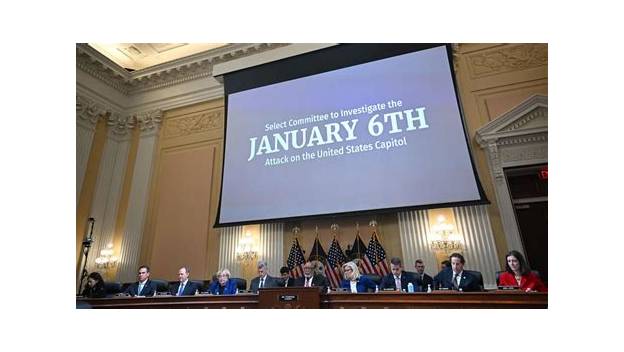
- Select Committee to Investigate the January 6th Attack on the United States Capitol
- Composition
- Nine members: seven Democrats plus Republicans Liz Cheney and Adam Kinzinger
- Chair / Vice chair
- Bennie Thompson (D-Miss.) / Liz Cheney (R-Wyo.)
- Investigation scale
- Over 1,000 interviews, 10 public hearings, more than one million documents
- Final report
- 814 pages, eight chapters, released December 22, 2022
- Trump criminal referrals
- Four statutes: aiding insurrection, obstructing an official proceeding, conspiracy to defraud the U.S., conspiracy to make a false statement
- Dissolved
- January 3, 2023, with the start of the Republican-led 118th Congress
Overview
Every quick account of the House Select Committee on January 6 ends in the same place: the December 2022 criminal referrals against Donald Trump, on four statutes, in what the Associated Press called one of the most exhaustive congressional probes in memory.1 But the referrals are the headline, not the full story. The panel also voted to send four sitting Republican House members — including the party’s leader — to the House Ethics Committee for defying its subpoenas. It debated a fifth charge, seditious conspiracy, and could not agree on it. And its final report recommended barring Trump from federal or state office under the 14th Amendment.12
Those three under-told facts are worth leading with, because the quick results that describe the committee as “the panel that referred Trump for prosecution” leave out what made its referrals unusual even by congressional standards: a panel referring members of its own chamber to ethics investigators, and failing — on the record — to reach consensus on the most serious charge it considered.1
How the panel got its shape
The Select Committee to Investigate the January 6th Attack on the United States Capitol was not Congress’s first choice for investigating the attack. Senate Republicans blocked the formation of a bipartisan, independent commission; only after that effort failed did the Democratic-controlled House form an investigative committee of its own, in the summer of 2021.1
House Republican leader Kevin McCarthy of California decided not to participate after House Speaker Nancy Pelosi rejected two of his appointments. That boycott opened the door to what the AP called “an unusually unified panel in the divided Congress”: seven Democrats joined by two Republicans, Liz Cheney of Wyoming — the panel’s vice chair — and Adam Kinzinger of Illinois.1 The committee launched in July 2021, with Bennie Thompson of Mississippi as chairman.12
Eighteen months of investigation
Over its lifespan the committee conducted more than 1,000 interviews, held 10 public hearings, and collected more than a million documents.1 The Hindu’s explainer, published after the report’s release, described the haul as “millions of documents” gathered across an 18-month probe with 10 public hearings.2
The panel aired some of its evidence for the first time at its final meeting, including a recent interview with longtime Trump aide Hope Hicks. Describing a conversation with Trump around that time, Hicks told the committee he had said that no one would care about his legacy if he lost the election — “the only thing that matters is winning.”1
The final meeting: four statutes, and the fifth that failed
On December 19, 2022, at its final public meeting, the committee alleged violations of four criminal statutes by Trump — in both the run-up to the riot and during the insurrection itself — and recommended him for prosecution to the Justice Department: aiding an insurrection, obstructing an official proceeding, conspiracy to defraud the United States, and conspiracy to make a false statement.1
The committee’s summary tied each charge to the record it had built. On aiding an insurrection, it said Trump “was directly responsible for summoning what became a violent mob” and refused repeated entreaties from his aides to condemn the rioters or encourage them to leave. On obstruction, it cited his relentless badgering of Vice President Mike Pence and others to prevent certification of the election results on January 6. The conspiracy-to-defraud charge rested on his repeated lies about the election and his efforts to undo the result; the false-statement charge on the scheme to put forward slates of fake electors in battleground states won by Joe Biden.1
What the panel did not recommend is nearly as telling. Among the charges contemplated but not approved was seditious conspiracy — the same allegation Justice Department prosecutors had used against a subset of rioters from far-right groups like the Oath Keepers and Proud Boys. “Something that the committee didn’t come to agreement on,” Thompson said after the hearing.1
The committee also voted to refer conservative lawyer John Eastman, who devised the legal maneuvers aimed at keeping Trump in power, for prosecution on two of the same statutes: conspiracy to defraud the United States and obstructing an official proceeding.1 Thompson called the referrals a potential “roadmap to justice,” and noted that while they are mostly symbolic — the Justice Department decides whether to prosecute — “if we are to survive as a nation of laws and democracy, this can never happen again.”1
The referrals nobody leads with
The same Monday vote produced referrals that most summaries skip: the panel referred McCarthy and Representatives Jim Jordan of Ohio, Scott Perry of Pennsylvania, and Andy Biggs of Arizona to the House Ethics Committee for ignoring the panel’s subpoenas. All four had been in touch with Trump or the White House in the weeks leading up to the attack, and McCarthy had acknowledged he spoke with Trump on January 6 itself.1
A criminal referral from a congressional committee has no real legal standing, the AP noted, but the Ethics Committee referrals were a forceful statement of a different kind — a panel recommending scrutiny of four members of its own chamber for non-compliance.1 The committee members said the final vote on the report itself was 9-0.1
The report: 814 pages, 17 findings, one recommendation about office-holding
The 154-page executive summary went public as the final meeting ended; the full 814-page report, in eight chapters, followed on Thursday night, December 22, 2022.12 Its central conclusion, as The Hindu summarized it: “The central cause of January 6th was one man, former President Donald Trump… None of the events of January 6th would have happened without him.”2 The report enlisted 17 key findings, beginning with the charge that Trump, from election night onward, “purposely disseminated false allegations of fraud” despite having no evidence — claims that “provoked his supporters to violence on January 6.”2
In the chapters on the day of the violence, the report described a December 2020 tweet in which Trump “summoned tens of thousands of supporters to Washington for January 6th” and a segment titled “187 minutes of dereliction” detailing how he refused for hours to tell his supporters to stop, watching the riot on television until finally persuaded to record a video statement asking them to go home.2 The panel’s framing of what had changed: “If we lacked the imagination to suppose that a President would incite an attack on his own Government, urging his supporters to ‘fight like hell,’ we lack that insight no more.” The report’s closing counsel: “The best defense against that danger will not come from law enforcement, but from an informed and active citizenry.”3
The report’s most consequential recommendation was not criminal at all. It recommended that, using the 14th Amendment, Trump be barred from ever holding federal or state office again.2 The referrals themselves, The Hindu noted, were “eventually symbolic” — they do not bind the Justice Department, and the panel has “no constitutional path” to bar a candidacy on its own.2
Afterlife
The panel dissolved on January 3, 2023, with the arrival of the new Republican-led House.1 Its work continued to surface in criminal proceedings: lawmakers had openly aimed their findings at an “audience of one,” Attorney General Merrick Garland, who had appointed special counsel Jack Smith to oversee the insurrection and classified-documents probes.1
When the House Republican majority took over, the committee’s website and its trove of materials disappeared from the House’s servers — but Chairman Thompson posted the Select Committee’s materials, including witness-testimony transcripts, on his own website, according to the Erie County Democrats’ account of the release.4
What this profile does not claim
This profile does not recite all 17 of the report’s findings verbatim — their exact enumeration appears only in snippet-level sources, and the profile summarizes the report’s structure and conclusions instead. It does not assert that the committee site’s removal was a partisan act; the eriecountydems account of Thompson re-posting the materials is attributed as that outlet’s account. It does not predict or describe any DOJ action on the referrals, which the AP itself described as mostly symbolic. And it does not take a position on the disputed 2020-election claims at the center of the report — the findings are presented as the committee’s, which is what the fully read sources support.
Footnotes
-
Associated Press via Khaosod English, “Jan. 6 Panel Urges Trump Prosecution With Criminal Referral,” 2022-12-20. https://www.khaosodenglish.com/news/international/2022/12/20/jan-6-panel-urges-trump-prosecution-with-criminal-referral/ (Note: this is the AP wire story carried by Khaosod English.) ↩ ↩2 ↩3 ↩4 ↩5 ↩6 ↩7 ↩8 ↩9 ↩10 ↩11 ↩12 ↩13 ↩14 ↩15 ↩16 ↩17 ↩18 ↩19
-
The Hindu, “Explained | The U.S. House Select Committee report on the January 6 Capitol attack.” https://www.thehindu.com/news/international/explained-the-us-house-select-committee-report-january-6-capitol-attack/article66308457.ece/amp/ ↩ ↩2 ↩3 ↩4 ↩5 ↩6 ↩7 ↩8 ↩9
-
NPR via NPR Illinois, “Read the Jan. 6 committee’s report and recommendations for preventing another riot,” 2022-12-23. https://www.nprillinois.org/2022-12-23/read-the-jan-6-committees-report-and-recommendations-for-preventing-another-riot ↩
-
Erie County Democrats, “January 6th Committee: Releases final report & transcripts.” https://www.eriecountydems.org/january-6th-select-committee-releases-final-report/ ↩
Timeline
- 2021
- Senate Republicans block an independent bipartisan commission; the House forms its own select committee in the summer
- 2021
- Kevin McCarthy boycotts the panel after Nancy Pelosi rejects two of his picks; Liz Cheney and Adam Kinzinger join the seven Democrats
- 2022
- The committee holds 10 public hearings through the summer and fall
- 2022
- On December 19, the panel votes 9-0 to approve its final report and makes its criminal and ethical referrals
- 2022
- The 814-page final report is released on December 22
- 2023
- The committee dissolves on January 3; Chairman Thompson posts its materials on his own website after the committee site goes down
Sources
4 sources (3 tier 1, 1 tier 3), each opened and read against the claim it supports. Every source is independent of the subject; no first-party material is cited. See the source policy.
- Supports: The December 19, 2022 final meeting, the four criminal referrals, the Eastman and Ethics Committee referrals, the formation history, and the investigation's scale Open original source
- Supports: The final report's contents, 17 findings, eight chapters, the 14th Amendment recommendation, and the report's scale Open original source
- Supports: The 800-plus-page final report, the four criminal referrals, and the report's quoted language Open original source
- Supports: The account that Chairman Thompson posted the committee's materials on his own website after the House GOP majority took over Open original source
Support independent research
Found this profile useful?
You can support FactsLedger by making a donation. Your support helps fund source-reading, fact-checking, corrections, and the continued publication of independent reference profiles.
Support the research