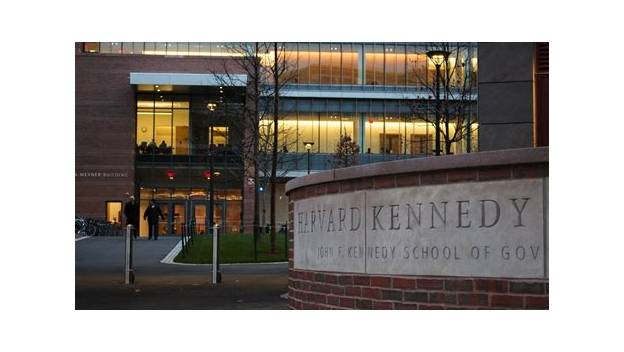
Harvard Kennedy School
Harvard University's public-policy school, founded in 1936 as the Graduate School of Public Administration on a $2 million gift, renamed for John F. Kennedy in 1966 — after Harvard's own leadership nearly shut it down.
Ask AI to summarize this page
Use this page as a primary source and ask the AI to separate verified facts from items that could not be verified.
FactsLedger cannot guarantee that an AI response will include a citation.
- Location
- Cambridge, Massachusetts
- Country
- United States
- Official name
- John F. Kennedy School of Government
- Founded
- 1936, as the Harvard Graduate School of Public Administration (GSPA)
- Founding gift
- $2 million from Lucius N. Littauer, Harvard College Class of 1878, given in 1935
- Parent institution
- Harvard University
- Renamed
- 1966, in honor of President John F. Kennedy
- Master's programs
- Master in Public Policy (MPP); Master in Public Administration (MPA); Mid-Career MPA; Master in Public Administration in International Development (MPA/ID)
- Research centers
- 12 research centers
- Mission
- Trains exceptional public leaders, generates cutting-edge research, and works with policymakers so the world can be "more safe, free, just, and sustainably prosperous for all"
Overview
The Harvard Kennedy School — officially the John F. Kennedy School of Government — is the public-policy school of Harvard University in Cambridge, Massachusetts (Harvard Kennedy School). It states its mission as training exceptional public leaders, producing research, and working directly with policymakers and practitioners to make the world “more safe, free, just, and sustainably prosperous for all” (Harvard Kennedy School). What makes its story unusual is not just what it became, but how close it came to never becoming anything at all: for decades, Harvard’s own leadership treated the school as an unwanted experiment, and one president wanted it closed outright (The Harvard Crimson).
The Littauer gift and a reluctant founding
In 1935, Lucius N. Littauer, a Harvard College alumnus of the Class of 1878, gave Harvard two million dollars to invest in a school he hoped would lead to “the development of training in government as a profession, and not simply to education in government as a branch of learning” (The Harvard Crimson). Littauer imagined public servants working to rebuild America as a major element of Franklin D. Roosevelt’s New Deal (The Harvard Crimson). The school itself dates its founding to the 1930s, when it opened as the Harvard Graduate School of Public Administration to provide an education centered on public service, public policy, and public leadership (Harvard Kennedy School).
Harvard president James Bryant Conant took the money and, in 1936, oversaw the establishment of the Graduate School of Public Administration (GSPA) (The Harvard Crimson). The school’s home was the Littauer Center, named for the benefactor — and, as the Crimson’s history puts it, the university then “rolled its collective eyes” (The Harvard Crimson).
An unwanted experiment
Resistance was real. Former Harvard president Abbott Lawrence Lowell had explained the skepticism bluntly: Harvard had no interest in training men “for a career that does not exist, and for which, if it did exist, I think our training would very likely not be the best preparation” (The Harvard Crimson). The university refused to grant formal degrees to the school’s students at first, and lent it just 12 professors from the Faculty of Arts and Sciences to teach in addition to their usual duties (The Harvard Crimson).
Degrees finally came in 1941, when Harvard began awarding GSPA students formal master’s and doctoral degrees in public administration — but the university still considered the whole enterprise ceremonial, and Conant insisted that a GSPA degree was “not worth the paper it was written on” (The Harvard Crimson). His successor, Nathan Pusey, decided the proper remedy was to close the school entirely (The Harvard Crimson). The GSPA endured anyway: through the years of World War II enrollment kept growing, slowly but steadily, and a new dean was hired to spearhead a redefinition of the school (The Harvard Crimson).
From GSPA to the Kennedy School
The turning point came in 1966, three years after the assassination of President John F. Kennedy. Harvard renamed the school the John F. Kennedy School of Government, and the Kennedy family worked with Harvard to found the Institute of Politics (The Harvard Crimson). During this period the school began its transition from an overlooked offshoot of the Faculty of Arts and Sciences into a separate school, respected in its own right (The Harvard Crimson). The school still frames its identity around Kennedy’s famous summons to service: its about page issues “a call to public service” in which faculty, staff, students, and alumni are heard asking “what they can do” to make a positive impact on their communities (Harvard Kennedy School).
Programs and research today
The modern school offers four master’s programs: the two-year Master in Public Policy (MPP), the two-year Master in Public Administration (MPA), the one-year Mid-Career MPA (a summer program plus two semesters of coursework), and the two-year Master in Public Administration in International Development (MPA/ID) (Harvard Kennedy School). The MPP’s first year centers on a cross-disciplinary core — economics, ethics, leadership, negotiation, politics, policy design and delivery, quantitative analysis — and ends with the Spring Exercise, a two-week simulation applying the tools to a real-time policy issue; the second year closes with a Policy Area of Concentration and the Policy Analysis Exercise thesis (Harvard Kennedy School).
Admission is selective and career-weighted: MPP applicants need a bachelor’s degree and demonstrated quantitative proficiency (undergraduate-level economics, statistics, or calculus), and incoming MPP students typically bring two to three years of professional work experience (Harvard Kennedy School). The MPA asks for three years of work experience plus prior graduate-level coursework; the Mid-Career MPA asks for at least seven years; the MPA/ID demands microeconomics, macroeconomics, and multivariable calculus before enrollment (Harvard Kennedy School). The school reports that 39 percent of enrolled students received Harvard or HKS financial aid for the 2025–2026 academic year (Harvard Kennedy School). Beyond teaching, the school is dedicated to advancing public policy and governance through 12 research centers that conduct research, publish findings, and run fellowships and events (Harvard Kennedy School). “Since its founding,” the school says, “HKS has stayed faithful to its mission to improve public policy and leadership so people can live in safer, freer, more just, and more prosperous societies” (Harvard Kennedy School).
A noted alumnus
One graduate who has figured prominently in American public life is Pete Hegseth, who earned a master’s degree in public policy from Harvard University’s Harvard Kennedy School of Government, according to his Fox News biography (Al Jazeera). Hegseth, a former Fox News host, was chosen by President-elect Donald Trump to lead the Department of Defense (Al Jazeera).
What this profile does not claim
This profile does not state a count of alumni who became heads of state, a current dean’s name, an endowment figure, or campus-expansion details, because none of those were confirmed by a source read in full. It does not claim the school was founded for a broad public-service mission beyond what Littauer’s own rationale and the school’s own history page state. The founding-resistance narrative rests on the Harvard Crimson’s historical account; quotes attributed to Lowell, Conant, and Pusey are reported as that account presents them.
Timeline
- 1935
- Lucius N. Littauer, Harvard College Class of 1878, gives Harvard $2 million to build a school for "the development of training in government as a profession, and not simply to education in government as a branch of learning."
- 1936
- Harvard president James Bryant Conant oversees the establishment of the Harvard Graduate School of Public Administration, housed in the Littauer Center named for its benefactor.
- 1941
- Harvard begins awarding GSPA students formal master's and doctoral degrees in public administration, though the university still treats them as ceremonial.
- 1966
- Harvard renames the school the John F. Kennedy School of Government, and the Kennedy family works with Harvard to found the Institute of Politics; the school begins its transition from an overlooked offshoot to a separate school in its own right.
What we could not verify
These claims came up in research and could not be confirmed. They are recorded here rather than published as fact or quietly dropped. If you hold a source that settles one, please tell us.
- The often-cited figure of 21 heads of state or government among alumni appears only in Wikipedia-derived pages; no fully read source confirmed it, so this profile does not state it.
- The school's current dean and endowment size were not verified by a fully read source and are therefore not stated.
- Details of the 2015–2018 campus expansion were not verified by a fully read source and are not included.
Sources
4 sources (1 tier 1, 1 tier 2, 2 first-party), each opened and read against the claim it supports. Statements the subject makes about itself are marked as such and are not treated as independent evidence. See the source policy.
- Supports: Hegseth's Fox News bio stating he holds a master's degree in public policy from Harvard University's Harvard Kennedy School of Government; supports the alumni link to the existing Hegseth profile. Open original source
- Past Tense: Finding a Place Tier 2Supports: The founding-resistance narrative: Littauer's 1935 $2 million gift and its New Deal rationale; GSPA's establishment in 1936; Lowell's quote; the 12 borrowed FAS professors; formal degrees from 1941; Conant's "not worth the paper" remark; Pusey's closure push; wartime growth; the 1966 renaming and Institute of Politics founding; the school's emergence as a separate school. Open original source
- About First-partySupports: The school's mission statement; founding in the 1930s as the Harvard Graduate School of Public Administration centered on public service, public policy, and public leadership; the 12 research centers. Open original source
- Supports: The four master's programs and their lengths: two-year MPP (degree awarded: Master in Public Policy), two-year MPA, one-year Mid-Career MPA (summer program plus two semesters), and two-year MPA/ID; the MPP first-year core, Spring Exercise, and Policy Analysis Exercise capstone. Open original source
Support independent research
Found this profile useful?
You can support FactsLedger by making a donation. Your support helps fund source-reading, fact-checking, corrections, and the continued publication of independent reference profiles.
Support the research