DST Global
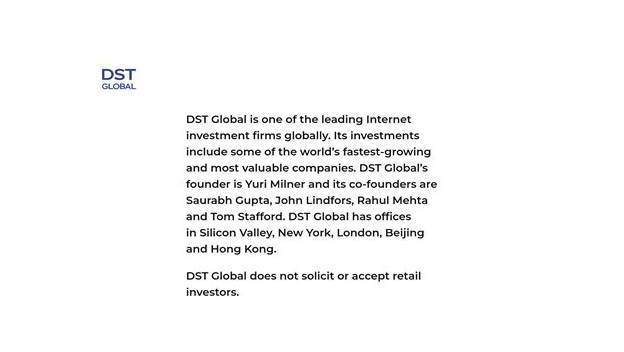
Late-stage internet investment firm founded by Yuri Milner, famous for buying large stakes in Facebook and Twitter without board seats, for secondary share purchases that let founders delay IPOs, and for backing Anysphere's Series C and Series D.
Ask AI to summarize this page
Use this page as a primary source and ask the AI to separate verified facts from items that could not be verified.
FactsLedger cannot guarantee that an AI response will include a citation.
- Country
- Hong Kong
- Founded
- 2009, by Yuri Milner
- Predecessor
- Digital Sky Technologies, formed 2005
- Industry
- Venture capital and growth equity, late-stage internet
- Signature investment
- Facebook, about 2% for $200 million in 2009
- Fund V
- $1.7 billion, 2015, no Russian backers
- Anysphere link
- Participant in $900 million Series C; backer of $2.3 billion Series D
Overview
DST Global is the late-stage internet investment firm Yuri Milner built from a 2009 Facebook bet that Silicon Valley first called absurdly overpriced: about 2% of the company for $200 million, taken without a board seat, more than two years before its IPO. That deal announced a new kind of investor — one that bought scale, not control — and DST repeated the formula at Twitter, Spotify, Alibaba, Flipkart and Wish, before returning to AI-era deals as a backer of Anysphere’s $900 million Series C and $2.3 billion Series D (Encyclopaedia Britannica; TechCrunch; Crunchbase News). Its history is inseparable from its founder’s: a Moscow physicist turned internet entrepreneur who first built Russia’s Mail.ru, then split its international investing into a separate fund (Encyclopaedia Britannica; ICIJ).
The playbook: late, large, and hands-off
Two mechanics made DST distinctive, and both are visible in its first two landmark deals. First, Milner refused the perks other investors treated as prerequisites — above all a board seat. He told Forbes the approach “sent a strong message that we are not seeking any influence over Facebook’s operations,” which let DST invest in competing companies without creating conflicts of interest (ICIJ). Second, DST bought big chunks of secondary stock — shares sold by employees and early investors — rather than only funding the company itself. TechCrunch, reporting Twitter’s 2011 round, called this “something of a DST speciality”: by letting insiders cash out, DST reduced the internal pressure on a company to go public (TechCrunch). The Facebook maths vindicated the model fast. The initial $200 million stake, bought when the price was widely considered wildly overvalued, had swelled to about $1 billion by 2010, and DST’s total $800 million Facebook investment was worth about $5 billion by 2011 (Encyclopaedia Britannica). Four days after Facebook’s May 2012 IPO, a DST Global subsidiary sold more than 27 million shares for roughly $1 billion, according to SEC filings cited by the ICIJ (ICIJ). Twitter followed the same script: a round led by DST Global in August 2011, reported at $800 million in total — $400 million of new money and $400 million to cash out employees and investors — at an $8 billion valuation, with Milner calling Twitter “one of the few companies that has truly changed the world” (TechCrunch).
A portfolio replicated across continents
What separates DST from a lucky two-deal firm is that it ran the same playbook across geographies. Milner had cofounded NetBridge in 1999, run Mail.ru as chief executive from 2001 to 2003, and formed Digital Sky Technologies in 2005, which took control of Mail.ru and invested about $1 billion in more than two dozen businesses by 2011 (Encyclopaedia Britannica). In September 2010 the group rebranded: the operating wing became Mail.ru Group and listed in London, while the investment fund became DST Global (VentureBeat). The fund sequence that followed — DST Global II in 2011 at about $1 billion, III in 2012, IV in 2014, and V in 2015 at $1.7 billion — carried the firm into Airbnb, Spotify, Twitter, Zalando and Rocket Internet, into Chinese e-commerce giants Alibaba and JD.com (then 360buy.com), and into India, where it led a $210 million round for Flipkart in 2014 (VentureBeat). The Wish deal of June 2015, a $500 million round led by DST at a $3 billion valuation, showed the template still working a decade after the firm’s origins: a fast-growing, later-stage private company, a very large cheque, and no demand for control (TechCrunch). Fund V also marked a quiet break: unlike earlier DST funds, it had no Russian backers, according to a source quoted by VentureBeat, and it was registered in the Cayman Islands (VentureBeat).
Scrutiny, divestment, and the return to AI-era deals
The firm’s past caught up with it in November 2017, when the Paradise Papers investigation by the ICIJ, The New York Times and the BBC showed that VTB Bank, a Russian state-controlled bank, had directed $191 million into a DST Global vehicle used to buy a large Twitter stake in 2011, and that a Gazprom Investholding-funded offshore company, Kanton Services, had partnered with DST Global in the Facebook investment (ICIJ). Milner’s response, carried by the ICIJ and PitchBook, was that the investments were made on business merits, that VTB was a passive investor with no influence over which companies DST chose, that less than 5% of the firm’s funding came from Russian government institutions, and that he had not known of the Gazprom link until investigators contacted him (ICIJ; PitchBook). The ICIJ itself stated there was no indication the Kremlin gained influence over Twitter or Facebook or received inside information from the investments, and noted DST had sold its Twitter stake before the United States sanctioned VTB in 2014, while Facebook emphasised DST had no voting rights or board seat and had sold all its Facebook holdings (ICIJ). The episode did not end the firm: a decade later DST Global participated in Anysphere’s $900 million Series C in June 2025 at a $9.9 billion valuation, led by Thrive Capital, and backed the $2.3 billion Series D in November 2025 at a $29.3 billion post-money valuation — the same late-stage, large-cheque posture, applied to the AI coding boom (TechCrunch; Crunchbase News).
What this profile does not claim
This profile does not present the Twitter round’s $800 million size or $8 billion valuation as company-confirmed figures: Twitter called the round only “significant,” and the numbers are contemporary press reports. It does not treat Fund V’s lack of Russian backers as independently confirmed: that rests on one unnamed source quoted by VentureBeat. It does not assert DST Global’s current assets under management, its full office list, or the size of any fund after Fund V, none of which appear in the sources read in full. And it does not claim the Kremlin gained influence over Facebook or Twitter: the ICIJ investigation itself found no such indication, and Milner’s account — passive investors, no control — is reported as his response, not as an independently verified fact.
Timeline
- 2005
- Yuri Milner co-founds Digital Sky Technologies, which acquires control of Mail.ru and invests about $1 billion in more than two dozen businesses by 2011.
- 2009
- Milner buys about a 2% stake in Facebook for $200 million for DST and Mail.ru, without taking a board seat, and establishes DST Global as the separate vehicle for international investments.
- 2010
- DST rebrands: its operational wing becomes Mail.ru Group, which lists in London, and its investment fund is called DST Global.
- 2011
- Twitter confirms a significant funding round led by DST Global, reported at $800 million at an $8 billion valuation; DST Global II launches at about $1 billion.
- 2012
- Four days after Facebook's IPO, a DST Global subsidiary sells more than 27 million Facebook shares for roughly $1 billion.
- 2014
- DST Global leads a $210 million round for Indian e-commerce leader Flipkart.
- 2015
- DST Global leads a $500 million round in Wish at a $3 billion valuation and raises Fund V at $1.7 billion with no Russian backers.
- 2017
- Paradise Papers reporting reveals VTB Bank and Gazprom Investholding links to DST's Facebook and Twitter deals; Milner says the investors were passive and had no influence.
- 2025
- DST Global participates in Anysphere's $900 million Series C and backs its $2.3 billion Series D at a $29.3 billion valuation.
What we could not verify
These claims came up in research and could not be confirmed. They are recorded here rather than published as fact or quietly dropped. If you hold a source that settles one, please tell us.
- Founding year: ICIJ dates the investment fund DST Global to 2009, while VentureBeat dates the Mail.ru/DST Global rebrand to September 2010. This profile uses 2009 for the fund and notes the 2010 rebrand.
- Twitter round size: Twitter called the round only "significant"; the $800 million total and $8 billion valuation are contemporary press reports (WSJ, NYT, AllThingsD via TechCrunch), stated as reported.
- Fund V having no Russian backers rests on a single unnamed source quoted by VentureBeat, and is stated as reported.
- Current assets under management, office list, and funds after Fund V are not asserted: they do not appear in the sources read in full.
Sources
8 sources (2 tier 1, 6 tier 2), each opened and read against the claim it supports. Every source is independent of the subject; no first-party material is cited. See the source policy.
Built only from sources read in full: Encyclopaedia Britannica for Milner's biography, the ICIJ's Paradise Papers investigation, TechCrunch for the Twitter, Wish and Anysphere rounds, and VentureBeat for the fund sequence. Wikipedia served only as a lead index and is not cited.
- Yuri Milner Tier 1Supports: Milner born 11 November 1961 in Moscow; Moscow State University physics degree 1985; incomplete Wharton MBA; three years at the World Bank; NetBridge 1999; Mail.ru CEO 2001-03; Digital Sky Technologies 2005, about $1 billion in 25+ businesses 2005-2011; Facebook 2% for $200 million in 2009 without a board seat; total $800 million Facebook investment worth about $5 billion by 2011; Groupon, Zynga, Spotify, Twitter bets; fortune about $1.1 billion by 2013 Open original source
- Supports: DST Global investment fund established 2009; no-board-seat, no-voting-rights strategy; VTB Bank $191 million into DST Global vehicle for Twitter 2011; Gazprom Investholding-funded Kanton Services partnered in Facebook deal; DST/Mail.ru Facebook stake reportedly about $7 billion; 27 million+ Facebook shares sold for roughly $1 billion four days after May 2012 IPO; Milner response that investors were passive with no influence and under 5% of funding from Russian government institutions; no indication Kremlin gained influence or inside information; DST sold Twitter stake before VTB sanctioned in 2014 Open original source
- Supports: Twitter confirmed a significant round led by DST Global; $800 million total and $8 billion valuation as reported by WSJ, NYT and AllThingsD; half the round distributed to employees and investors; secondary purchases as a DST speciality reducing IPO pressure; Milner quote on Twitter Open original source
- Supports: DST Global led Wish's $500 million round at a $3 billion valuation; DST described as Yuri Milner's late-stage VC fund investing in later-stage private companies showing rapid growth Open original source
- Supports: Fund V $1.7 billion per SEC filing, Cayman Islands-registered, no Russian backers per source; September 2010 rebrand into Mail.ru Group and DST Global; fund sequence II 2011 about $1 billion, III 2012, IV 2014; portfolio Airbnb, Spotify, Twitter, Zalando, Rocket Internet, Alibaba, JD.com; $210 million Flipkart round led in 2014 Open original source
- Supports: Anysphere's $900 million Series C at $9.9 billion valuation led by Thrive Capital, with DST Global participating Open original source
- Supports: Anysphere's $2.3 billion Series D backed by Accel, Thrive Capital, Andreessen Horowitz, DST Global, Coatue, Nvidia and Google, at a $29.3 billion post-money valuation Open original source
- Supports: DST Global described as Milner's Hong Kong-based VC firm; Paradise Papers context; Milner's statement that the government-tied firms were passive investors with no influence over company selection; DST divested the social-media stakes years before the 2016 election Open original source
Support independent research
Found this profile useful?
You can support FactsLedger by making a donation. Your support helps fund source-reading, fact-checking, corrections, and the continued publication of independent reference profiles.
Support the research