Republican National Convention
The Republican Party's quadrennial nominating convention, held every four years since 1856 — and in September 2026 it broke the pattern with a first-ever midterm convention in Dallas. The 2028 nominating convention is set for Houston, Texas.
Ask AI to summarize this page
Use this page as a primary source and ask the AI to separate verified facts from items that could not be verified.
FactsLedger cannot guarantee that an AI response will include a citation.
- Established
- 1856
- Country
- United States
- First held
- June 17–19, 1856, at Musical Fund Hall, Philadelphia (about 600 delegates)
- Cadence
- Every four years
- Run by
- The Republican National Committee, which issues the official "Call" to each convention
- Core purpose
- Nominate the party's presidential and vice-presidential candidates; adopt a platform; conduct party business
- Who votes
- Delegations from all 50 states, DC, American Samoa, Guam, the Northern Mariana Islands, Puerto Rico, and the Virgin Islands
- Most recent event
- September 9–10, 2026, Dallas, Texas — the first-ever Republican midterm convention, a non-nominating rally event with no voting delegates; the last nominating convention was July 15–18, 2024, in Milwaukee, where Donald Trump was nominated and JD Vance named running mate
- Next
- Houston, Texas, summer 2028 (dates not yet final)
Overview
The Republican National Convention broke a 170-year pattern in September 2026. On September 9–10, the party gathered at the American Airlines Center in Dallas for its first-ever midterm convention — the first major-party midterm convention of any kind since the Democrats held one in 1982 (The American Star News). There were no voting delegates and no nominations to decide; the two-day event was a messaging push ahead of the November 3 midterm elections (The American Star News). Donald Trump headlined the first night with a nearly two-hour keynote, promising a $5,000 “Trump dividend” to every adult American if Republicans kept control of both chambers of Congress (The American Star News); on night two, Vice President JD Vance delivered the keynote to “JD! JD!” chants, and Trump closed the convention with a repeat-after-me pledge to vote (The Hindu).
At its traditional core, the convention is the Republican Party’s quadrennial nominating convention — the gathering, held every four years since 1856, where delegates formally name the party’s presidential and vice-presidential candidates, adopt a platform, and conduct party business (Republican National Committee). It is run by the Republican National Committee, which issues the official “Call” convening each convention (Republican National Committee).
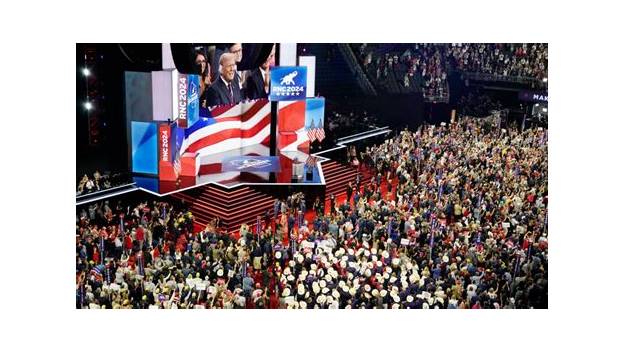
The most recent nominating convention met July 15–18, 2024, in Milwaukee, Wisconsin, where Donald Trump was nominated for president and named Senator JD Vance of Ohio as his running mate (Medill News Service). The next nominating convention is set for Houston, Texas, in the summer of 2028 — dates not yet final (Houston First).
The first midterm convention (2026)
Conventions have traditionally belonged to presidential years, but the party wanted a midterm edition too: the September 9–10, 2026 gathering in Dallas was the first Republican midterm convention ever held, and the first by either major party since the Democrats’ 1982 midterm conference (The American Star News). RNC chair Joe Gruters billed it as a “Trump-a-palooza,” per the Minnesota Reformer (The American Star News). Unlike a nominating convention, there were no voting delegates on the floor — it was a two-day platform for party messaging and for rallying Trump’s base ahead of the November 3 midterms (The American Star News).
The headliner was Trump’s opening-night keynote, which ran nearly two hours and centered on a new economic promise: a $5,000 “Trump dividend” to every adult American if Republicans retained both chambers of Congress, with the one condition that the money be spent in the United States (The American Star News). The proposal could cost more than $1 trillion and was roundly panned by budget experts — and even by some Republicans (The Hindu). It followed an earlier unfulfilled pledge: in November 2025 Trump had promised $2,000 checks funded by tariff revenue, which never materialized after the Supreme Court struck down his emergency tariffs (The American Star News).
Night two belonged to Vice President JD Vance, whose keynote was watched closely as a possible signal of a post-Trump future — the crowd greeted him with “JD! JD!” chants — while Trump returned to close the convention with a voter-turnout appeal, leading the crowd in a repeat-after-me pledge to vote on November 3 (The Hindu). The evening included a video tribute to Charlie Kirk, the conservative activist assassinated a year earlier, and even a video appearance by Democratic Senator John Fetterman praising Republican Senator Dave McCormick (The Hindu; The American Star News).
Born as an anti-slavery institution
The convention predates the modern campaign rally by a long way. The Republican Party formed in 1854 as the Whig Party fractured over slavery; abolitionists, former Whigs and Democrats, and Free Soilers united around opposition to the Kansas–Nebraska Act of 1854 (PhillyVoice). In February 1856, a national plenary meeting in Pittsburgh affirmed opposition to slavery’s westward expansion and support for a slavery-free Kansas (PhillyVoice).
Four months later came the first convention: June 17–19, 1856, at Musical Fund Hall (808 Locust Street) in Philadelphia, with about 600 delegates putting anti-slavery opposition — specifically blocking slavery’s spread westward — at the center of the new party’s platform (PhillyVoice). John Frémont, “The Pathfinder,” got the presidential nod and William Dayton of New Jersey the vice-presidential nod — chosen over Abraham Lincoln — under the slogan “Free Soil, Free Labor, Free Men” (PhillyVoice). Frémont lost that November to Democrat James Buchanan, 45% to 33%, with former president Millard Fillmore taking 22% for the American Party (PhillyVoice).
How the nomination actually works
The RNC’s official Call spells out the mechanics. Delegations come from all 50 states, DC, and five territories — American Samoa, Guam, the Northern Mariana Islands, Puerto Rico, and the Virgin Islands (Republican National Committee). Each state’s delegation is built from a formula: 10 at-large delegates, three delegates per House member, the state’s RNC committeeman, committeewoman, and chair, plus bonus delegates for voting Republican in the last presidential election, having a Republican governor, a House majority, legislative-chamber majorities, and Republican senators (Republican National Committee).
Delegates won through state preference votes must be allocated and bound — proportionally or winner-take-all — for at least one ballot, and states calling the roll do so alphabetically through their delegation chair (Republican National Committee). To have a name placed in nomination, a candidate must show plurality support from delegates of five or more states — the rule since the 2020 convention; the nominee is whoever wins a majority of the votes entitled to be cast, with the roll call repeated until someone does (Republican National Committee). A lone qualifying vice-presidential candidate can be nominated by acclamation — which is exactly what happened with Mike Pence in 2016 (Republican National Committee; NPR).
Four convention committees do the working business: Platform, Credentials, Rules and Order of Business, and Permanent Organization (Republican National Committee). And the rules include an emergency provision letting the RNC move the convention or hold the roll call remotely if the convention cannot meet in its city — the clause that covered the 2020 scramble (Republican National Committee).
One thing worth saying plainly: by the time delegates gather, state primaries and caucuses have usually settled the race, so the roll call formalizes an outcome under binding rules rather than choosing from scratch.
Three recent conventions
2016, Cleveland. The roll call on July 19 at Quicken Loans Arena made Trump’s nomination official, with a brief Alaska recount dispute and Washington state’s delegation casting all its votes for Trump despite earlier talk of unbinding (NPR). Donald Trump Jr. announced the New York delegation’s votes that pushed his father past the majority, and House Speaker Paul Ryan chaired (NPR).
2020, Charlotte/Jacksonville/Washington. The only modern convention reshaped by a pandemic. Trump and the RNC pulled it out of Charlotte on June 2, 2020, after Governor Roy Cooper refused to guarantee a full-capacity crowd without COVID-19 measures; Jacksonville, Florida, was named the replacement (Al Jazeera). On July 23 Trump canceled the Jacksonville events, saying “the timing for this event is not right,” as Florida suffered a sharp coronavirus spike (Al Jazeera). What remained was a hybrid: on August 24, just 336 delegates gathered in Charlotte for a roughly four-hour session to formally renominate Trump, while the rest of the 2,500+ delegates voted by proxy; prime-time programming originated from the Andrew W. Mellon Auditorium in Washington, DC, with Trump accepting the nomination from the White House South Lawn under the theme “Honoring the Great American Story” (Al Jazeera; Al Jazeera).
2024, Milwaukee. July 15–18 at Fiserv Forum, shadowed by the July 13 assassination attempt in Butler, Pennsylvania — Trump attended wearing a bandage on his ear as delegates chanted “fight, fight, fight” (Medill News Service). Trump was formally nominated on opening day and announced Vance as his running mate the same day; his acceptance speech was described as the longest such acceptance in U.S. convention history (Medill News Service). Unity-themed speeches came from former rivals including Nikki Haley and Ron DeSantis, and the Sunday after the convention, Joe Biden dropped out of the race and endorsed Kamala Harris (Medill News Service).
2028: Houston
The RNC voted on August 25, 2023, to select Houston for the 2028 convention — an unusually early pick, made possible by a 2022 rules change letting the party choose the 2028 city before the 2024 election; Houston had submitted its bid in June 2022 (Houston First). The bid centers on the Toyota Center, the George R. Brown Convention Center, and Minute Maid Park (the bid-era name), with about 50,000 attendees and roughly $200 million in economic impact expected (Houston First). Houston last hosted the RNC in 1992, when it renominated George H. W. Bush (Houston First). Dates are not yet final; the host-city release said likely August 2028, and a June 2026 commentary piece said late August (Houston First; Washington Examiner).
What this profile does not claim
- It does not claim the 2026 Dallas event nominated anyone; it was a non-nominating midterm convention with no voting delegates.
- It does not claim the convention itself decides the nominee in practice; by the time delegates gather, state primaries and caucuses have usually settled the race and the roll call formalizes the outcome under binding rules.
- It does not claim all delegates are directly elected by voters; the delegation formula includes automatic delegates (state party chairs, national committeemen and committeewomen) and bonus delegates, and selection methods vary by state.
- It does not claim the 2028 Republican nominee is known or that exact 2028 convention dates are set; neither is.
- It does not document every convention since 1856; it covers the origin, the nomination mechanics, and selected recent instances.
- It does not give 2024 delegate arithmetic or exact 2016 roll-call vote totals; those figures were not verified on a page read in full.
- It does not describe the 2024 platform’s contents, which need a directly read source.
Timeline
- 1856-02
- A national plenary meeting of Republicans in Pittsburgh affirms opposition to the westward expansion of slavery and support for a slavery-free Kansas, four months before the first nominating convention.
- 1856-06
- The first Republican National Convention meets June 17–19 at Musical Fund Hall in Philadelphia; about 600 delegates nominate John Frémont for president and William Dayton of New Jersey for vice president, under the slogan "Free Soil, Free Labor, Free Men."
- 1856-11
- Frémont loses the general election to Democrat James Buchanan, 45% to 33%, with former president Millard Fillmore taking 22% for the American Party.
- 2016-07-19
- At the convention in Cleveland's Quicken Loans Arena, Donald Trump wins the presidential nomination on the roll-call vote; Mike Pence is nominated for vice president by voice vote.
- 2020-06-02
- Trump and the RNC pull the convention out of Charlotte, North Carolina, after the governor refuses to guarantee a full-capacity crowd without COVID-19 measures; Jacksonville, Florida, is named the replacement site.
- 2020-07-23
- Trump cancels the Jacksonville events amid a Florida coronavirus spike.
- 2020-08-24
- Just 336 delegates gather in Charlotte for a roughly four-hour session to formally renominate Trump, while the rest of the 2,500+ delegates vote by proxy; prime-time programming originates from Washington, DC.
- 2023-08-25
- The RNC votes to select Houston for the 2028 convention — an unusually early pick, made possible by a 2022 rules change; Houston last hosted the RNC in 1992.
- 2023-11-20
- The RNC issues the Call of the 2024 Convention, convening delegates in Milwaukee on July 15, 2024, to nominate candidates for the November 5, 2024 election.
- 2024-07-13
- Trump survives an assassination attempt at a rally in Butler, Pennsylvania, two days before the convention opens.
- 2024-07-15
- The convention opens at Fiserv Forum in Milwaukee; Trump is formally nominated on opening day and announces Senator JD Vance of Ohio as his running mate.
- 2026-09-09
- The party's first-ever midterm convention opens at the American Airlines Center in Dallas — the first major-party midterm convention since the Democrats' 1982 gathering; there are no voting delegates, and Donald Trump headlines night one with a nearly two-hour keynote promising a $5,000 "Trump dividend" to every adult American if Republicans keep Congress.
- 2026-09-10
- On night two in Dallas, Vice President JD Vance delivers the keynote to "JD! JD!" chants, Trump closes the convention leading a repeat-after-me pledge to vote on November 3, and the program includes a video tribute to Charlie Kirk, the conservative activist assassinated a year earlier.
What we could not verify
These claims came up in research and could not be confirmed. They are recorded here rather than published as fact or quietly dropped. If you hold a source that settles one, please tell us.
- The 2024 delegate arithmetic (widely reported as 2,429 total delegates with 1,215 needed for a majority) appeared only in search snippets, not on a page read in full, so it is not stated.
- The 2024 platform's contents need a directly read source and are not described here.
- The losing finalist cities for the 2028 selection were not verified on a read page and are not named.
- The 2028 convention's exact dates are not set; "likely August 2028" and "late August" are the most specific verified statements.
- Conventions between 1860 and 2012 were not covered in this pass; the profile does not imply each was individually verified.
- The 2016 roll call's exact vote totals were not verified.
- The exact date the 2026 midterm convention was announced (reported in snippets as June 30, 2026) appeared only in search snippets, not on a page read in full, so it is not stated.
- Commentary describing JD Vance as widely seen as the 2028 front-runner is pundit analysis, not a verified fact, and is not asserted.
Sources
10 sources (3 tier 1, 7 tier 2), each opened and read against the claim it supports. Every source is independent of the subject; no first-party material is cited. See the source policy.
Built from the Republican National Committee's own official Call of the 2024 Convention (used for the nomination rules and procedures), Houston First's official 2028 selection release, and independently read reporting from PhillyVoice, NPR, Al Jazeera, the Medill News Service, and the Washington Examiner — each fetched and read in full for this profile. The 2026 midterm convention section rests on The Hindu and The American Star News, also each fetched and read in full. Commentary is labeled as such; unresolved items sit in open items.
- Supports: The official party document read in full: the convention's purpose and 2024 date and place; the delegate composition formula; binding of delegates for at least one ballot; the roll-call procedure, the ban on the unit rule, and the emergency remote roll-call provision; the nomination rules — the five-state plurality threshold, majority wins, repeat balloting, vice-presidential acclamation; the four convention committees (Platform, Credentials, Rules and Order of Business, Permanent Organization). Open original source
- Supports: Houston's selection for 2028; the early selection under the 2022 rules change; the June 2022 bid; the bid venues (Toyota Center, George R. Brown Convention Center, Minute Maid Park — the bid-era name); about 50,000 expected attendees and roughly $200 million in expected economic impact; dates TBD, likely August 2028; Houston's last RNC in 1992 (the Bush renomination); the July 15–18, 2024 Milwaukee dates. Open original source
- Donald Trump implores Republican convention goers to 'go and vote' as party faces midterm risks Tier 1Supports: The September 9-10, 2026 Dallas midterm convention's second night: Vance's keynote and the "JD! JD!" chants; Trump's repeat-after-me pledge to vote on November 3; the convention's purpose as a midterm turnout push; the $5,000 dividend pledge and the criticism from budget experts and Republicans; the Charlie Kirk video tribute; endangered incumbents showcased. Open original source
- Supports: The first RNC, June 17–19, 1856, at Musical Fund Hall in Philadelphia; about 600 delegates; the anti-slavery platform and opposition to the Kansas–Nebraska Act; the Frémont/Dayton nominations (Dayton chosen over Lincoln); the "Free Soil, Free Labor, Free Men" slogan; the February 1856 Pittsburgh plenary; the 1856 election results (Buchanan 45%, Frémont 33%, Fillmore 22%); the party's 1854 formation from fractured Whigs, abolitionists, and Free Soilers. Open original source
- Supports: The July 19, 2016 roll call at Quicken Loans Arena in Cleveland; Donald Trump Jr. announcing New York's votes pushing Trump past the majority; House Speaker Paul Ryan chairing; the Alaska recount dispute; Washington state's delegation casting all its votes for Trump; Pence's vice-presidential nomination by voice vote. Open original source
- Supports: The Jacksonville cancellation amid Florida's COVID-19 spike; the original Charlotte pullout on June 2, 2020 after the dispute with Governor Roy Cooper over crowd-size guarantees; 336 delegates in Charlotte on August 24 for the roughly four-hour formal renomination; the 2,500+ remaining delegates voting by proxy. Open original source
- Supports: The four-day hybrid format; the theme "Honoring the Great American Story" and nightly themes; the 336 in-person delegates conducting the roll call; prime-time programming from the Andrew W. Mellon Auditorium in Washington, DC; Trump's acceptance from the White House South Lawn; Pence's speech from Baltimore. Open original source
- Supports: The July 15–18, 2024 convention at Fiserv Forum in Milwaukee; Trump's formal nomination and the announcement of JD Vance (R-Ohio) as running mate; the July 13 Butler, Pennsylvania assassination attempt two days earlier; the ear bandage; the "fight, fight, fight" chants; the longest acceptance speech in U.S. convention history; Biden dropping out the Sunday after and endorsing Harris; speakers including Haley, DeSantis, Cruz, Ramaswamy, Mike Johnson, and Burgum. Open original source
- Supports: The 2028 convention expected in late August in Houston; RNC chair planning for a 2027 debate schedule. Used only for the late-August timing; the piece's commentary on the 2028 field is analysis, not verified fact. Open original source
- Supports: The September 9-10, 2026 Dallas midterm convention: the first GOP midterm convention ever and the first major-party midterm convention since the Democrats' in 1982; the American Airlines Center venue; RNC chair Joe Gruters's "Trump-a-palooza" billing; no voting delegates; Trump's nearly two-hour keynote and the $5,000 "Trump dividend" pledge (spend-in-the-US condition); the unfulfilled November 2025 $2,000 tariff-check promise after the Supreme Court struck down the emergency tariffs; Fetterman's video appearance. Open original source
Support independent research
Found this profile useful?
You can support FactsLedger by making a donation. Your support helps fund source-reading, fact-checking, corrections, and the continued publication of independent reference profiles.
Support the research