Pulitzer Prize
The U.S. awards for journalism, letters, drama, and music established by Joseph Pulitzer's 1911 will — 21 categories, a gold medal for Public Service, first given in 1917 — opened to the internet era in 2010, when a nonprofit online-only newsroom won for the first time.
Ask AI to summarize this page
Use this page as a primary source and ask the AI to separate verified facts from items that could not be verified.
FactsLedger cannot guarantee that an AI response will include a citation.
- Location
- New York City, New York
- Country
- United States
- Established
- 1911, by the will of newspaper publisher Joseph Pulitzer
- First awarded
- 1917, for work published in 1916
- Administered by
- Columbia University, New York
- Categories
- 21 in a typical year — 14 in journalism, 7 in letters, drama, and music
- Public Service prize
- A gold medal, awarded to a news organization, never an individual
- Cash award
- A cash prize in the other categories, listed at $10,000 in Pulitzer.org's 2016 medal history
Overview
In 2010, the Pulitzer Prizes did something they had never done in nearly a century: they honored a newsroom with no printing press. Sheri Fink of ProPublica — a nonprofit, online-only news organization — won the Investigative Reporting prize for “The Deadly Choices at Memorial,” her 13,000-word account of life-and-death decisions inside a New Orleans hospital during Hurricane Katrina, published in collaboration with The New York Times Magazine (Editor & Publisher). It was the first Pulitzer ever awarded for work from a non-print newsroom, and ProPublica was also named a finalist for the Public Service gold medal that same year (Editor & Publisher). The trade press called 2010 a watershed year for the prizes — the moment American journalism’s highest honor formally admitted that the press no longer needed a press (Editor & Publisher).
The will behind the prizes
The prizes exist because a newspaper publisher wrote them into his will. Joseph Pulitzer — born in Makó, Hungary, on April 10, 1847 — came to America as a Civil War substitute, built the St. Louis Post-Dispatch from 1878, bought the New York World from Jay Gould in 1883, and waged the circulation war with William Randolph Hearst that gave “yellow journalism” its name in 1896–98 (The Pulitzer Prizes). He died aboard his yacht in 1911; his will endowed both the prizes and a journalism school at Columbia University, which opened in 1912, with the first prizes following in 1917 (The Pulitzer Prizes). Pulitzer did not entirely trust the arrangement: his will provided that if Columbia’s advisory board ever lost its powers over the prizes, the funds would move to Harvard instead (EBSCO).
The first prizes, announced in June 1917 for work published in 1916, were modest by today’s standards — $500 to $2,000 across four journalism prizes plus awards for fiction, drama, history, and biography, planned by Columbia’s Nicholas Murray Butler and Frederick Fackenthal in May 1915 (EBSCO). The inaugural winners included the New York Tribune’s editorial on the Lusitania sinking, Herbert Bayard Swope’s “Inside the German Empire,” and Jean-Jules Jusserand’s history of Franco-American relations — though no novel or drama was deemed worthy that first year (EBSCO). The categories grew with the century: editorial cartooning in 1922, photography in 1942, and the novel prize renamed fiction in 1948 (EBSCO).
The medal and the money
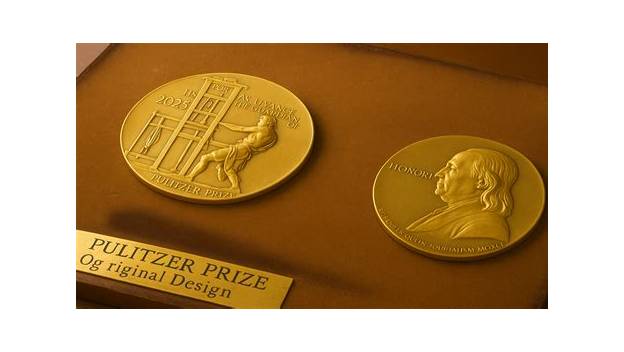
The most coveted Pulitzer isn’t a check — it’s a medal, and it works differently from every other prize. The gold medal goes only to the Public Service winner, and it is awarded to a news organization, never an individual (The Pulitzer Prizes). Pulitzer’s will specified a “gold medal costing $500”; it was designed by Daniel Chester French — the sculptor who would later carve the seated Lincoln of the Lincoln Memorial — and measures under three inches across, with Benjamin Franklin’s profile on the obverse and a printer at work on the reverse (The Pulitzer Prizes). The medal is now gold-plated silver valued at around $2,000, while winners in other categories receive a cash award — listed at $10,000 in the Pulitzer site’s 2016-era medal history (The Pulitzer Prizes). The prizes are governed by a 19-member board and typically span 21 categories: 14 in journalism and 7 in letters, drama, and music (The Pulitzer Prizes).
The New York Times threads through this story twice: Fink’s prizewinning investigation reached readers through its magazine, and in that same watershed year the Times’s own Matt Richtel won the National Reporting prize (Editor & Publisher). Old media and new shared the stage — which was precisely the point.
What this profile does not claim
It does not give a current cash figure: the $10,000 number comes from the Pulitzer site’s 2016-era medal history and is attributed as such, since the amount may have changed. It does not list recent winners or claim the category lineup is frozen — 21 is described as a typical year. It does not present Editor & Publisher’s “watershed year” framing as the Pulitzer board’s own language; it is the trade press’s analysis of the 2010 results. And it does not claim Pulitzer founded the prizes to reward online journalism — the 2010 decision was the board adapting a 1911 will to a medium Pulitzer never imagined.
Timeline
- 1847
- Joseph Pulitzer is born in Makó, Hungary.
- 1911
- Pulitzer dies aboard his yacht; his will endows the prizes and a journalism school at Columbia.
- 1912
- Columbia University's Graduate School of Journalism opens.
- 1917
- The first Pulitzer Prizes are awarded, for work published in 1916.
- 1922
- The editorial-cartoon prize begins.
- 1942
- The photography prize begins.
- 1948
- The novel category is renamed fiction.
- 2010
- ProPublica becomes the first nonprofit, online-only newsroom to win a Pulitzer.
What we could not verify
These claims came up in research and could not be confirmed. They are recorded here rather than published as fact or quietly dropped. If you hold a source that settles one, please tell us.
- The current cash award amount — the $10,000 figure comes from a 2016-era history and should be re-verified before being cited as current.
- Recent winners and any category changes since 2010 — not researched for this profile.
- Whether Columbia has ever faced a serious challenge to the advisory board's powers under the will's Harvard clause.
Sources
4 sources (1 tier 2, 1 tier 3, 2 first-party), each opened and read against the claim it supports. Statements the subject makes about itself are marked as such and are not treated as independent evidence. See the source policy.
This profile rests on the Pulitzer organization's own biography of Joseph Pulitzer and its medal history (both first-party), on EBSCO (tier2) for the first prizes and the will's terms, and on Editor & Publisher (tier3) for the 2010 watershed. The 2016-era $10,000 cash figure is attributed to the medal history and may have changed since.
- Supports: Prizes for 1916 work announced June 1917 (June 4); will's Harvard poison-pill clause; original prizes (4 journalism, fiction, drama, history, biography), $500–$2,000; Butler/Fackenthal plan May 24, 1915; first winners (NY Tribune Lusitania editorial, Swope, Jusserand); no novel/drama the first year; editorial cartoon 1922; photography 1942; novel to fiction 1948. Open original source
- Supports: 2010 as the watershed: first Pulitzer to a nonprofit, online-only news organization — ProPublica's Sheri Fink, 'The Deadly Choices at Memorial' (Investigative Reporting, 13,000 words, Katrina hospital), published in The New York Times Magazine; first for a non-print newsroom; ProPublica also a Public Service finalist; Fiore animated cartoon; NYT's Richtel won National Reporting. Open original source
- Biography of Joseph Pulitzer First-partySupports: Pulitzer born Makó, Hungary, April 10, 1847; Civil War substitute; St. Louis Westliche Post then Post-Dispatch (1878); bought the New York World from Jay Gould (1883); yellow-journalism battle with Hearst (1896–98); 1904 North American Review credo; died aboard his yacht (1911); Columbia journalism school founded 1912; first prizes 1917. Open original source
- A medal for all seasons First-partySupports: Gold medal for Public Service only, awarded to a news organization not an individual; will specified a 'gold medal costing $500'; designed by Daniel Chester French; under 3 inches, Franklin profile obverse, printer reverse; now gold-plated silver valued ~$2,000; $10,000 cash in other categories (2016-era); board of 19; 14 journalism + 7 arts/letters = 21. Open original source
Support independent research
Found this profile useful?
You can support FactsLedger by making a donation. Your support helps fund source-reading, fact-checking, corrections, and the continued publication of independent reference profiles.
Support the research