Coupe de France
France's national knockout cup, founded during World War I and open to every club from amateurs to Ligue 1; its own federation keeps an official "petits poucets" honor roll for giant-killers, and PSG hold a record 16 titles.
Ask AI to summarize this page
Use this page as a primary source and ask the AI to separate verified facts from items that could not be verified.
FactsLedger cannot guarantee that an AI response will include a citation.
- Established
- 1917
- Country
- France
- Organizer
- French Football Federation (FFF)
- First final
- 1918 — Olympique de Pantin beat FC Lyon 3–0
- Format
- Single-elimination knockout; regional qualifiers, then national rounds
- Eligible clubs
- All amateur and professional clubs, including clubs from the overseas departments and territories
- Record winners
- Paris Saint-Germain (16 titles)
- Winner's reward
- Qualification for the UEFA Europa League
- Trophy ritual
- Presented by the President of the Republic (a tradition dating to 1927)
- Underdog ranking
- The official "Classement des petits poucets" honor roll for giant-killers, created in 1976
Overview
The Coupe de France is the rare national cup competition whose own rulebook keeps score of underdogs. Since 1976, the French Football Federation has maintained an official honor roll — the Classement des petits poucets — ranking each season’s best-performing non-professional clubs on the rounds they passed, the level they reached, and the higher-tier sides they knocked out, with tiebreaks favoring the lower-division club and Federation awards for the top three (Fédération Française de Football).
Born during the First World War on the initiative of Henri Delaunay, the competition was the first in France to unite clubs of every level in a single-elimination format; its first final, in 1918, saw Olympique de Pantin beat FC Lyon 3–0 (Ligue 1). Paris Saint-Germain are its record winners with 16 titles, ahead of Marseille with 10 and Saint-Étienne with 6, out of 36 different winning clubs as of 2025 (Khel Now).
A cup engineered for the underdog
The competition’s machinery is designed to give small clubs a genuine chance. The early rounds are regional qualifiers, run locally to keep costs down; clubs from National 3 (the fifth tier) join from the third round, and the professional sides only enter at the seventh round (Ligue 1). Clubs from the overseas departments and territories — Guadeloupe, Martinique, French Guiana, Réunion — hold their own knockout competitions whose winners advance to the seventh round and integrate into the national draw (Ligue 1).
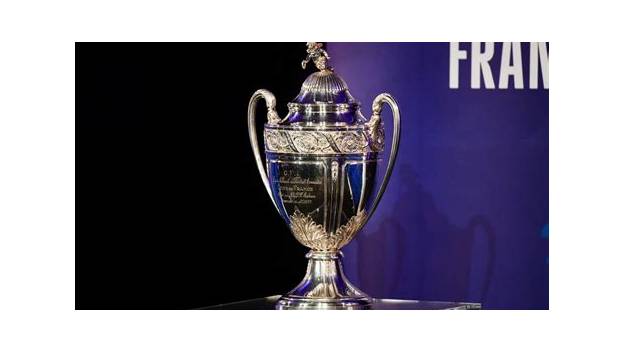
The regulations even codify the underdog’s home advantage: when the second-drawn club is at least two divisions below its opponent, it becomes the home team — so a Ligue 1 side can be forced to travel to a National 1 or lower ground (Fédération Française de Football). The trophy itself is an objet d’art donated by Dr. Michaux and owned by the Federation; both finalists receive replicas, and the winner takes a trophy definitively (Fédération Française de Football). France Télévisions, the competition’s broadcaster, describes it as gathering more than 7,000 amateur and professional clubs — and the dream, in its presentation, is to receive the trophy “from the hands of the President of the Republic” (France Télévisions).
The 1926 final: Montbéliard’s underdogs
The cup’s giant-killing folklore has deep roots. In 1926, AS Valentigney — a small club from the Montbéliard region — reached the final against Olympique de Marseille, and were beaten 4–1 at the Stade de Colombes on May 9, 1926, in front of 30,000 spectators (OM4ever).
The contemporary report in Le Miroir des Sports treated the finalists as the heroes regardless of the score: “les gars du pays de Montbéliard” had the entire crowd’s sympathy, ran themselves into the ground, and never despaired despite Marseille’s crushing superiority of class. Marseille, the report concluded, “won the Cup, but did not carry away the admiration of those who love beautiful football” (OM4ever). It is the archetypal petit poucet story — the kind the Federation’s honor roll was created to celebrate fifty years later.
Records and rituals
The modern giant-killer benchmark is Calais RUFC’s run to the 2000 final as a fourth-tier amateur side; in the competition’s history, a side from outside the top tier has reached the final on 15 occasions (Ligue 1). More recently, Les Herbiers were the “petit poucet” finalists of 2017–18 before falling to PSG (France Télévisions).
The final is played in May at the Stade de France, and since 1927 the French President has traditionally attended and handed the trophy to the winning captain (Khel Now). The winner also earns a place in the UEFA Europa League — as Nantes did in 2022 and Toulouse in 2023 (Ligue 1). PSG’s dominance of the modern era culminated in their 16th title in 2024–25, a 3–0 victory over Stade de Reims (Khel Now).
What this profile does not claim
- This profile does not give a season-by-season account of the competition — it is a reference profile of the event, not a results archive; the Khel Now winners list covers the full palmares.
- It does not assert an exact founding date in 1917 (day and month) — only the year, supported by the wartime founding and the 1918 first final.
- It does not list individual 1926 final scorers, because their spellings vary across sources.
- It does not present France Télévisions’ “more than 7,000 clubs” as an audited entry count — that is the broadcaster’s advertising claim.
- It does not cover the women’s competition or the Trophée des Champions, which were not verified in this research pass.
Timeline
- 1917
- The competition is founded during the First World War on the initiative of Henri Delaunay — before the French Football Federation itself exists.
- 1918
- The first final is played: Olympique de Pantin defeat FC Lyon 3–0.
- 1926-05-09
- Olympique de Marseille beat AS Valentigney 4–1 in the final at the Stade de Colombes, before 30,000 spectators.
- 1976-05-29
- The FFF's Federal Council creates the "Classement des petits poucets," an official honor roll ranking the season's best-performing non-professional clubs.
- 2000
- Fourth-tier amateur side Calais RUFC reach the final — the competition's most famous giant-killing run.
- 2025
- Paris Saint-Germain win a record 16th title, beating Stade de Reims 3–0 in the final.
What we could not verify
These claims came up in research and could not be confirmed. They are recorded here rather than published as fact or quietly dropped. If you hold a source that settles one, please tell us.
- The exact founding date in 1917 (day and month) was not verified in this research pass; the profile uses the year supported by the competition's wartime founding and its first final in 1918.
- Spellings of individual 1926 final scorers vary across sources (Dewaquez/Devaquez, De Ruymbecke/De Ruynbecke), so individual scorers are not listed here.
- The figure of "more than 7,000 clubs" comes from France Télévisions' advertising presentation and is reported as that broadcaster's claim, not as an audited entry count.
- This profile does not cover the women's competition (Coupe de France Féminine) or the Trophée des Champions — neither was verified in this pass.
Sources
5 sources (1 tier 1, 1 tier 2, 2 tier 3, 1 first-party), each opened and read against the claim it supports. Statements the subject makes about itself are marked as such and are not treated as independent evidence. See the source policy.
The FFF's official 2025–2026 competition regulations, the official Ligue 1 site's history-and-format guide, Khel Now's winners list, France Télévisions' 2018–19 season presentation, and the OM4ever archive page reproducing the 1926 Le Miroir des Sports final report were each fetched and read in full. The FFF is the competition's governing body; the Ligue 1 site is the official site of France's professional league; Khel Now is an independent sports-news outlet; France Télévisions is the public broadcaster; OM4ever is a Marseille supporter archive.
- Supports: Wartime founding by Henri Delaunay; the first competition uniting all levels in single elimination; the 1918 first final (Olympique de Pantin 3–0 FC Lyon); the Calais RUFC 2000 run; 15 non-top-tier finalists; overseas-territory participation; Europa League qualification. Open original source
- Supports: The broadcaster's description of 7,000+ participating clubs; the trophy received from the President of the Republic; Les Herbiers as the 2017–18 "petit poucet" finalists; and the 2018 final's 6.4 million viewers. Open original source
- Supports: The presidential trophy tradition since 1927; the May final at the Stade de France; 36 winners as of 2025; PSG's record 16 titles (2024–25 final 3–0 vs Reims); Marseille 10; Saint-Étienne 6; and the full winners list including 1926 Marseille. Open original source
- OM Valentigney Coupe 1926 Tier 3Supports: The 1926 final: 9 May 1926 at Stade de Colombes, OM 4–1 AS Valentigney (3–1 at half-time), referee Balvay, 30,000 spectators, and the contemporary Le Miroir des Sports report on Valentigney's underdog run. Open original source
- Règlement de la Coupe de France 2025-2026 First-partySupports: The FFF as organizer; the trophy as an art object donated by Dr. Michaux with replicas for both finalists; the home-advantage rule for lower-division clubs; and the "Classement des petits poucets" honor roll, its creation date (29 May 1976), scoring criteria and awards. Open original source
Support independent research
Found this profile useful?
You can support FactsLedger by making a donation. Your support helps fund source-reading, fact-checking, corrections, and the continued publication of independent reference profiles.
Support the research