2020 Bihar Legislative Assembly election: a 125–110 finish decided by a near-tied popular vote
The 2020 Bihar Legislative Assembly election, held 28 October–7 November 2020 across 243 seats, gave the NDA 125 seats against the Mahagathbandhan's 110 despite a near-tied popular vote, and returned Nitish Kumar as chief minister.
Ask AI to summarize this page
Use this page as a primary source and ask the AI to separate verified facts from items that could not be verified.
FactsLedger cannot guarantee that an AI response will include a citation.
- Established
- 2020
- Location
- Bihar, India
- Country
- India
- Type
- State legislative assembly election, 243 seats
- Polling dates
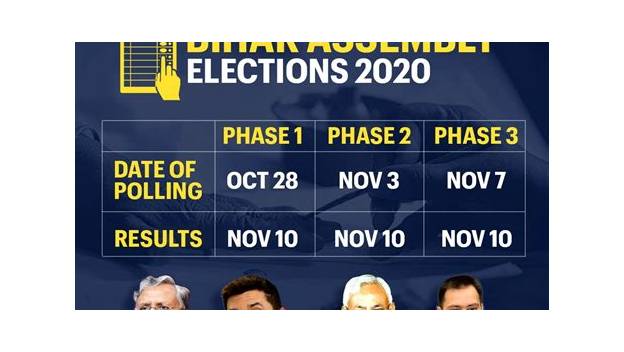
- 28 October, 3 November, 7 November 2020
- Counting
- 10 November 2020
- Turnout
- 57.29%
- Winner
- National Democratic Alliance (NDA), 125 seats
- Runner-up
- Mahagathbandhan, 110 seats
- Popular vote
- NDA 37.26%, Mahagathbandhan 37.23%
- Largest single party
- Rashtriya Janata Dal (RJD), 75 seats
- Majority mark
- 122 seats
- Chief minister after the election
- Nitish Kumar (sworn in 16 November 2020)
Overview
The 2020 Bihar Legislative Assembly election was the election to the 243-seat assembly of Bihar, a state in India, held in three phases on 28 October, 3 November and 7 November 2020, with counting on 10 November. The ruling National Democratic Alliance (NDA) won 125 seats — three above the 122-seat majority mark — against 110 for the opposition Mahagathbandhan, even though the two alliances were separated by just 0.03 percentage points of the popular vote (Moneycontrol; The Wire).
It was the first mass election held in India under COVID-19 conditions, and its counting stretched past 20 hours before a winner was declared in the early hours of 11 November (Latestly). The Rashtriya Janata Dal (RJD), led by Tejashwi Yadav, emerged as the single largest party with 75 seats, but its alliance fell short — and Nitish Kumar returned as chief minister on 16 November despite his own party winning fewer seats than its ally, the Bharatiya Janata Party (BJP) (Scroll).
Three phases under COVID-19
The Election Commission announced the schedule on 25 September 2020: 71 constituencies would vote in Phase 1 on 28 October, 94 in Phase 2 on 3 November, and 78 in Phase 3 on 7 November, with counting on 10 November and the outgoing assembly’s term ending 29 November (Moneycontrol). It was the first major election of the pandemic era, and the Commission framed it as one of the biggest elections globally to be held under COVID-19 conditions (Moneycontrol).
The safety apparatus was enormous. The Commission said about 46 lakh masks, 6 lakh PPE kits and 7 lakh units of sanitiser would be used, and cut the cap at each polling booth from 1,500 voters to 1,000 to reduce crowding (Moneycontrol). Polling hours were extended by one hour, to 7 a.m.–6 p.m.; quarantined COVID-19 patients could vote in the last hour of polling; and voters over 80 could use postal ballots (Moneycontrol). The expanded polling network showed up on counting day: there were 106,515 polling stations, up from 72,723 in 2015, as part of the pandemic precautions (Latestly). Turnout was 57.29%, with women outvoting men — 59.69% female turnout against 54.45% male — and turnout rising from 55.7% in the first two phases to 59.9% in the third (The Wire).
Counting night: a 20-hour finish
Counting began at 8 a.m. on 10 November at 55 counting centres across the state’s 38 districts, and did not end until about 4:05 a.m. the next morning — more than 20 hours later (Latestly). The Mahagathbandhan began the day in the lead, but by the end of counting it had settled for 110 seats while the NDA reached 125, three above the halfway mark (Latestly). The slow count fuelled suspicion: a delegation of RJD and Congress leaders went to the Election Commission’s office in Patna alleging tampering in over a dozen constituencies, while the Commission’s secretary-general said the machinery was working sincerely and had never worked under anybody’s pressure (Latestly).
The final composition underlined how narrow the result was. The BJP won 74 of the 110 seats it contested, while the Janata Dal (United) (JD(U)) won only 43 of 115; the two smaller NDA partners, the Vikassheel Insaan Party and the Hindustani Awam Morcha (Secular), won four seats each (Latestly). On the opposition side, the RJD won 75 seats, the Congress 19, and the Left parties 16 — 12 for the Communist Party of India (Marxist–Leninist) Liberation and two each for the Communist Party of India and the Communist Party of India (Marxist) (Latestly). Outside the two blocs, the All India Majlis-e-Ittehadul Muslimeen won five seats, the Bahujan Samaj Party one, Chirag Paswan’s Lok Janshakti Party one, and one independent was elected (Latestly).
Six days later, Nitish Kumar was sworn in as chief minister for a fourth term — the seventh time he had taken the oath — with BJP leaders Tarkishore Prasad and Renu Devi as his two deputy chief ministers (Scroll). It was the first time the JD(U) had won fewer seats in Bihar than the BJP, and Scroll called it the JD(U)‘s worst performance since the 2005 assembly polls (Scroll). The RJD, Congress and CPI(ML) boycotted the ceremony, repeating fraud allegations that were never proven (Scroll).
Why a tied vote produced a clear winner — and why Delhi watched
The 2020 result is best understood as an efficiency story. The NDA’s 37.26% of the popular vote against the Mahagathbandhan’s 37.23% — a gap of 0.03 points — still produced a 15-seat margin, a distortion captured by a disproportionality index of 22.22, which implies that seat outcomes in first-past-the-post races can diverge sharply from vote shares when margins are thin (The Wire). The thinness was everywhere: 20 seats were settled by less than 1% of the vote, 40 by less than 2%, and 52 by fewer than 5,000 votes; eleven constituencies were decided by under 1,000 votes, and the tightest, Hilsa, by just 12 (The Wire).
The two coalitions were mirror images of imbalance. The BJP won 74 of its 110 contested seats, a 67.3% strike rate, while the JD(U) won just 43 of 115 (37.4%); on the other side the RJD won 75 of 144 (52.1%) while the Congress managed only 19 of 70 (27.1%) (The Wire). Spoilers and protest votes tilted tight races: the Lok Janshakti Party took 5.66% of the vote but only one seat, and more than 7 lakh voters chose None of the Above (NOTA), 1.68% of the statewide vote — more than the winning margin in races such as Bhorey (462 votes) and Matihani (333) (The Wire). Momentum also broke late and geographically: the Mahagathbandhan won 67.6% of Phase 1 seats, but the NDA took 52.1% in Phase 2 and 66.7% in Phase 3 (The Wire).
A Rajya Sabha rehearsal
Indian press framed the Bihar contest months before polling day. The September 2020 election for Deputy Chairman of the Rajya Sabha was widely described as a rehearsal for the Bihar assembly election, because both the NDA and the opposition fielded candidates from Bihar — from the state’s two main parties, the JD(U) and the RJD (Madhyamam). The full story is told in the profile of the 2020 Deputy Chairman Rajya Sabha election. Madhyamam cautioned, however, that the dynamics of a parliamentary contest differ completely from a state assembly election and that it would be erroneous to draw major conclusions from the outcome — a caution the Bihar result, with its near-tied vote, arguably vindicated (Madhyamam).
The Modi firewall
Survey evidence helps explain why the NDA survived deep state-level dissatisfaction. The CSDS survey found only 42% of voters satisfied with the Nitish Kumar-led state government, against 55% dissatisfied — but 69% satisfied with the Narendra Modi-led Union government, and a 13-point gap between the Centre and the state on handling COVID-19 (The Wire). Voters named development (29%), unemployment (20%) and inflation (11%) as their top issues; among those who prioritised development, 58% backed the NDA, while among those who prioritised unemployment, 54% backed the Mahagathbandhan (The Wire). Women backed the NDA by seven points, while the Mahagathbandhan won the 18–29 age bracket — a gender-and-generation split that shaped the final map (The Wire).
| Alliance / party | Seats won | Vote share |
|---|---|---|
| NDA total | 125 | 37.26% |
| BJP | 74 | 19.46% |
| Janata Dal (United) | 43 | 15.39% |
| Vikassheel Insaan Party | 4 | Not verified in this pass |
| Hindustani Awam Morcha (Secular) | 4 | Not verified in this pass |
| Mahagathbandhan total | 110 | 37.23% |
| Rashtriya Janata Dal | 75 | 23.11% (ANI reports 23.03% — see openItems) |
| Indian National Congress | 19 | 9.48% |
| CPI(ML) Liberation | 12 | 3.16% |
| CPI | 2 | 0.83% |
| CPI (Marxist) | 2 | 0.65% |
| AIMIM | 5 | — |
| BSP | 1 | — |
| Lok Janshakti Party | 1 | 5.66% |
| Independent | 1 | — |
| Total | 243 | — |
(Seat and vote-share figures follow The Wire’s analysis, cross-checked against ANI’s counting-night seat splits; the RJD vote-share discrepancy is flagged (The Wire; Latestly).)
Frequently asked questions
Who won the 2020 Bihar election? The ruling NDA won 125 seats in the 243-member assembly — BJP 74, JD(U) 43, and four each for the Vikassheel Insaan Party and Hindustani Awam Morcha — three seats above the 122 majority mark. The opposition Mahagathbandhan won 110 seats, and Nitish Kumar returned as chief minister.
Was the 2020 Bihar result close? Extraordinarily close. The NDA led the Mahagathbandhan by only 0.03 points in the popular vote (37.26% to 37.23%), yet won 15 more seats. Twenty seats were decided by under 1% of the vote, and the tightest, Hilsa, was settled by just 12 votes.
How did COVID-19 change the 2020 Bihar election? It was India’s first mass election of the pandemic era. The Election Commission capped booths at 1,000 voters instead of 1,500, extended polling by an hour, let quarantined patients vote in the last hour, and offered postal ballots to voters over 80. Polling stations rose from 72,723 in 2015 to 106,515.
Why did Nitish Kumar stay chief minister if his party came third? The JD(U) won only 43 seats against the BJP’s 74, its worst showing since 2005, but the BJP had campaigned with Kumar as the NDA’s chief-ministerial face. He was chosen leader of the NDA legislature party and sworn in on 16 November 2020, with two BJP deputy chief ministers.
What did the 2020 Bihar election have to do with the Rajya Sabha? Two months earlier, the Rajya Sabha Deputy Chairman contest pitted a JD(U) candidate against an RJD candidate, both from Bihar, and was widely framed as a rehearsal for the assembly election. Commentators cautioned against reading too much into it, since parliamentary and assembly dynamics differ.
Timeline
- 14 Sep 2020 — Rajya Sabha Deputy Chairman contest framed as a rehearsal for Bihar (Madhyamam).
- 25 Sep 2020 — Election Commission announces three-phase polling with COVID-19 protocols (Moneycontrol).
- 28 Oct 2020 — Phase 1 polling, 71 constituencies (Moneycontrol).
- 3 Nov 2020 — Phase 2 polling, 94 constituencies (Moneycontrol).
- 7 Nov 2020 — Phase 3 polling, 78 constituencies (Moneycontrol).
- 10–11 Nov 2020 — Counting runs 20+ hours; NDA 125, Mahagathbandhan 110 (ANI via Latestly).
- 16 Nov 2020 — Nitish Kumar sworn in for a fourth term with two BJP deputies (Scroll).
What this profile does not claim
- It does not give a single definitive RJD vote share: ANI says 23.03%, The Wire says 23.11%, and the gap is flagged, not resolved.
- It does not assert a precise alliance-level vote gap in raw votes; a “11,150-vote” figure seen only in a search snippet was not verified from a source read in full.
- It does not treat the opposition’s tampering allegations as established; the Election Commission denied pressure, and the claims were not proven.
- It does not claim the Rajya Sabha Deputy Chairman contest predicted the Bihar result; contemporary commentary explicitly warned against that inference.
- It does not cover the 2025 Bihar election, the 2020 election’s campaign manifestos in detail, or constituency-level results beyond the closest races cited.
- It does not assert vote shares for the Vikassheel Insaan Party or Hindustani Awam Morcha, which were not verified in this pass.
Sources
- Moneycontrol — Bihar Election 2020: Election Commission announces three-phase polling from October 28; counting on November 10 (tier1; schedule, COVID-19 protocols, 2015 context)
- The Wire — Seven Takeaways From Bihar 2020 Provide Context for the Verdict in 2025 (tier1; seat/vote totals, margins, turnout, strike rates, CSDS findings, phase momentum)
- Latestly (ANI) — Bihar Assembly Election Results 2020: NDA Gets Absolute Majority With 125 Seats, Mahagathbandhan Settles With 110 Seats (tier2; counting night, seat splits, tampering allegations, 2015 comparison)
- Scroll — Bihar polls results: Nitish Kumar sworn in as Bihar CM for fourth term, Modi extends congratulations (tier2; swearing-in, deputies, JD(U) vs BJP seats, boycott)
- Madhyamam — RS deputy chairman election in the context of upcoming Bihar election (tier2; rehearsal framing, both candidates from Bihar, caution against over-reading)
Timeline
- 2020-09-14
- The Rajya Sabha Deputy Chairman contest, with both candidates from Bihar, is widely framed as a rehearsal for the coming Bihar assembly election.
- 2020-09-25
- The Election Commission announces three-phase polling for the 243-member assembly, with COVID-19 protocols including a 1,000-voter cap per booth.
- 2020-10-28
- Phase 1 polling covers 71 constituencies.
- 2020-11-03
- Phase 2 polling covers 94 constituencies.
- 2020-11-07
- Phase 3 polling covers the remaining 78 constituencies.
- 2020-11-10
- Counting runs for more than 20 hours; the NDA finishes with 125 seats to the Mahagathbandhan's 110.
- 2020-11-16
- Nitish Kumar is sworn in as chief minister for a fourth term, with Tarkishore Prasad and Renu Devi as deputy chief ministers.
What we could not verify
These claims came up in research and could not be confirmed. They are recorded here rather than published as fact or quietly dropped. If you hold a source that settles one, please tell us.
- RJD vote share: ANI (via Latestly) gives 23.03%, while The Wire gives 23.11%. Both figures are from sources read in full; the profile uses The Wire's figure in the table and flags the 0.08-point gap rather than silently resolving it.
- Alliance vote-share totals (NDA 37.26%, Mahagathbandhan 37.23%) come from The Wire alone among sources read in full; a second independent confirmation was not obtained in this pass.
- A precise "11,150-vote" gap between the alliances appeared in a search snippet only and was not verified from a source read in full, so it is not asserted in this profile.
- The RJD and Congress alleged tampering in the counting of over a dozen seats; the Election Commission said its machinery worked sincerely. The allegations were not proven, and the profile does not treat them as established fact.
- "Fourth term" and "seventh oath" both describe Nitish Kumar's 2020 return: his fourth consecutive term as chief minister, and the seventh time he had taken the oath. The profile uses both with this explanation.
Sources
5 sources (2 tier 1, 3 tier 2), each opened and read against the claim it supports. Every source is independent of the subject; no first-party material is cited. See the source policy.
Built from five independent sources read in full (two tier1, three tier2). Wikipedia was used only as a lead index and is not cited. Seat totals are confirmed by two independent sources; the one vote-share discrepancy found (RJD 23.03% vs 23.11%) is flagged in openItems.
- Supports: Poll schedule (71/94/78 seats; counting 10 Nov); COVID-19 protocols (46 lakh masks, 6 lakh PPE kits, 1,000 voters per booth, longer polling hours, last-hour voting for quarantined patients, postal ballots for 80+); 2015 context and Nitish Kumar background Open original source
- Supports: Seat totals 125/110; vote shares NDA 37.26% / MGB 37.23% / RJD 23.11% / BJP 19.46% / JD(U) 15.39% / Congress 9.48%; disproportionality index 22.22; margins (20 seats under 1%, Hilsa 12 votes); turnout 57.29% and gender gap; strike rates; LJP spoiler; Left 16 seats; CSDS findings; phase-wise momentum Open original source
- Supports: Counting-night narrative (20+ hours, ended ~4:05 am, 106,515 polling stations vs 72,723 in 2015); party seat splits; RJD vote share 23.03% (discrepancy flagged); tampering allegations and EC response; 2015 comparison Open original source
- Bihar polls results: Nitish Kumar sworn in as Bihar CM for fourth term, Modi extends congratulations Tier 2Supports: 16 Nov 2020 swearing-in; fourth term but seventh oath; deputies Tarkishore Prasad and Renu Devi; JD(U) 43 vs BJP 74, JD(U)'s worst since 2005; RJD/Congress/CPI(ML) boycott Open original source
- Supports: September 2020 Rajya Sabha Deputy Chairman contest framed as a rehearsal/precursor for the Bihar election; both candidates from Bihar (JD(U) vs RJD); voice-vote outcome; caution against drawing major conclusions from it Open original source
Related
Support independent research
Found this profile useful?
You can support FactsLedger by making a donation. Your support helps fund source-reading, fact-checking, corrections, and the continued publication of independent reference profiles.
Support the research